Hussein Mostafa Omran, Alruthea Mohammed Suliman
Department of Prosthodontic Sciences, College of Dentistry in Ar Rass, Qassim University, Saudi Arabia.
Eur J Dent. 2020 Oct;14(4):590-597. doi: 10.1055/s-0040-1714763. Epub 2020 Aug 10.
Studies considered edentulous patients having smoking habit as a compromised oral condition. This research examined the value of using mini implant mandibular overdenture to maintain long-term satisfactory levels of oral health quality of life and marginal vertical bone loss.
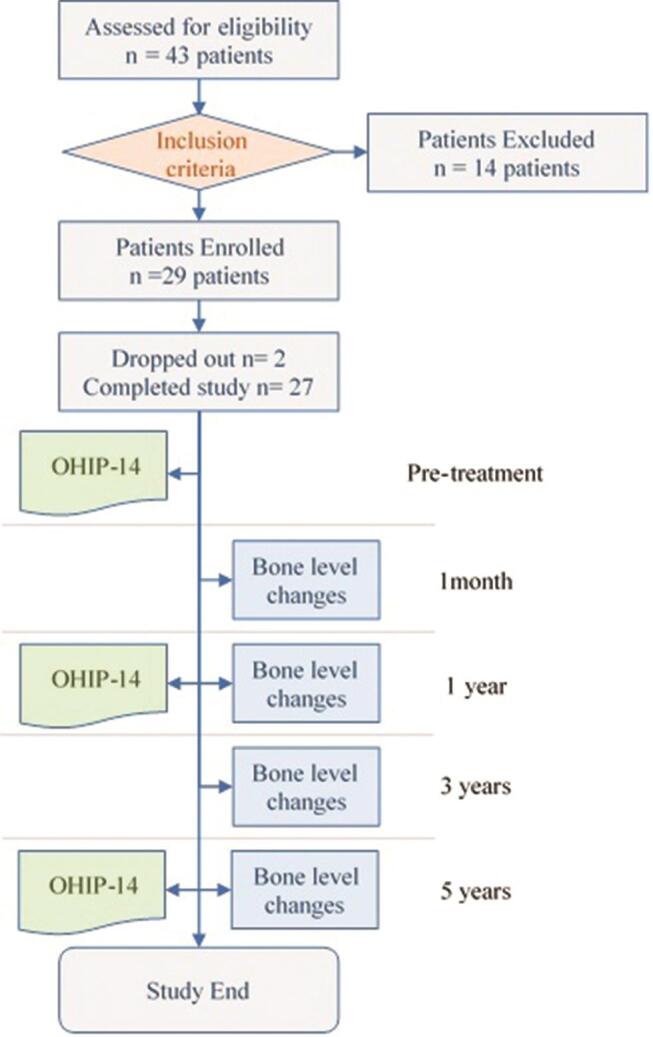
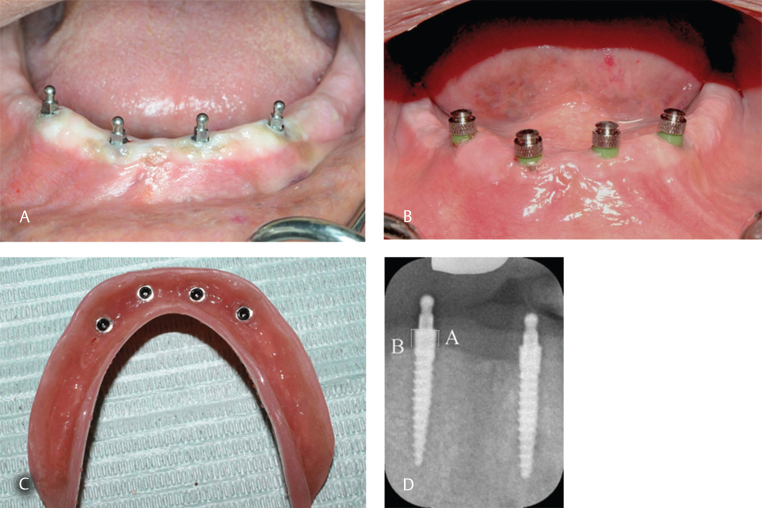
Twenty-nine edentulous patients with smoking habit received four mini implants in the mandible loaded by overdentures. The present study monitored patients radiographically for vertical bone loss after (1 month, 1, 3, and 5 years) of treatment. Patients were also evaluated by oral health impact profile 14 (OHIP-14) pretreatment and at 1 and 5 years of treatment.
Repeated measure analysis of variance with Bonferroni's test as a post-hoc test was used to see the difference among time points. Independent sample -tests were used to compare between anterior and posterior mini implant positions after 5 years of follow-up. OHIP-14 questionnaire was analyzed by Wilcoxon signed ranks for pairwise comparisons at different evaluation times. A Holm-Bonferroni correction method was used to control the familywise error rate.
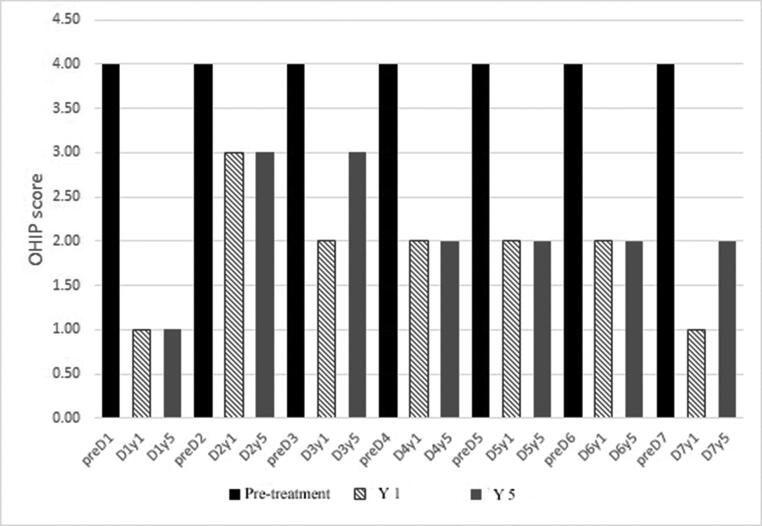
The mean of the bone height changes showed a significant difference between 1-month data and all other evaluation intervals while no significance was calculated among other evaluation intervals. Bone loss of the mini implants placed anteriorly was less than those placed posteriorly with a statistically significant difference. A significant reduction in the OHIP-14 score levels was observed between pretreatment and both 1 and 5 years of treatment. No significance was seen between the first and fifth year after treatment.
Mini implant overdenture could maintain satisfactory marginal bone level changes and oral health quality of life for patients with smoking habit after 5-year follow-up period.
以往研究将有吸烟习惯的无牙颌患者视为口腔状况不佳。本研究探讨了使用微型种植体下颌覆盖义齿维持长期满意的口腔健康生活质量水平及边缘垂直骨吸收的价值。
29例有吸烟习惯的无牙颌患者在下颌植入4枚微型种植体并加载覆盖义齿。本研究在治疗后(1个月、1年、3年和5年)通过影像学监测患者的垂直骨吸收情况。还在治疗前、治疗1年和5年时采用口腔健康影响程度量表14(OHIP - 14)对患者进行评估。
采用重复测量方差分析并以Bonferroni检验作为事后检验来观察各时间点之间的差异。采用独立样本t检验比较随访5年后微型种植体前后位置的差异。采用Wilcoxon符号秩检验对OHIP - 14问卷在不同评估时间进行成对比较。采用Holm - Bonferroni校正方法控制家族性错误率。
骨高度变化均值在1个月数据与所有其他评估时间间隔之间存在显著差异,而其他评估时间间隔之间无显著差异。前部植入的微型种植体骨吸收少于后部植入的,差异有统计学意义。治疗前与治疗1年和5年时相比,OHIP - 14评分水平均显著降低。治疗后第1年和第5年之间无显著差异。
经过5年随访,微型种植体覆盖义齿可为有吸烟习惯的患者维持满意的边缘骨水平变化和口腔健康生活质量。