
围手术期非侵入性与半侵入性心排血量监测在肥胖症手术患者中的应用-一项前瞻性观察研究。
Perioperative non-invasive versus semi-invasive cardiac index monitoring in patients with bariatric surgery - a prospective observational study.
机构信息
Department of Anaesthesiology and Intensive Care Medicine, University Medical Center Schleswig-Holstein, Campus Kiel, Arnold-Heller-Str. 3 Haus R3, 24105, Kiel, Germany.
Department of Anesthesiology, Helios Kliniken Schwerin, 19055, Schwerin, Germany.
出版信息
BMC Anesthesiol. 2020 Aug 10;20(1):196. doi: 10.1186/s12871-020-01110-x.
BACKGROUND
In morbidly obese patients undergoing laparoscopic bariatric surgery, the combination of obesity-related comorbidities, pneumoperitoneum and extreme posture changes constitutes a high risk of perioperative hemodynamic complications. Thus, an advanced hemodynamic monitoring including continuous cardiac index (CI) assessment is desirable. While invasive catheterization may bear technical difficulties, transesophageal echocardiography is contraindicated due to the surgical procedure. Evidence on the clinical reliability of alternative semi- or non-invasive cardiac monitoring devices is limited. The aim was to compare the non-invasive vascular unloading to a semi-invasive pulse contour analysis reference technique for continuous CI measurements in bariatric surgical patients.
METHODS
This prospective observational study included adult patients scheduled for elective, laparoscopic bariatric surgery after obtained institutional ethics approval and written informed consent. CI measurements were performed using the vascular unloading technique (Nexfin®) and semi-invasive reference method (FloTrac™). At 10 defined measurement time points, the influence of clinically indicated body posture changes, passive leg raising, fluid bolus administration and pneumoperitoneum was evaluated pre- and intraoperatively. Correlation, Bland-Altman and concordance analyses were performed.
RESULTS
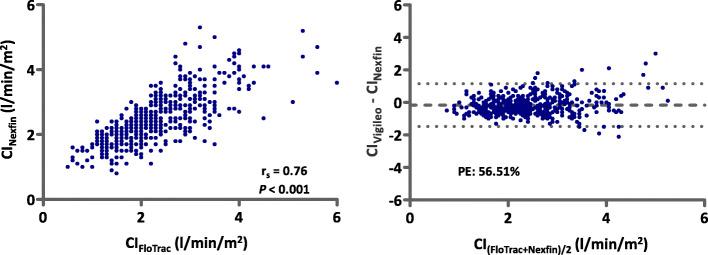
Sixty patients (mean BMI 49.2 kg/m) were enrolled into the study and data from 54 patients could be entered in the final analysis. Baseline CI was 3.2 ± 0.9 and 3.3 ± 0.8 l/min/m, respectively. Pooled absolute CI values showed a positive correlation (r = 0.76, P < 0.001) and mean bias of of - 0.16 l/min/m (limits of agreement: - 1.48 to 1.15 l/min/m) between the two methods. Pooled percentage error was 56.51%, missing the criteria of interchangeability (< 30%). Preoperatively, bias ranged from - 0.33 to 0.08 l/min/m with wide limits of agreement. Correlation of CI was best (r = 0.82, P < 0.001) and percentage error lowest (46.34%) during anesthesia and after fluid bolus administration. Intraoperatively, bias ranged from - 0.34 to - 0.03 l/min/m with wide limits of agreement. CI measurements correlated best during pneumoperitoneum and after fluid bolus administration (r = 0.77, P < 0.001; percentage error 35.95%). Trending ability for all 10 measurement points showed a concordance rate of 85.12%, not reaching the predefined Critchley criterion (> 92%).
CONCLUSION
Non-invasive as compared to semi-invasive CI measurements did not reach criteria of interchangeability for monitoring absolute and trending values of CI in morbidly obese patients undergoing bariatric surgery.
TRIAL REGISTRATION
The study was registered retrospectively on June 12, 2017 with the registration number NCT03184272 .
背景
在接受腹腔镜减重手术的病态肥胖患者中,肥胖相关合并症、气腹和极端体位变化的组合构成了围手术期血流动力学并发症的高风险。因此,需要进行先进的血流动力学监测,包括连续心指数(CI)评估。虽然有创导管可能存在技术困难,但由于手术过程,经食管超声心动图是禁忌的。替代半侵入性或非侵入性心脏监测设备的临床可靠性证据有限。目的是比较非侵入性血管卸载与半侵入性脉搏轮廓分析参考技术,用于测量减重手术患者的连续 CI。
方法
这项前瞻性观察研究纳入了成年患者,这些患者在获得机构伦理批准和书面知情同意书后,计划接受择期腹腔镜减重手术。使用血管卸载技术(Nexfin®)和半侵入性参考方法(FloTrac™)进行 CI 测量。在 10 个定义的测量时间点,评估了临床指示的体位变化、被动抬腿、液体负荷和气腹术前和术中的影响。进行了相关性、Bland-Altman 和一致性分析。
结果
60 名患者(平均 BMI 49.2kg/m)入组研究,54 名患者的数据可纳入最终分析。基线 CI 分别为 3.2±0.9 和 3.3±0.8l/min/m。两组的 CI 差值呈正相关(r=0.76,P<0.001),平均偏差为-0.16l/min/m(一致性区间:-1.48 至 1.15l/min/m)。两组方法之间的百分比误差为 56.51%,未达到可互换性的标准(<30%)。术前,偏差范围为-0.33 至 0.08l/min/m,一致性区间较宽。麻醉和液体负荷后 CI 的相关性最好(r=0.82,P<0.001),百分比误差最低(46.34%)。术中,偏差范围为-0.34 至-0.03l/min/m,一致性区间较宽。气腹和液体负荷后 CI 测量的相关性最好(r=0.77,P<0.001;百分比误差为 35.95%)。所有 10 个测量点的趋势能力显示出 85.12%的一致性率,未达到预设的 Critchley 标准(>92%)。
结论
与半侵入性 CI 测量相比,非侵入性 CI 测量在接受减重手术的病态肥胖患者中无法达到监测 CI 的绝对值和趋势值的可互换性标准。
试验注册
该研究于 2017 年 6 月 12 日进行了回顾性登记,注册号为 NCT03184272。




 Zotero 插件