Division of Clinical Pharmacy, College of Pharmacy, Ajou University, 206 Worldcup-ro Yeongtong-gu, Suwon, 16499, South Korea.
BMC Endocr Disord. 2020 Aug 10;20(1):122. doi: 10.1186/s12902-020-00605-5.
The prevalence of type 2 diabetes mellitus (T2DM) is expected to increase from 7.7% in 2017 to 8.4% in 2045 worldwide. Diabetes complications contribute to morbidity and mortality. To evaluate whether the diabetes complications severity index (DCSI) was associated with increased risks of mortality and hospitalization.
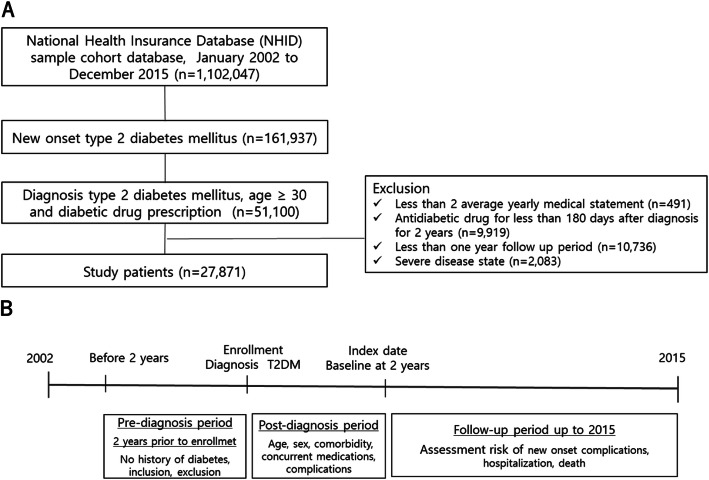
A retrospective cohort study was conducted using the National Health Insurance Database (NHID) sample cohort of 1,102,047 patients (2002-2015) in Korea. Diabetes complications were evaluated at 2 years after the initial diagnosis and during the subsequent follow-up period (mean duration 6.56 ± 2.81 years). The type and severity of complications were evaluated on the basis of the International Classification of Disease Ninth (ICD-9) codes used in DCSI with 7 categories and 55 subcategories of complications. The Cox proportional hazard and Poisson regression models were used to evaluate the mortality and hospitalization rates. The incidence and relative risk of diabetes complications as well as the risk of mortality and hospitalization were the main outcome measures.
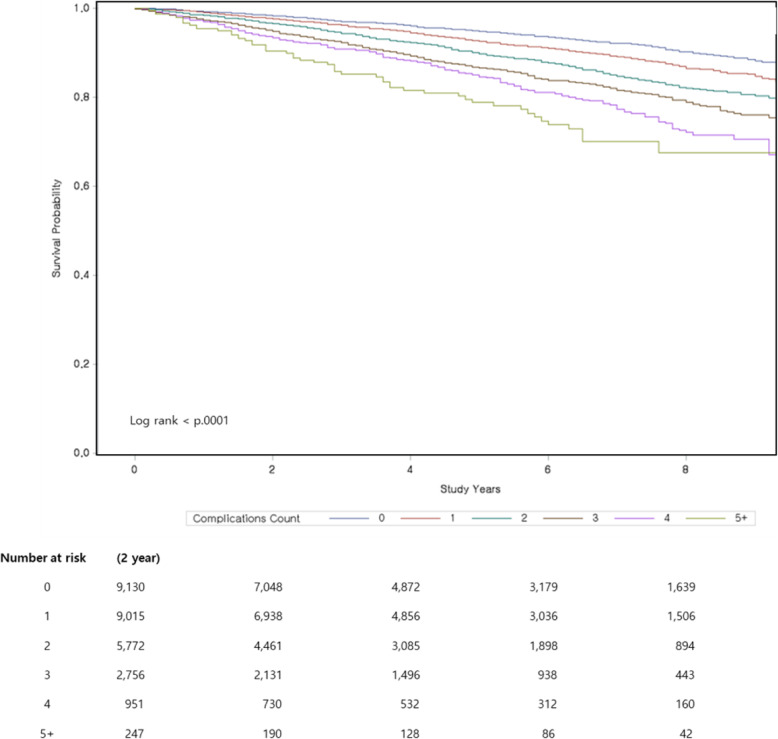
A total of 27,871 patients were finally included and grouped by the number of complications present at 2 years. Four hundred ninety patients (5.37%) died without complications, 659 (7.31%) died with one complication and 1153 (11.85%) died with two or more complications. As DCSI at index date increased, the risk of additional new diabetes complications increased by 26% [relative risk (RR) 1.26, 95% CI 1.25-1.27]. The risks of mortality and hospitalization were linearly related to DCSI [hazard ratio 1.13 (95% CI 1.11-1.16), relative risk 1.04 (95% CI 1.03-1.06)].
Patients with higher incidence and severity of diabetes complications have increased risks of mortality and hospitalization.
全球范围内,2 型糖尿病(T2DM)的患病率预计将从 2017 年的 7.7%上升至 2045 年的 8.4%。糖尿病并发症导致发病率和死亡率升高。本研究旨在评估糖尿病并发症严重程度指数(DCSI)是否与死亡率和住院率升高相关。
本研究采用回顾性队列研究,使用 2002 年至 2015 年期间韩国国民健康保险数据库(NHID)的 1102047 例患者样本队列。在初始诊断后 2 年以及随后的随访期间(平均持续时间 6.56±2.81 年)评估糖尿病并发症。根据 DCSI 使用的国际疾病分类第 9 版(ICD-9)代码,对 7 个类别和 55 个并发症亚类的并发症类型和严重程度进行评估。采用 Cox 比例风险和泊松回归模型评估死亡率和住院率。发病率、相对风险、糖尿病并发症风险以及死亡率和住院率是主要的观察指标。
最终纳入 27871 例患者,并根据 2 年内存在的并发症数量分组。无并发症的患者中有 490 例(5.37%)死亡,有 1 种并发症的患者中有 659 例(7.31%)死亡,有 2 种或以上并发症的患者中有 1153 例(11.85%)死亡。随着指数日期 DCSI 的增加,新发生糖尿病并发症的风险增加 26%[相对风险(RR)1.26,95%置信区间(CI)1.25-1.27]。死亡率和住院率与 DCSI 呈线性相关[风险比(HR)1.13(95%CI 1.11-1.16),相对风险(RR)1.04(95%CI 1.03-1.06)]。
糖尿病并发症发生率和严重程度较高的患者,死亡率和住院率风险增加。