From the Departments of Radiology (Y.J.M., H.J., Z.W., Z.C., Y.X., R.R.L., E.Y.C., G.M.B., J.D.) and Neurosciences (J.C.B.) University of California San Diego, 9452 Medical Center Dr, La Jolla, CA 92037; and Radiology Service, Veterans Affairs San Diego Healthcare System, San Diego, Calif (E.Y.C.).
Radiology. 2020 Nov;297(2):392-404. doi: 10.1148/radiol.2020200425. Epub 2020 Aug 11.
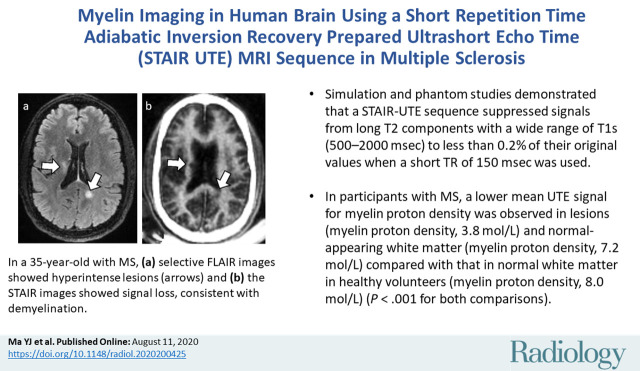
Background Water signal contamination is a major challenge for direct ultrashort echo time (UTE) imaging of myelin in vivo because water contributes most of the signals detected in white matter. Purpose To validate a new short repetition time (TR) adiabatic inversion recovery (STAIR) prepared UTE (STAIR-UTE) sequence designed to suppress water signals and to allow imaging of ultrashort T2 protons of myelin in white matter using a clinical 3-T scanner. Materials and Methods In this prospective study, an optimization framework was used to obtain the optimal inversion time for nulling water signals using STAIR-UTE imaging at different TRs. Numeric simulation and phantom studies were performed. Healthy volunteers and participants with multiple sclerosis (MS) underwent MRI between November 2018 and October 2019 to compare STAIR-UTE and a clinical T2-weighted fluid-attenuated inversion recovery sequence for assessment of MS lesions. UTE measures of myelin were also performed to allow comparison of signals in lesions and with those in normal-appearing white matter (NAWM) in patients with MS and in normal white matter (NWM) in healthy volunteers. Results Simulation and phantom studies both suggest that the proposed STAIR-UTE technique can effectively suppress long T2 tissues with a broad range of T1s. Ten healthy volunteers (mean age, 33 years ± 8 [standard deviation]; six women) and 10 patients with MS (mean age, 51 years ± 16; seven women) were evaluated. The three-dimensional STAIR-UTE sequence effectively suppressed water components in white matter and selectively imaged myelin, which had a measured T2* value of 0.21 msec ± 0.04 in the volunteer study. A much lower mean UTE measure of myelin proton density was found in MS lesions (3.8 mol/L ± 1.5), and a slightly lower mean UTE measure was found in NAWM (7.2 mol/L ± 0.8) compared with that in NWM (8.0 mol/L ± 0.8) in the healthy volunteers ( < .001 for both comparisons). Conclusion The short repetition time adiabatic inversion recovery-prepared ultrashort echo time sequence provided efficient water signal suppression for volumetric imaging of myelin in the brain and showed excellent myelin signal contrast as well as marked ultrashort echo time signal reduction in multiple sclerosis lesions and a smaller reduction in normal-appearing white matter compared with normal white matter in volunteers. © RSNA, 2020 See also the editorial by Messina and Port in this issue.
背景 水信号污染是活体进行直接超短回波时间(UTE)髓鞘成像的主要挑战,因为水在白质中检测到的信号中占比最大。目的 验证一种新的短重复时间(TR)绝热反转恢复(STAIR)准备 UTE(STAIR-UTE)序列,该序列旨在抑制水信号,以便在临床 3-T 扫描仪上使用超短 T2 弛豫质子对髓鞘进行成像。材料与方法 本前瞻性研究采用优化框架,使用不同 TR 的 STAIR-UTE 成像获得最优反转时间以实现水信号的零化。进行了数值模拟和体模研究。2018 年 11 月至 2019 年 10 月,健康志愿者和多发性硬化症(MS)患者接受 MRI 检查,比较 STAIR-UTE 和临床 T2 加权液体衰减反转恢复序列评估 MS 病变。还进行了 UTE 髓鞘测量,以比较 MS 患者病变内和正常表现白质(NAWM)内以及健康志愿者正常白质(NWM)内的信号。结果 模拟和体模研究均表明,所提出的 STAIR-UTE 技术可有效抑制具有广泛 T1 的长 T2 组织。评估了 10 名健康志愿者(平均年龄 33 岁±8[标准差];6 名女性)和 10 名 MS 患者(平均年龄 51 岁±16;7 名女性)。三维 STAIR-UTE 序列可有效抑制白质中的水成分,并选择性地对髓鞘成像,志愿者研究中测得的髓鞘质子密度的 UTE 值为 0.21 msec±0.04。与健康志愿者的 NWM(8.0 mol/L±0.8)相比,MS 病变中的平均 UTE 髓鞘质子密度测量值明显较低(3.8 mol/L±1.5),NAWM 中的平均 UTE 髓鞘质子密度测量值略低(7.2 mol/L±0.8)(两者均<0.001)。结论 短重复时间绝热反转恢复准备的超短回波时间序列为脑内髓鞘的容积成像提供了有效的水信号抑制,并显示出优异的髓鞘信号对比,以及在 MS 病变中明显的超短回波时间信号降低,与志愿者 NAWM 相比,正常白质的降低幅度较小。