• 文献检索
  • 文档翻译
  • 深度研究
  • 学术资讯
  • Suppr Zotero 插件Zotero 插件
  • 邀请有礼
  • 套餐&价格
  • 历史记录
应用&插件
Suppr Zotero 插件Zotero 插件浏览器插件Mac 客户端Windows 客户端微信小程序
定价
高级版会员购买积分包购买API积分包
服务
文献检索文档翻译深度研究API 文档MCP 服务
关于我们
关于 Suppr公司介绍联系我们用户协议隐私条款
关注我们

Suppr 超能文献

核心技术专利:CN118964589B侵权必究
粤ICP备2023148730 号-1Suppr @ 2026

文献检索

告别复杂PubMed语法,用中文像聊天一样搜索,搜遍4000万医学文献。AI智能推荐,让科研检索更轻松。

立即免费搜索

文件翻译

保留排版,准确专业,支持PDF/Word/PPT等文件格式,支持 12+语言互译。

免费翻译文档

深度研究

AI帮你快速写综述,25分钟生成高质量综述,智能提取关键信息,辅助科研写作。

立即免费体验

模型失败的案例研究?纽约州 COVID-19 每日死亡人数和 ICU 床位利用预测。

A case study in model failure? COVID-19 daily deaths and ICU bed utilisation predictions in New York state.

机构信息

ARC Centre for Data Analytics for Resources and Environments, Sydney, Australia.

School of Mathematics and Statistics, The University of Sydney, Sydney, Australia.

出版信息

Eur J Epidemiol. 2020 Aug;35(8):733-742. doi: 10.1007/s10654-020-00669-6. Epub 2020 Aug 11.

DOI:10.1007/s10654-020-00669-6
PMID:32780189
原文链接:https://pmc.ncbi.nlm.nih.gov/articles/PMC7417851/
Abstract

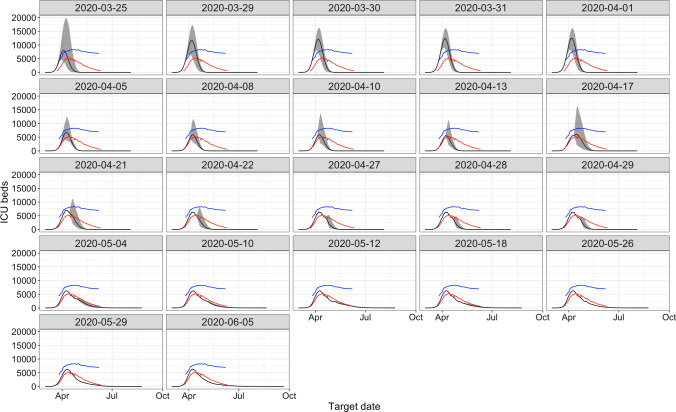
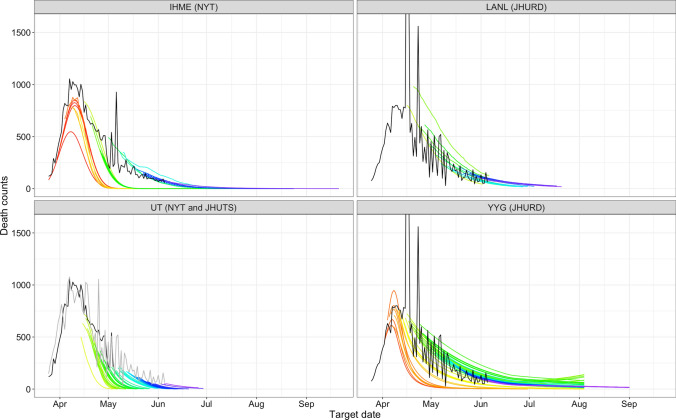
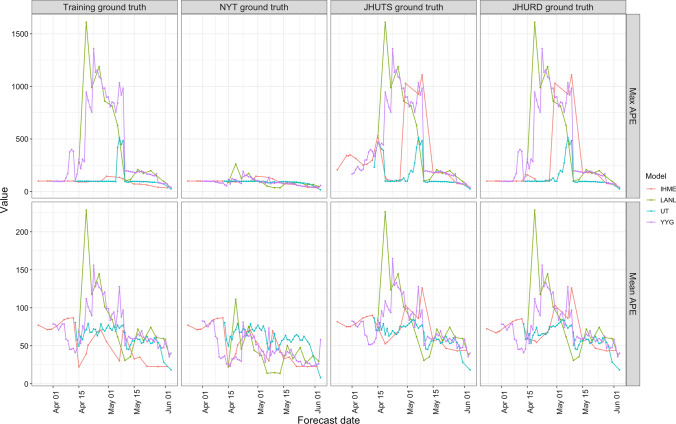
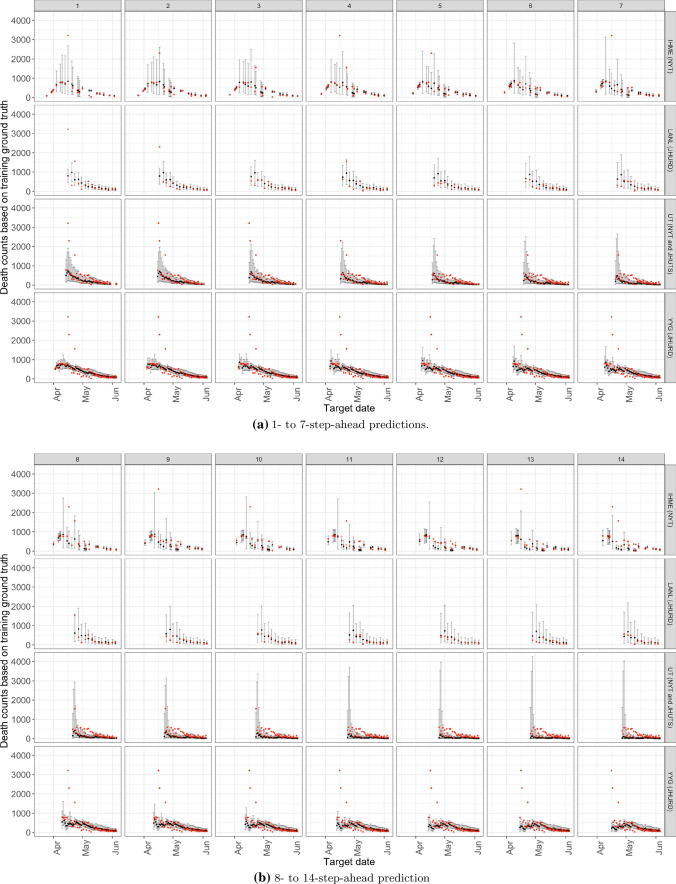
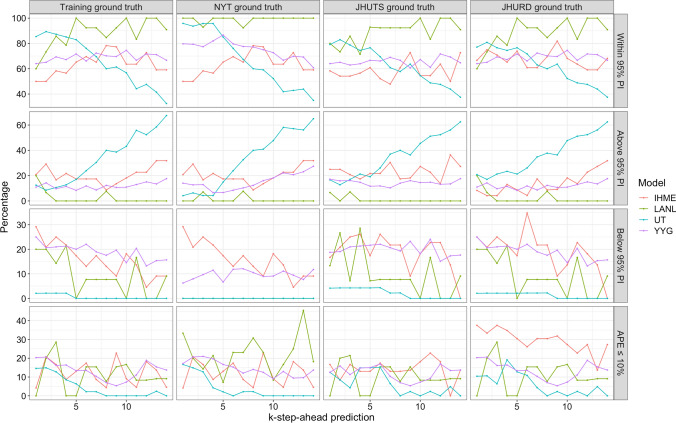
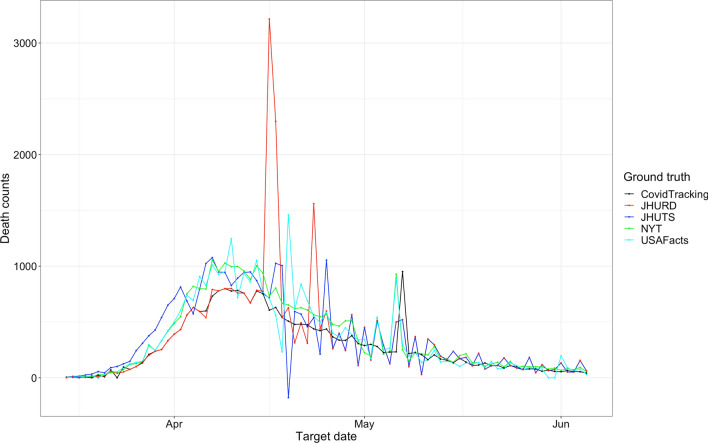
Forecasting models have been influential in shaping decision-making in the COVID-19 pandemic. However, there is concern that their predictions may have been misleading. Here, we dissect the predictions made by four models for the daily COVID-19 death counts between March 25 and June 5 in New York state, as well as the predictions of ICU bed utilisation made by the influential IHME model. We evaluated the accuracy of the point estimates and the accuracy of the uncertainty estimates of the model predictions. First, we compared the "ground truth" data sources on daily deaths against which these models were trained. Three different data sources were used by these models, and these had substantial differences in recorded daily death counts. Two additional data sources that we examined also provided different death counts per day. For accuracy of prediction, all models fared very poorly. Only 10.2% of the predictions fell within 10% of their training ground truth, irrespective of distance into the future. For accurate assessment of uncertainty, only one model matched relatively well the nominal 95% coverage, but that model did not start predictions until April 16, thus had no impact on early, major decisions. For ICU bed utilisation, the IHME model was highly inaccurate; the point estimates only started to match ground truth after the pandemic wave had started to wane. We conclude that trustworthy models require trustworthy input data to be trained upon. Moreover, models need to be subjected to prespecified real time performance tests, before their results are provided to policy makers and public health officials.

摘要

预测模型在塑造 COVID-19 大流行中的决策方面发挥了重要作用。然而,人们担心这些预测可能存在误导。在这里,我们剖析了四个模型在 3 月 25 日至 6 月 5 日期间对纽约州每日 COVID-19 死亡人数的预测,以及 IHME 模型对 ICU 床位使用情况的预测。我们评估了模型预测的点估计准确性和不确定性估计准确性。首先,我们将这些模型所依据的每日死亡的“真实数据”来源与实际数据进行了比较。这些模型使用了三种不同的数据来源,这些数据来源在记录的每日死亡人数方面存在很大差异。我们检查的另外两个数据来源也提供了不同的每日死亡人数。对于预测的准确性,所有模型的表现都非常差。无论距离未来的时间远近,只有 10.2%的预测落在其训练真实数据的 10%以内。对于准确评估不确定性,只有一个模型与名义上的 95%覆盖率相对匹配,但该模型直到 4 月 16 日才开始预测,因此对早期的重大决策没有影响。对于 ICU 床位使用情况,IHME 模型的预测非常不准确;点估计只有在大流行浪潮开始减弱后才开始与真实数据匹配。我们的结论是,可靠的模型需要基于可靠的输入数据进行训练。此外,在向政策制定者和公共卫生官员提供模型结果之前,需要对模型进行预定的实时性能测试。
https://cdn.ncbi.nlm.nih.gov/pmc/blobs/7771/7417851/818c208857d4/10654_2020_669_Fig6_HTML.jpg
https://cdn.ncbi.nlm.nih.gov/pmc/blobs/7771/7417851/f768a24a6769/10654_2020_669_Fig1_HTML.jpg
https://cdn.ncbi.nlm.nih.gov/pmc/blobs/7771/7417851/72ae175f5bb9/10654_2020_669_Fig2_HTML.jpg
https://cdn.ncbi.nlm.nih.gov/pmc/blobs/7771/7417851/6a9e7a9706da/10654_2020_669_Fig3_HTML.jpg
https://cdn.ncbi.nlm.nih.gov/pmc/blobs/7771/7417851/b5d62e56013c/10654_2020_669_Fig4_HTML.jpg
https://cdn.ncbi.nlm.nih.gov/pmc/blobs/7771/7417851/6fb7ea640b5e/10654_2020_669_Fig5_HTML.jpg
https://cdn.ncbi.nlm.nih.gov/pmc/blobs/7771/7417851/818c208857d4/10654_2020_669_Fig6_HTML.jpg
https://cdn.ncbi.nlm.nih.gov/pmc/blobs/7771/7417851/f768a24a6769/10654_2020_669_Fig1_HTML.jpg
https://cdn.ncbi.nlm.nih.gov/pmc/blobs/7771/7417851/72ae175f5bb9/10654_2020_669_Fig2_HTML.jpg
https://cdn.ncbi.nlm.nih.gov/pmc/blobs/7771/7417851/6a9e7a9706da/10654_2020_669_Fig3_HTML.jpg
https://cdn.ncbi.nlm.nih.gov/pmc/blobs/7771/7417851/b5d62e56013c/10654_2020_669_Fig4_HTML.jpg
https://cdn.ncbi.nlm.nih.gov/pmc/blobs/7771/7417851/6fb7ea640b5e/10654_2020_669_Fig5_HTML.jpg
https://cdn.ncbi.nlm.nih.gov/pmc/blobs/7771/7417851/818c208857d4/10654_2020_669_Fig6_HTML.jpg

相似文献

1
A case study in model failure? COVID-19 daily deaths and ICU bed utilisation predictions in New York state.模型失败的案例研究?纽约州 COVID-19 每日死亡人数和 ICU 床位利用预测。
Eur J Epidemiol. 2020 Aug;35(8):733-742. doi: 10.1007/s10654-020-00669-6. Epub 2020 Aug 11.
2
Advanced forecasting of SARS-CoV-2-related deaths in Italy, Germany, Spain, and New York State.意大利、德国、西班牙和纽约州与新冠病毒相关死亡人数的高级预测。
Allergy. 2020 Jul;75(7):1813-1815. doi: 10.1111/all.14327. Epub 2020 May 11.
3
How New Mexico Leveraged a COVID-19 Case Forecasting Model to Preemptively Address the Health Care Needs of the State: Quantitative Analysis.新墨西哥州如何利用新冠疫情预测模型来预先满足该州的医疗保健需求:定量分析
JMIR Public Health Surveill. 2021 Jun 9;7(6):e27888. doi: 10.2196/27888.
4
Initial Assessment of the Impact of the Emergency State Lockdown Measures on the 1st Wave of the COVID-19 Epidemic in Portugal.紧急状态封锁措施对葡萄牙第一波新冠疫情影响的初步评估
Acta Med Port. 2020 Nov 2;33(11):733-741. doi: 10.20344/amp.14129.
5
Cohort of Four Thousand Four Hundred Four Persons Under Investigation for COVID-19 in a New York Hospital and Predictors of ICU Care and Ventilation.在纽约一家医院中对 4404 人进行的 COVID-19 调查队列研究,以及 ICU 护理和通气的预测因素。
Ann Emerg Med. 2020 Oct;76(4):394-404. doi: 10.1016/j.annemergmed.2020.05.011. Epub 2020 May 11.
6
Clinical Mortality in a Large COVID-19 Cohort: Observational Study.大型新冠病毒肺炎队列中的临床死亡率:观察性研究
J Med Internet Res. 2020 Sep 25;22(9):e23565. doi: 10.2196/23565.
7
Health system collapse 45 days after the detection of COVID-19 in Ceará, Northeast Brazil: a preliminary analysis.新冠肺炎在巴西东北部塞阿拉州出现 45 天后,卫生系统崩溃:初步分析。
Rev Soc Bras Med Trop. 2020;53:e20200354. doi: 10.1590/0037-8682-0354-2020. Epub 2020 Jul 3.
8
Preliminary Estimate of Excess Mortality During the COVID-19 Outbreak - New York City, March 11-May 2, 2020.2020 年 3 月 11 日至 5 月 2 日期间 COVID-19 爆发期间超额死亡的初步估计-纽约市。
MMWR Morb Mortal Wkly Rep. 2020 May 15;69(19):603-605. doi: 10.15585/mmwr.mm6919e5.
9
Development of a multivariate prediction model of intensive care unit transfer or death: A French prospective cohort study of hospitalized COVID-19 patients.建立 ICU 转科或死亡的多变量预测模型:一项法国前瞻性队列研究COVID-19 住院患者。
PLoS One. 2020 Oct 19;15(10):e0240711. doi: 10.1371/journal.pone.0240711. eCollection 2020.
10
[Forecasting the Pandemic: The Role of Mathematical Models].预测大流行:数学模型的作用
Acta Med Port. 2020 Nov 2;33(11):713-715. doi: 10.20344/amp.15049.

引用本文的文献

1
Comparative performance of twelve machine learning models in predicting COVID-19 mortality risk in children: a population-based retrospective cohort study in Brazil.十二种机器学习模型预测儿童新冠病毒疾病死亡率风险的比较性能:巴西一项基于人群的回顾性队列研究
PeerJ Comput Sci. 2025 May 28;11:e2916. doi: 10.7717/peerj-cs.2916. eCollection 2025.
2
Machine learning algorithms for predicting COVID-19 mortality in Ethiopia.用于预测埃塞俄比亚 COVID-19 死亡率的机器学习算法。
BMC Public Health. 2024 Jun 28;24(1):1728. doi: 10.1186/s12889-024-19196-0.
3
Comparing machine learning algorithms to predict COVID‑19 mortality using a dataset including chest computed tomography severity score data.

本文引用的文献

1
Characteristics of U.S. Nursing Homes with COVID-19 Cases.有新冠病例的美国养老院的特征。
J Am Geriatr Soc. 2020 Aug;68(8):1653-1656. doi: 10.1111/jgs.16661. Epub 2020 Jul 7.
2
Collateral damage: the impact on outcomes from cancer surgery of the COVID-19 pandemic.附带损害:新冠疫情对癌症手术结果的影响。
Ann Oncol. 2020 Aug;31(8):1065-1074. doi: 10.1016/j.annonc.2020.05.009. Epub 2020 May 19.
3
Wrong but Useful - What Covid-19 Epidemiologic Models Can and Cannot Tell Us.错误但有用——新冠疫情流行病学模型能告诉我们什么及不能告诉我们什么
比较机器学习算法,使用包含胸部计算机断层扫描严重程度评分数据的数据集来预测 COVID-19 死亡率。
Sci Rep. 2023 Jul 13;13(1):11343. doi: 10.1038/s41598-023-38133-6.
4
Unraveling the COVID-19 hospitalization dynamics in Spain using Bayesian inference.利用贝叶斯推断方法揭示西班牙 COVID-19 住院动态。
BMC Med Res Methodol. 2023 Jan 25;23(1):24. doi: 10.1186/s12874-023-01842-7.
5
Pandemics, policy, and pluralism: A Feyerabend-inspired perspective on COVID-19.大流行、政策与多元主义:一种受费耶阿本德启发的关于新冠疫情的视角
Synthese. 2022;200(6):441. doi: 10.1007/s11229-022-03923-4. Epub 2022 Oct 26.
6
A meta-epidemiological assessment of transparency indicators of infectious disease models.传染病模型透明度指标的元流行病学评估。
PLoS One. 2022 Oct 7;17(10):e0275380. doi: 10.1371/journal.pone.0275380. eCollection 2022.
7
Predicting the Need for Intubation among COVID-19 Patients Using Machine Learning Algorithms: A Single-Center Study.使用机器学习算法预测COVID-19患者的插管需求:一项单中心研究。
Med J Islam Repub Iran. 2022 Apr 4;36:30. doi: 10.47176/mjiri.36.30. eCollection 2022.
8
Associations between the COVID-19 Pandemic and Hospital Infrastructure Adaptation and Planning-A Scoping Review.**标题**:COVID-19 大流行与医院基础设施调整和规划之间的关联:一项范围综述 **摘要**:背景:COVID-19 大流行对全球医疗系统产生了前所未有的压力。本研究旨在通过对已发表文献进行综述,全面了解 COVID-19 大流行对医院基础设施的影响,以及医疗设施为适应 COVID-19 而进行的调整和规划。 方法:检索了 PubMed、Embase、Cochrane 图书馆和 Web of Science 核心合集数据库中截至 2023 年 7 月 1 日的相关文献。采用描述性方法对纳入的文献进行了总结。 结果:共纳入了 24 项研究,涵盖了来自 16 个国家的 137 家医院。研究主要集中在欧洲和北美地区。COVID-19 大流行对医院基础设施的影响包括增加了医院床位、改造和扩建、建立临时医疗设施和负压病房、优化医院布局和流程、加强医院感染控制措施、提高医疗人员防护水平和医疗废物管理。 结论:COVID-19 大流行对全球医院基础设施产生了重大影响,需要不断调整和规划以适应疫情。各国应加强医院基础设施建设和应急准备,以应对未来可能出现的公共卫生危机。
Int J Environ Res Public Health. 2022 Jul 4;19(13):8195. doi: 10.3390/ijerph19138195.
9
Enhancing long-term forecasting: Learning from COVID-19 models.增强长期预测:从 COVID-19 模型中学习。
PLoS Comput Biol. 2022 May 19;18(5):e1010100. doi: 10.1371/journal.pcbi.1010100. eCollection 2022 May.
10
When Do We Need Massive Computations to Perform Detailed COVID-19 Simulations?我们何时需要进行大规模计算来执行详细的新冠病毒模拟?
Adv Theory Simul. 2022 Feb;5(2):2100343. doi: 10.1002/adts.202100343. Epub 2021 Nov 23.
N Engl J Med. 2020 Jul 23;383(4):303-305. doi: 10.1056/NEJMp2016822. Epub 2020 May 15.
4
Reduced Rate of Hospital Admissions for ACS during Covid-19 Outbreak in Northern Italy.意大利北部新冠疫情期间急性冠状动脉综合征住院率降低
N Engl J Med. 2020 Jul 2;383(1):88-89. doi: 10.1056/NEJMc2009166. Epub 2020 Apr 28.
5
Predictive Mathematical Models of the COVID-19 Pandemic: Underlying Principles and Value of Projections.2019年冠状病毒病大流行的预测数学模型:基本原理与预测价值
JAMA. 2020 May 19;323(19):1893-1894. doi: 10.1001/jama.2020.6585.
6
Coronavirus disease 2019: The harms of exaggerated information and non-evidence-based measures.2019冠状病毒病:夸大信息和非循证措施的危害。
Eur J Clin Invest. 2020 Apr;50(4):e13222. doi: 10.1111/eci.13222.