ISI Foundation, Via Chisola 5, 10126, Torino, Italy.
Institute for Biocomputation and Physics of Complex Systems (BIFI), University of Zaragoza, 50018, Zaragoza, Spain.
BMC Med Res Methodol. 2023 Jan 25;23(1):24. doi: 10.1186/s12874-023-01842-7.
One of the main challenges of the COVID-19 pandemic is to make sense of available, but often heterogeneous and noisy data. This contribution presents a data-driven methodology that allows exploring the hospitalization dynamics of COVID-19, exemplified with a study of 17 autonomous regions in Spain from summer 2020 to summer 2021.
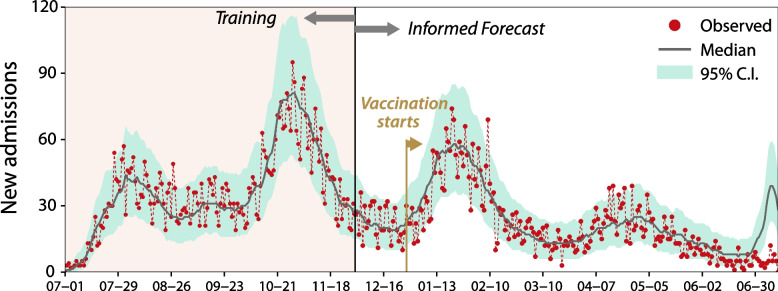
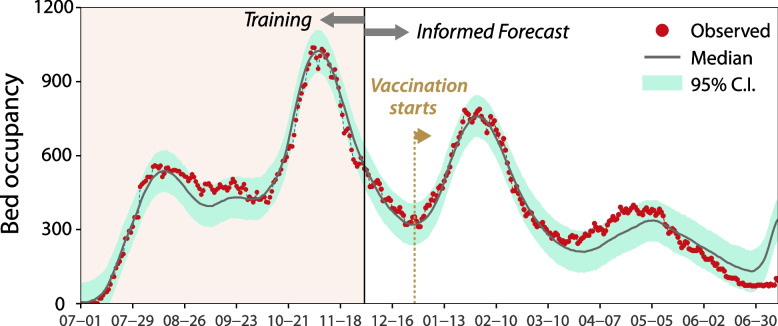
We use data on new daily cases and hospitalizations reported by the Spanish Ministry of Health to implement a Bayesian inference method that allows making short-term predictions of bed occupancy of COVID-19 patients in each of the autonomous regions of the country.
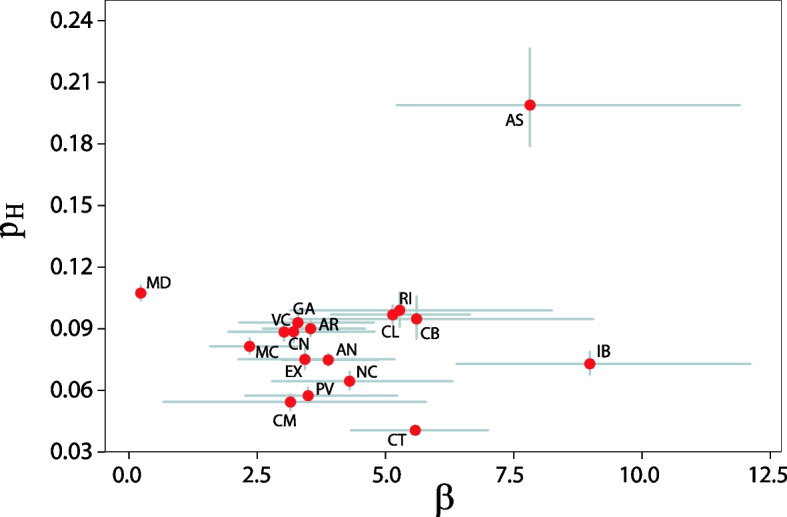
We show how to use the temporal series for the number of daily admissions and discharges from hospital to reproduce the hospitalization dynamics of COVID-19 patients. For the case-study of the region of Aragon, we estimate that the probability of being admitted to hospital care upon infection is 0.090 [0.086-0.094], (95% C.I.), with the distribution governing hospital admission yielding a median interval of 3.5 days and an IQR of 7 days. Likewise, the distribution on the length of stay produces estimates of 12 days for the median and 10 days for the IQR. A comparison between model parameters for the regions analyzed allows to detect differences and changes in policies of the health authorities.
We observe important regional differences, signaling that to properly compare very different populations, it is paramount to acknowledge all the diversity in terms of culture, socio-economic status, and resource availability. To better understand the impact of this pandemic, much more data, disaggregated and properly annotated, should be made available.
COVID-19 大流行面临的主要挑战之一是理解可用的数据,但这些数据通常是异构且嘈杂的。本研究提出了一种数据驱动的方法,该方法允许探索 COVID-19 的住院动态,以 2020 年夏季至 2021 年夏季西班牙 17 个自治区的研究为例。
我们使用西班牙卫生部报告的新的每日病例和住院数据,实施贝叶斯推断方法,以对该国各自治区 COVID-19 患者的床位占用情况进行短期预测。
我们展示了如何使用每日入院和出院人数的时间序列来再现 COVID-19 患者的住院动态。对于阿拉贡地区的案例研究,我们估计感染后住院治疗的概率为 0.090 [0.086-0.094](95%置信区间),控制住院入院的分布产生 3.5 天的中位数间隔和 7 天的 IQR。同样,逗留时间分布产生 12 天的中位数和 10 天的 IQR 的估计值。对分析地区的模型参数进行比较,可检测到卫生当局政策的差异和变化。
我们观察到重要的地区差异,表明为了正确比较非常不同的人群,必须承认在文化、社会经济地位和资源可用性方面的所有差异。为了更好地了解这一大流行的影响,应提供更多、更细分且适当标注的数据。