Wen Ming, Feron Romain, Pan Qiaowei, Guguin Justine, Jouanno Elodie, Herpin Amaury, Klopp Christophe, Cabau Cedric, Zahm Margot, Parrinello Hugues, Journot Laurent, Burgess Shawn M, Omori Yoshihiro, Postlethwait John H, Schartl Manfred, Guiguen Yann
State Key Laboratory of Developmental Biology of Freshwater Fish, College of Life Science, Hunan Normal University, Changsha, China.
INRAE, LPGP, 35000, Rennes, France.
BMC Genomics. 2020 Aug 11;21(1):552. doi: 10.1186/s12864-020-06959-3.
Goldfish is an important model for various areas of research, including neural development and behavior and a species of significant importance in aquaculture, especially as an ornamental species. It has a male heterogametic (XX/XY) sex determination system that relies on both genetic and environmental factors, with high temperatures being able to produce female-to-male sex reversal. Little, however, is currently known on the molecular basis of genetic sex determination in this important cyprinid model. Here we used sequencing approaches to better characterize sex determination and sex-chromosomes in an experimental strain of goldfish.
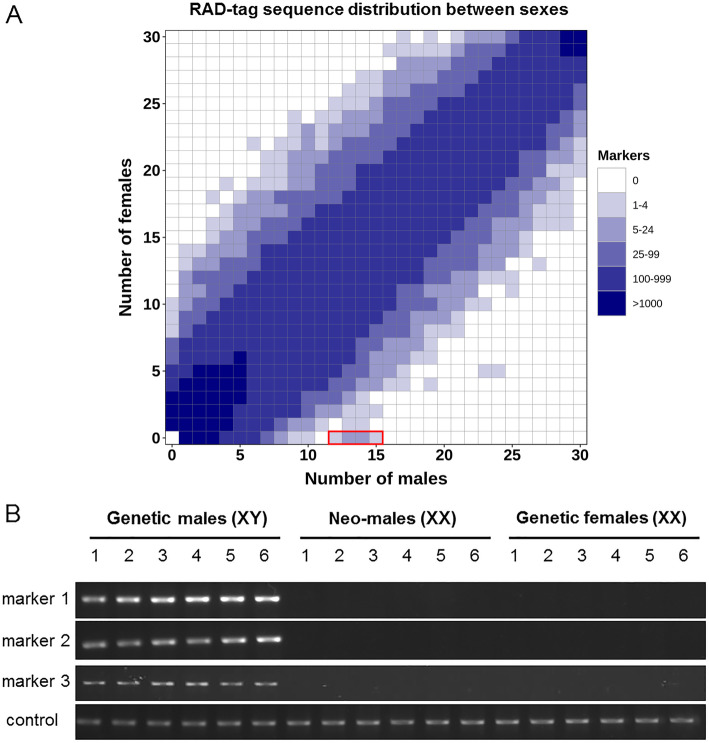
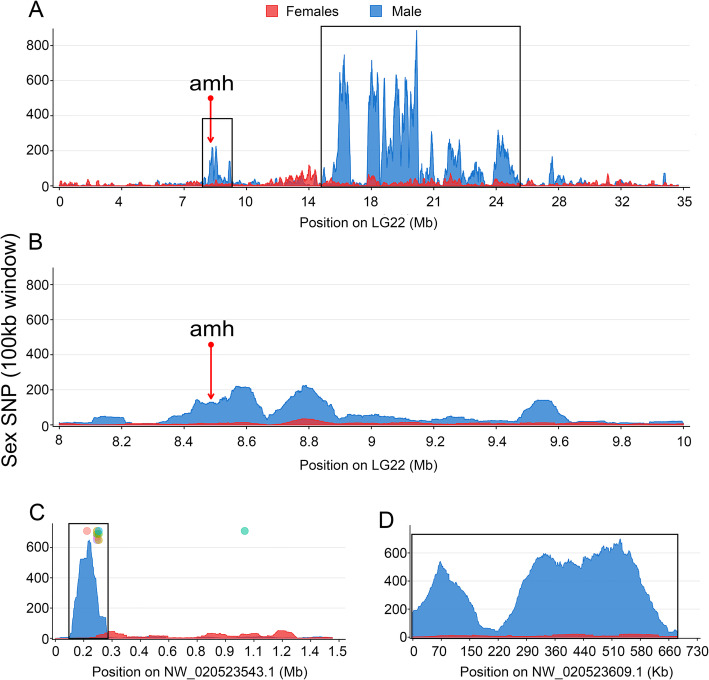
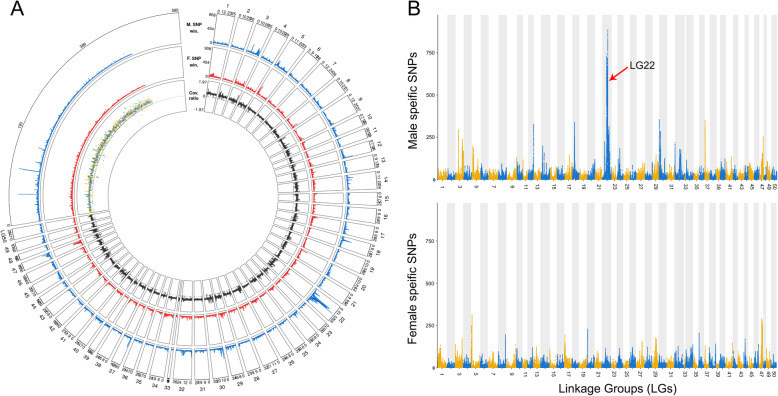
Our results confirmed that sex determination in goldfish is a mix of environmental and genetic factors and that its sex determination system is male heterogametic (XX/XY). Using reduced representation (RAD-seq) and whole genome (pool-seq) approaches, we characterized sex-linked polymorphisms and developed male specific genetic markers. These male specific markers were used to distinguish sex-reversed XX neomales from XY males and to demonstrate that XX female-to-male sex reversal could even occur at a relatively low rearing temperature (18 °C), for which sex reversal has been previously shown to be close to zero. We also characterized a relatively large non-recombining region (~ 11.7 Mb) on goldfish linkage group 22 (LG22) that contained a high-density of male-biased genetic polymorphisms. This large LG22 region harbors 373 genes, including a single candidate as a potential master sex gene, i.e., the anti-Mullerian hormone gene (amh). However, no sex-linked polymorphisms were detected in the coding DNA sequence of the goldfish amh gene.
These results show that our goldfish strain has a relatively large sex locus on LG22, which is likely the Y chromosome of this experimental population. The presence of a few XX males even at low temperature also suggests that other environmental factors in addition to temperature could trigger female-to-male sex reversal. Finally, we also developed sex-linked genetic markers, which will be important tools for future research on sex determination in our experimental goldfish population. However, additional work would be needed to explore whether this sex locus is conserved in other populations of goldfish.
金鱼是包括神经发育与行为等多个研究领域的重要模型,也是水产养殖中具有重要意义的物种,尤其是作为一种观赏鱼。它具有雄性异配(XX/XY)的性别决定系统,该系统依赖于遗传和环境因素,高温能够导致雌性向雄性的性逆转。然而,目前对于这个重要鲤科鱼类模型中遗传性别决定的分子基础知之甚少。在此,我们使用测序方法来更好地描述金鱼一个实验品系中的性别决定和性染色体特征。
我们的结果证实,金鱼的性别决定是环境和遗传因素的混合,其性别决定系统为雄性异配(XX/XY)。使用简化基因组测序(RAD-seq)和全基因组测序(pool-seq)方法,我们鉴定了性连锁多态性并开发了雄性特异性遗传标记。这些雄性特异性标记用于区分性逆转的XX新雄性和XY雄性,并证明XX雌性向雄性的性逆转甚至可以在相对较低的饲养温度(18°C)下发生,而此前已表明该温度下的性逆转接近零。我们还鉴定了金鱼连锁群22(LG22)上一个相对较大的非重组区域(约11.7 Mb),该区域含有高密度的雄性偏向遗传多态性。这个大的LG22区域包含373个基因,其中包括一个作为潜在主性别基因的候选基因,即抗缪勒氏管激素基因(amh)。然而,在金鱼amh基因的编码DNA序列中未检测到性连锁多态性。
这些结果表明,我们的金鱼品系在LG22上有一个相对较大的性别位点,这可能是该实验群体的Y染色体。即使在低温下也存在少数XX雄性,这也表明除温度外的其他环境因素可能触发雌性向雄性的性逆转。最后,我们还开发了性连锁遗传标记,这将是未来对我们的实验金鱼群体进行性别决定研究的重要工具。然而,还需要进一步研究来探索这个性别位点在其他金鱼群体中是否保守。