Aix Marseille Univ, IRD, AP-HM, SSA, VITROME, Marseille, France.
IHU-Méditerranée Infection, Marseille, France.
Parasit Vectors. 2020 Aug 11;13(1):410. doi: 10.1186/s13071-020-04293-x.
Pediculus humanus, which includes two ecotypes (body and head lice), is an obligate bloodsucking parasite that co-evolved with their human hosts over thousands of years, thus providing a valuable source of information to reconstruct the human migration. Pediculosis due to head lice occurred each year throughout the world and several pathogenic bacteria, which are usually associated with body lice, are increasingly detected in them. In Gabon, where this pediculosis is still widespread, there is a lack of data on genetic diversity of head lice and their associated bacteria.
This study aimed to investigate the phylogeny of head lice collected in Gabon and their associated bacteria, using molecular tools. Between 26 March and 11 April 2018, 691 head lice were collected from 86 women in Franceville. We studied the genetic diversity of these lice based on the cytochrome b gene, then we screened them for DNA of Bartonella quintana, Borrelia spp., Acinetobacter spp., Yersinia pestis, Rickettsia spp., R. prowazekii, Anaplasma spp. and C. burnetii, using real time or standard PCR and sequencing.
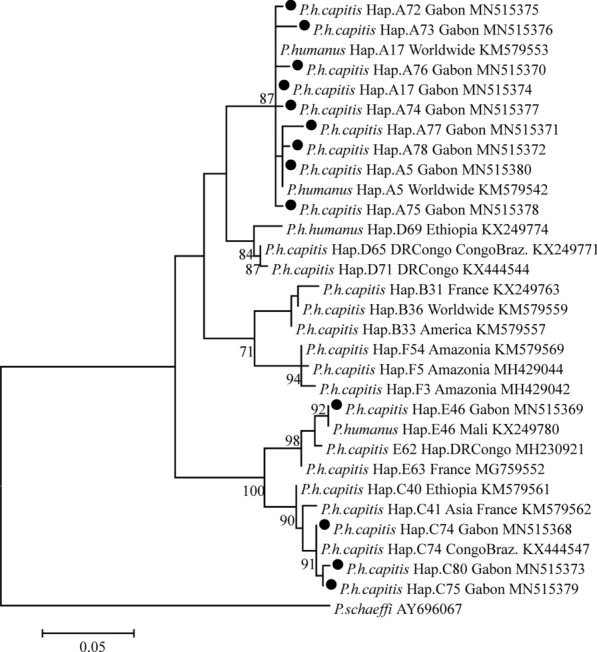
Overall 74.6% of studied lice belonged to Clade A, 25.3% to Clade C and 0.1% to Clade E. The phylogenetic analysis of 344 head lice yielded 45 variable positions defining 13 different haplotypes from which 8 were novel. Bacterial screening revealed the presence of Borrelia spp. DNA in 3 (0.4%) of 691 head lice belonging to Clade A and infesting one individual. This Borrelia is close to B. theileri (GenBank: MN621894). Acinetobacter spp. DNA has been detected in 39 (25%) of the 156 screened lice; of these 13 (8.3%) corresponded to A. baumannii. Acinetobacter nosocomialis (n = 2) and A. pittii (n = 1) were also recorded.
To of our knowledge, this study is the first to investigate the genetic diversity of head lice from Gabon. It appears that Clade C is the second most important clade in Gabon, after Clade A which is known to have a global distribution. The detection of Borrelia spp. DNA in these lice highlight the potential circulation of these bacteria in Gabon.
人虱,包括体虱和头虱两种生态型,是一种专性吸血寄生虫,与人类宿主共同进化了数千年,因此为重建人类迁徙提供了有价值的信息来源。全世界每年都会发生头虱病,而在这些头虱中,越来越多地检测到通常与体虱有关的几种致病细菌。在加蓬,这种头虱病仍然很普遍,但对头虱及其相关细菌的遗传多样性缺乏数据。
本研究旨在使用分子工具研究加蓬采集的头虱及其相关细菌的系统发育。2018 年 3 月 26 日至 4 月 11 日,从法国城的 86 名妇女中采集了 691 个头虱。我们基于细胞色素 b 基因研究了这些虱子的遗传多样性,然后使用实时或标准 PCR 和测序筛查它们是否携带贝氏疏螺旋体、巴尔通体、不动杆菌、鼠疫耶尔森菌、立克次体、普氏立克次体、无形体和伯氏考克斯体的 DNA。
总体而言,74.6%的研究虱子属于 A 群,25.3%属于 C 群,0.1%属于 E 群。344 个头虱的系统发育分析产生了 45 个可定义 13 种不同单倍型的变异位置,其中 8 种是新的。细菌筛查显示,属于 A 群的 691 个头虱中有 3 个头虱(0.4%)携带贝氏疏螺旋体 DNA,其中 1 个头虱感染了 1 个头虱。这种疏螺旋体与 B. theileri(GenBank:MN621894)密切相关。在 156 个筛查的虱子中,检测到 39 个(25%)带有不动杆菌属 DNA;其中 13 个(8.3%)对应于鲍曼不动杆菌。还记录了不动杆菌 nosocomialis(n=2)和不动杆菌 pittii(n=1)。
据我们所知,这是首次研究加蓬头虱的遗传多样性。似乎 C 群是继全球分布的 A 群之后第二重要的群体。在这些虱子中检测到疏螺旋体 DNA 突出表明这些细菌在加蓬的潜在传播。