Centre for Chronic Inflammatory and Infectious and Diseases, Biomedical Sciences Cluster, School of Health and Biomedical Sciences, RMIT University, Bundoora, VIC, 3083, Australia.
Infection and Immunity Program, Department of Microbiology, Biomedicine Discovery Institute, Monash University, Clayton, VIC, 3800, Australia.
Nat Commun. 2020 Aug 11;11(1):4015. doi: 10.1038/s41467-020-17829-7.
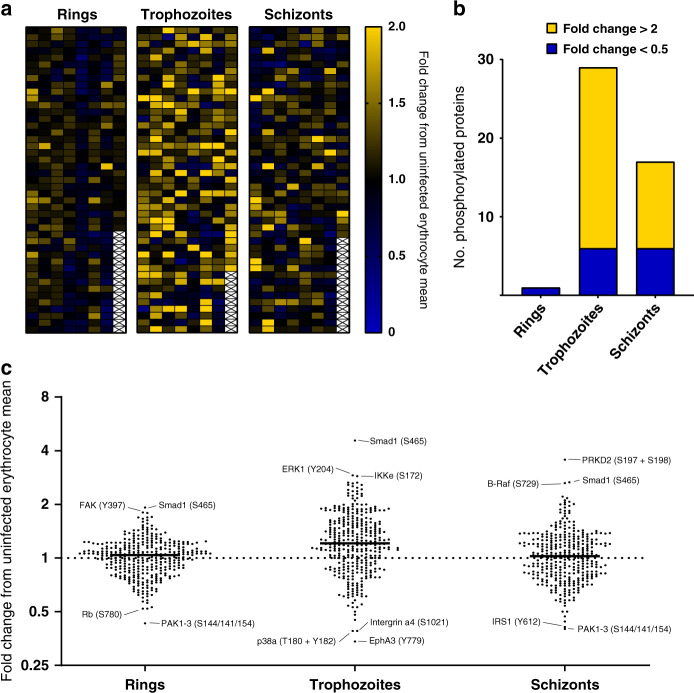
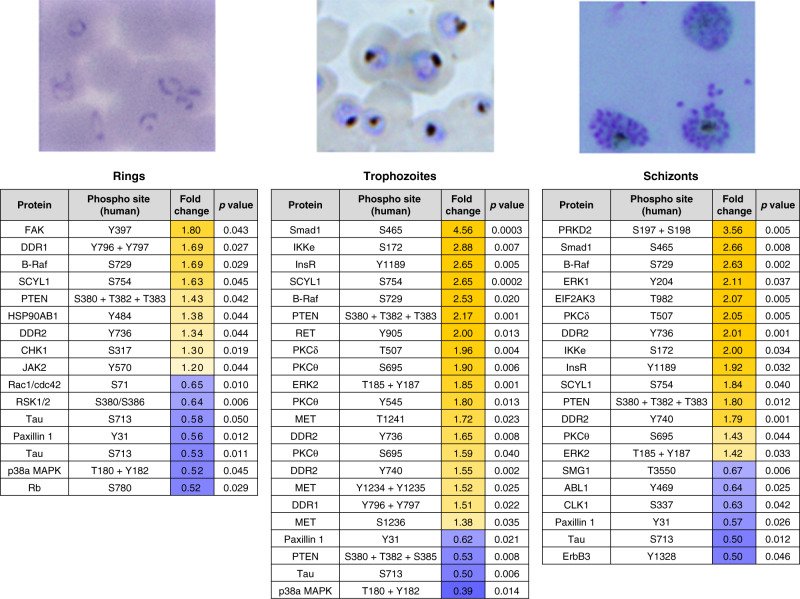
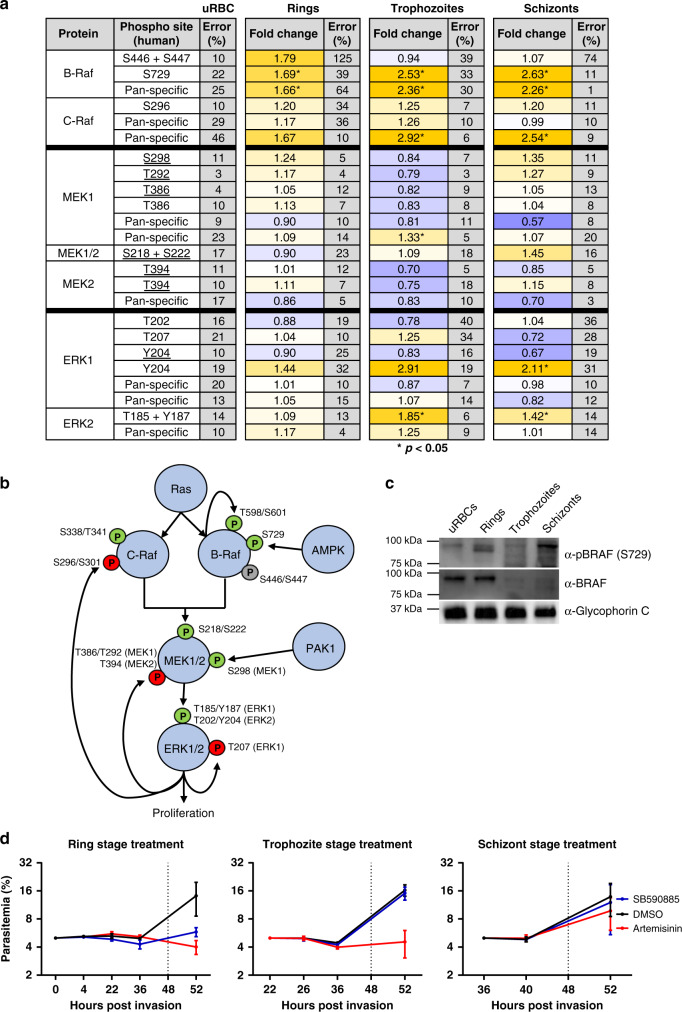
Intracellular pathogens mobilize host signaling pathways of their host cell to promote their own survival. Evidence is emerging that signal transduction elements are activated in a-nucleated erythrocytes in response to infection with malaria parasites, but the extent of this phenomenon remains unknown. Here, we fill this knowledge gap through a comprehensive and dynamic assessment of host erythrocyte signaling during infection with Plasmodium falciparum. We used arrays of 878 antibodies directed against human signaling proteins to interrogate the activation status of host erythrocyte phospho-signaling pathways at three blood stages of parasite asexual development. This analysis reveals a dynamic modulation of many host signalling proteins across parasite development. Here we focus on the hepatocyte growth factor receptor (c-MET) and the MAP kinase pathway component B-Raf, providing a proof of concept that human signaling kinases identified as activated by malaria infection represent attractive targets for antimalarial intervention.
细胞内病原体调动宿主细胞的信号通路来促进自身的存活。有证据表明,疟原虫感染无核红细胞后,信号转导元件被激活,但这种现象的程度尚不清楚。在这里,我们通过全面和动态评估恶性疟原虫感染过程中宿主红细胞信号转导来填补这一知识空白。我们使用了 878 种针对人类信号蛋白的抗体阵列,来检测疟原虫无性发育的三个血液阶段中宿主红细胞磷酸化信号通路的激活状态。该分析揭示了许多宿主信号蛋白在寄生虫发育过程中的动态调节。在这里,我们重点关注肝细胞生长因子受体(c-MET)和 MAP 激酶途径成分 B-Raf,为感染疟疾后被激活的人类信号激酶代表了抗疟干预的有吸引力的靶点提供了概念验证。