University of Lille, CNRS, Institut Pasteur de Lille, UMR 8161 - M3T - Mechanisms of Tumorigenesis and Target Therapies, F-59000 Lille, France.
BMB Rep. 2019 Apr;52(4):239-249. doi: 10.5483/BMBRep.2019.52.4.024.
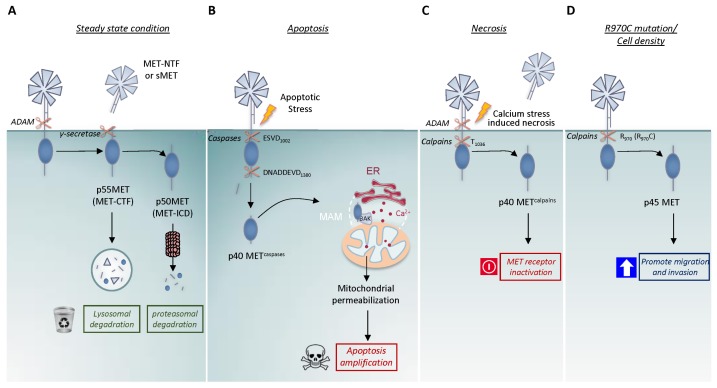
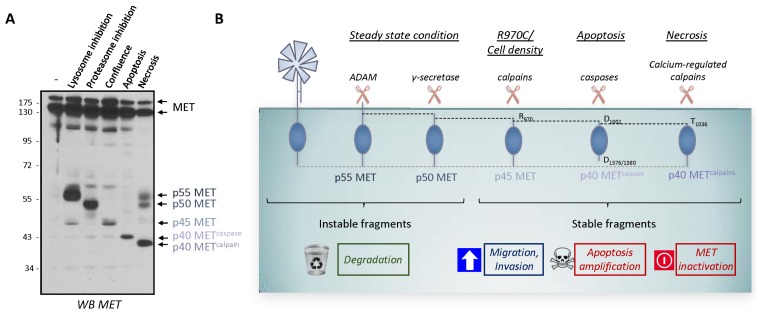
Membrane-anchored full-length MET stimulated by its ligand HGF/SF induces various biological responses, including survival, growth, and invasion. This panel of responses, referred to invasive growth, is required for embryogenesis and tissue regeneration in adults. On the contrary, MET deregulation is associated with tumorigenesis in many kinds of cancer. In addition to its well-documented ligand-stimulated downstream signaling, the receptor can be cleaved by proteases such as secretases, caspases, and calpains. These cleavages are involved either in MET receptor inactivation or, more interestingly, in generating active fragments that can modify cell fate. For instance, MET fragments can promote cell death or invasion. Given a large number of proteases capable of cleaving MET, this receptor appears as a prototype of proteolytic-cleavage-regulated receptor tyrosine kinase. In this review, we describe and discuss the mechanisms and consequences, both physiological and pathological, of MET proteolytic cleavages. [BMB Reports 2019; 52(4): 239-249].
膜锚定全长 MET 受其配体 HGF/SF 的刺激,可诱导多种生物学反应,包括存活、生长和侵袭。这种反应被称为侵袭性生长,是胚胎发生和成人组织再生所必需的。相反,MET 失调与多种癌症的肿瘤发生有关。除了其有充分文献记载的配体刺激的下游信号外,受体还可以被蛋白酶如分泌酶、半胱天冬酶和钙蛋白酶切割。这些切割要么参与 MET 受体失活,要么更有趣的是,产生能够改变细胞命运的活性片段。例如,MET 片段可以促进细胞死亡或侵袭。鉴于能够切割 MET 的大量蛋白酶,这种受体似乎是蛋白水解切割调节的受体酪氨酸激酶的原型。在这篇综述中,我们描述并讨论了 MET 蛋白水解切割的机制和生理及病理后果。[BMB 报告 2019;52(4): 239-249]。