Yu Miao, Li Zhenming, Rong Ting, Wang Gang, Liu Zhichang, Chen Weidong, Li Jiazhou, Li Jianhao, Ma Xianyong
Institute of Animal Science, Guangdong Academy of Agricultural Sciences; State Key Laboratory of Livestock and Poultry Breeding; Key Laboratory of Animal Nutrition and Feed Science in South China, Ministry of Agriculture and Rural Affairs; Guangdong Provincial Key Laboratory of Animal Breeding and Nutrition; Guangdong Engineering Technology Research Center of animal Meat quality and Safety Control and Evaluation; Maoming Branch, Guangdong Laboratory for Lingnan Modern Agriculture, Guangzhou, 510640 Guangdong China.
J Anim Sci Biotechnol. 2020 Aug 7;11:78. doi: 10.1186/s40104-020-00484-9. eCollection 2020.
With increasing health awareness among consumers, the demand for healthier, tastier, higher quality and nutritional value pork is increasing. It has been shown that different dietary starch sources can alter the carcass traits and meat quality. However, research on the effects of different starch sources with clear different amylose/amylopectin ratio on the amino acid and fatty acid composition in (. ) muscle of pigs is limited. This study aimed to investigate the effects of different dietary starch sources on carcass traits, meat quality, muscle amino acid and fatty acid composition, and the mRNA expression levels of genes involved in lipid metabolism and muscle fiber characteristics in finishing pigs. A total of 72 Duroc × Landrace × Large White barrows were randomly allocated to 3 different dietary treatment groups with 8 replicate pens/group and 3 pigs per pen. Tapioca starch (TS), corn starch (CS), and pea starch (PS), with amylose/amylopectin ratio of 0.11, 0.25, and 0.44, respectively, were used as their dietary starch sources for 40 days.
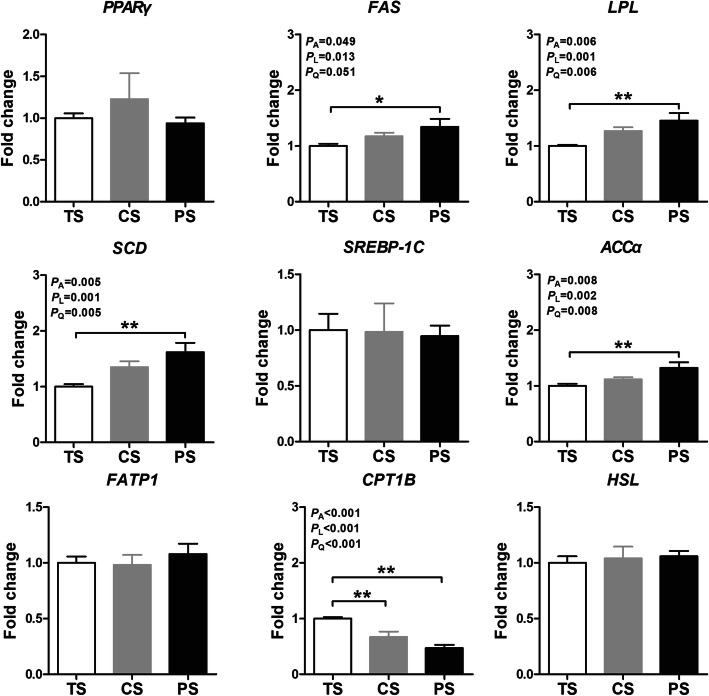
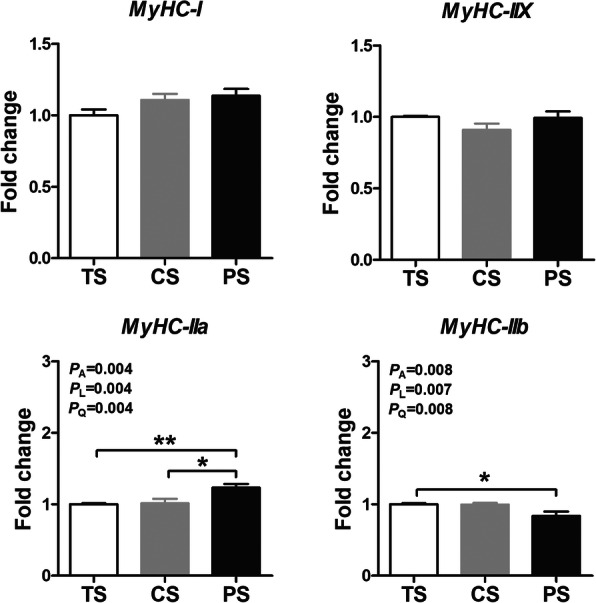
Results showed that the PS diet significantly increased ( < 0.05) the final body weight, average daily gain, loin-eye area, and fat-free lean index compared with the TS diet, but significantly decreased ( < 0.05) the feed to gain ratio and backfat thickness. Compared with the TS diet, PS diet also increased ( < 0.05) the pH, marbling scores, the content of intramuscular fat and inosine monophosphate in the . , and decreased ( < 0.05) the drip loss and shear force. In addition, compared with the TS diet, PS diet increased ( < 0.05) the proportions of flavor amino acids, DHA, EPA, and n-3 polyunsaturated fatty acid (PUFA) in the . compared with TS diet, but decreased ( < 0.05) the ratio of n-6/n-3 PUFA. Furthermore, compared with the TS diet, PS diet also upregulated ( < 0.05) the lipogenic genes (, , , ) and myosin heavy-chain ()- mRNA expression levels compared with the TS diet, but downregulated ( < 0.05) the and mRNA levels.
In conclusion, these results provided compelling evidence that the different dietary starch source altered the carcass traits, meat flavor and quality in finishing pigs, and consumption of a diet with higher amylose/amylopectin ratio results in the production of a healthy, higher quality, and nutritional value pork.
随着消费者健康意识的提高,对更健康、更美味、更高品质和营养价值的猪肉的需求不断增加。研究表明,不同的膳食淀粉来源可以改变胴体性状和肉质。然而,关于不同直链淀粉/支链淀粉比例的淀粉来源对猪(.)肌肉中氨基酸和脂肪酸组成影响的研究有限。本研究旨在探讨不同膳食淀粉来源对育肥猪胴体性状、肉质、肌肉氨基酸和脂肪酸组成以及参与脂质代谢和肌肉纤维特性的基因mRNA表达水平的影响。总共72头杜洛克×长白×大白阉公猪被随机分配到3个不同的日粮处理组,每组8个重复栏,每栏3头猪。分别以直链淀粉/支链淀粉比例为0.11、0.25和0.44的木薯淀粉(TS)、玉米淀粉(CS)和豌豆淀粉(PS)作为日粮淀粉来源,持续40天。
结果表明,与TS日粮相比,PS日粮显著增加(<0.05)了末体重、平均日增重、眼肌面积和无脂瘦肉率,但显著降低(<0.05)了料重比和背膘厚度。与TS日粮相比,PS日粮还提高了(<0.05)pH值、大理石花纹评分、肌肉内脂肪和肌苷单磷酸的含量,并降低了(<0.05)滴水损失和剪切力。此外,与TS日粮相比,PS日粮增加了(<0.05)风味氨基酸、DHA、EPA和n-3多不饱和脂肪酸(PUFA)的比例,但降低了(<0.05)n-6/n-3 PUFA的比例。此外,与TS日粮相比,PS日粮还上调了(<0.05)生脂基因(、、、)和肌球蛋白重链()-mRNA表达水平,但下调了(<0.05)和mRNA水平。
总之,这些结果提供了有力证据,表明不同的膳食淀粉来源改变了育肥猪的胴体性状、肉的风味和品质,食用直链淀粉/支链淀粉比例较高的日粮可生产出健康、高品质和具有营养价值的猪肉。