Fantazzini Alice, Esposito Mario, Finotello Alice, Auricchio Ferdinando, Pane Bianca, Basso Curzio, Spinella Giovanni, Conti Michele
Department of Experimental Medicine, University of Genoa, Via Leon Battista Alberti, 2, 16132, Genoa, Italy.
Camelot Biomedical Systems S.r.l, Via Al Ponte Reale, 2, 16124, Genoa, Italy.
Cardiovasc Eng Technol. 2020 Oct;11(5):576-586. doi: 10.1007/s13239-020-00481-z. Epub 2020 Aug 11.
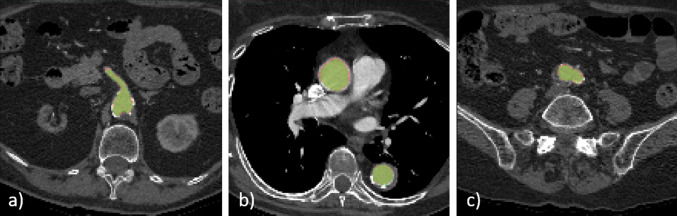
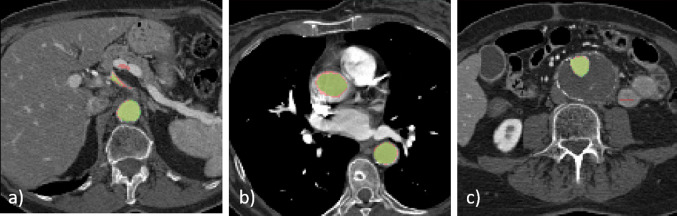
The quantitative analysis of contrast-enhanced Computed Tomography Angiography (CTA) is essential to assess aortic anatomy, identify pathologies, and perform preoperative planning in vascular surgery. To overcome the limitations given by manual and semi-automatic segmentation tools, we apply a deep learning-based pipeline to automatically segment the CTA scans of the aortic lumen, from the ascending aorta to the iliac arteries, accounting for 3D spatial coherence.
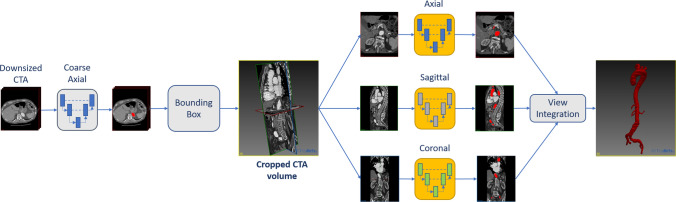
A first convolutional neural network (CNN) is used to coarsely segment and locate the aorta in the whole sub-sampled CTA volume, then three single-view CNNs are used to effectively segment the aortic lumen from axial, sagittal, and coronal planes under higher resolution. Finally, the predictions of the three orthogonal networks are integrated to obtain a segmentation with spatial coherence.
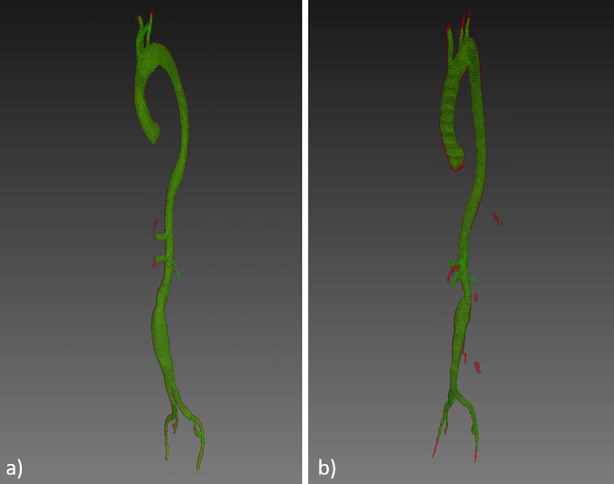
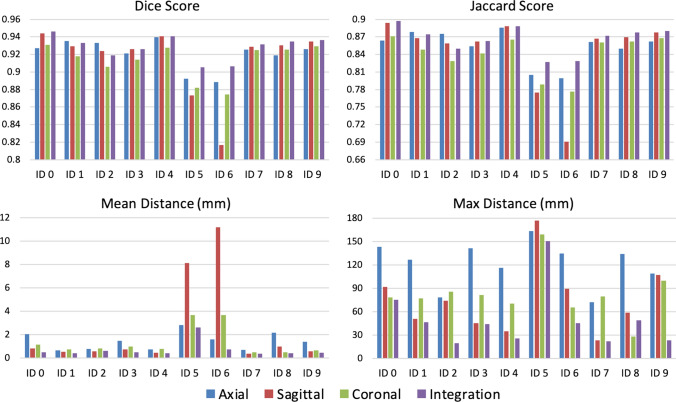
The coarse segmentation performed to identify the aortic lumen achieved a Dice coefficient (DSC) of 0.92 ± 0.01. Single-view axial, sagittal, and coronal CNNs provided a DSC of 0.92 ± 0.02, 0.92 ± 0.04, and 0.91 ± 0.02, respectively. Multi-view integration provided a DSC of 0.93 ± 0.02 and an average surface distance of 0.80 ± 0.26 mm on a test set of 10 CTA scans. The generation of the ground truth dataset took about 150 h and the overall training process took 18 h. In prediction phase, the adopted pipeline takes around 25 ± 1 s to get the final segmentation.
The achieved results show that the proposed pipeline can effectively localize and segment the aortic lumen in subjects with aneurysm.
对比增强计算机断层血管造影(CTA)的定量分析对于评估主动脉解剖结构、识别病变以及在血管外科手术中进行术前规划至关重要。为了克服手动和半自动分割工具的局限性,我们应用基于深度学习的流程来自动分割从升主动脉到髂动脉的主动脉腔CTA扫描图像,同时考虑三维空间连贯性。
首先使用一个卷积神经网络(CNN)在整个下采样的CTA体积中对主动脉进行粗略分割和定位,然后使用三个单视图CNN在更高分辨率下从轴向、矢状和冠状平面有效地分割主动脉腔。最后,将三个正交网络的预测结果进行整合,以获得具有空间连贯性的分割结果。
用于识别主动脉腔的粗略分割的骰子系数(DSC)为0.92±0.01。单视图轴向、矢状和冠状CNN的DSC分别为0.92±0.02、0.92±0.04和0.91±0.02。在一个包含10次CTA扫描的测试集上,多视图整合的DSC为0.93±0.02,平均表面距离为0.80±0.26毫米。生成地面真值数据集耗时约150小时,整个训练过程耗时18小时。在预测阶段,所采用的流程大约需要25±1秒来获得最终分割结果。
所取得的结果表明,所提出的流程能够有效地定位和分割患有动脉瘤患者的主动脉腔。