Department of Internal Medicine, Erasmus University Medical Center, 3015 Rotterdam, The Netherlands.
Department of Epidemiology, Erasmus University Medical Center, 3015 GD Rotterdam, The Netherlands.
Nutrients. 2020 Aug 8;12(8):2377. doi: 10.3390/nu12082377.
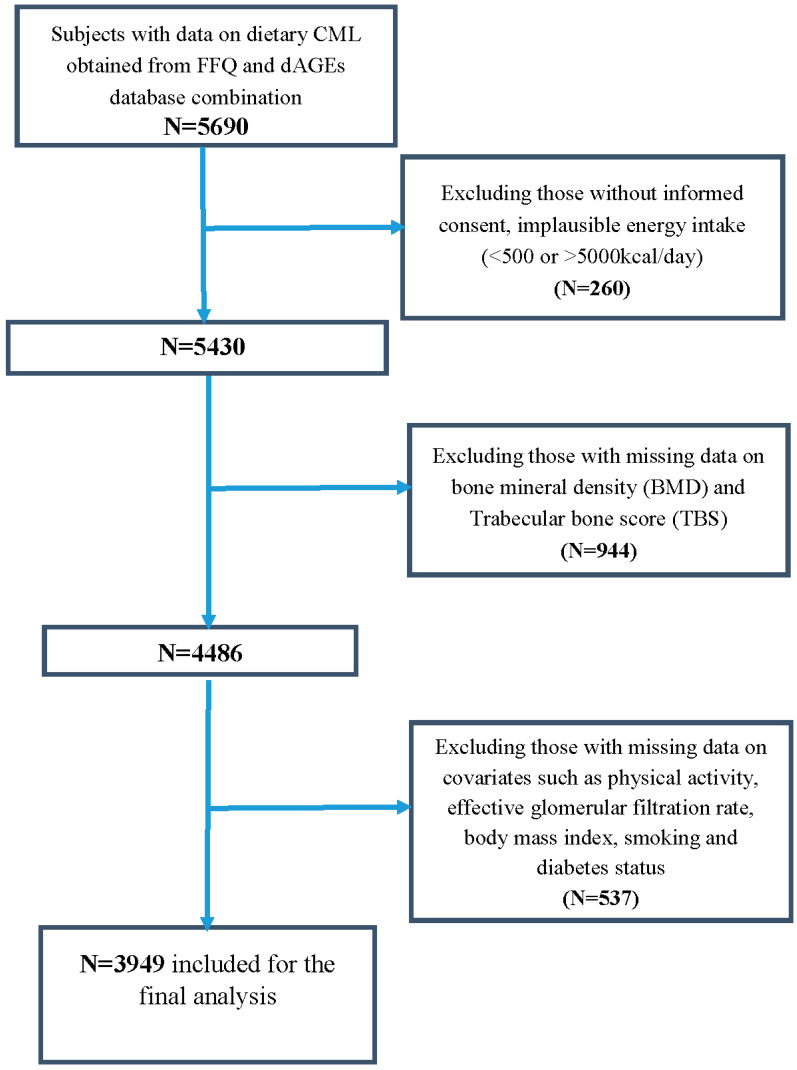
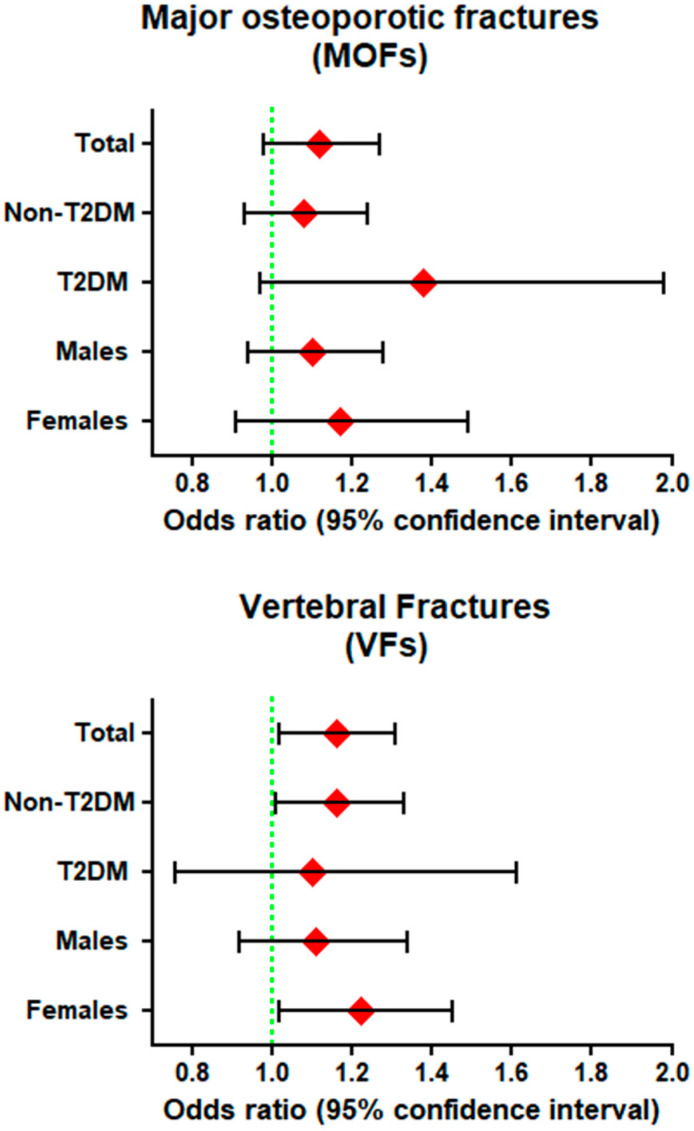
Animal studies suggest a role for dietary advanced glycation end-products (dAGEs) in bone health, but human studies on dAGEs in relation to bone are lacking. We aimed to study whether dAGEs intake is associated with the parameters of bone strength namely, bone mineral density (BMD), prevalent vertebral (VFs), and major osteoporotic fractures (MOFs = hip, wrist, proximal humerus, and clinical VFs). 3949 participants (mean age 66.7 ± 10.5 years) were included from a Rotterdam study for whom Carboxymethyllysine (CML-a dietary AGE) was estimated from food frequency questionnaires combined with dAGEs databases. Multivariable linear and logistic regression models were performed adjusting for age, sex, energy intake, dietary quality, physical activity, diabetes, smoking, renal function, and cohort effect and for models on fractures, subsequently for BMD. We observed no association of CML with BMD at both femoral neck (β = -0.006; = 0.70) and lumbar spine (β = -0.013; = 0.38). A higher intake of CML was linearly associated with VFs (Odds ratio, OR = 1.16, 95% CI (1.02-1.32) and a similar but non-significant trend with MOFs (OR = 1.12 (0.98-1.27). Additional adjustment for BMD did not change the associations. Our results imply a positive association between dietary intake of CML and VFs independent of BMD. Future studies are needed in order to elucidate whether associations found are causal.
动物研究表明,饮食中晚期糖基化终产物(dAGEs)在骨骼健康中起作用,但关于 dAGEs 与骨骼的人类研究还很缺乏。我们旨在研究 dAGEs 的摄入量是否与骨强度参数有关,即骨矿物质密度(BMD)、普遍存在的椎体(VFs)和主要骨质疏松性骨折(MOFs=髋部、腕部、近端肱骨和临床 VFs)。我们从鹿特丹研究中纳入了 3949 名参与者(平均年龄 66.7 ± 10.5 岁),他们的饮食 AGE 羧甲基赖氨酸(CML)是根据食物频率问卷并结合 dAGEs 数据库估算的。多变量线性和逻辑回归模型在调整年龄、性别、能量摄入、饮食质量、体力活动、糖尿病、吸烟、肾功能和队列效应后进行,骨折模型随后调整 BMD。我们没有观察到 CML 与股骨颈(β=-0.006; =0.70)和腰椎(β=-0.013; =0.38)的 BMD 之间存在关联。CML 摄入量较高与 VFs 呈线性相关(比值比,OR=1.16,95%置信区间(1.02-1.32),与 MOFs 也呈类似但无统计学意义的趋势(OR=1.12(0.98-1.27)。进一步调整 BMD 并未改变这些关联。我们的结果表明,饮食中 CML 的摄入与 VFs 之间存在正相关,而与 BMD 无关。需要进一步研究以阐明是否发现的关联具有因果关系。