Department of Psychiatry, Massachusetts General Hospital and Harvard Medical School, Boston, Massachusetts, United States of America.
Channing Division of Network Medicine, Department of Medicine, Brigham and Women's Hospital and Harvard Medical School, Boston, Massachusetts, United States of America.
PLoS One. 2020 Aug 12;15(8):e0237235. doi: 10.1371/journal.pone.0237235. eCollection 2020.
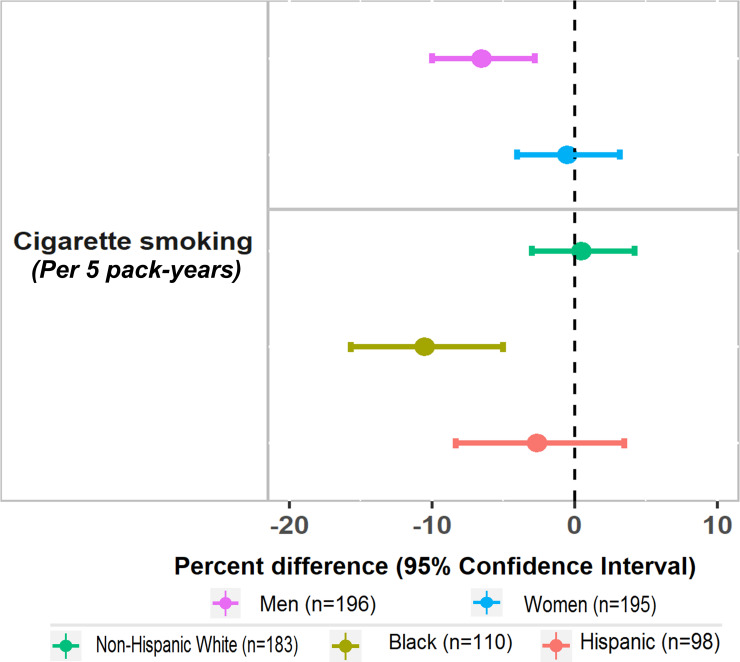
Mitochondrial DNA copy number (mtDNAcn) is a putative biomarker of oxidative stress and biological aging. Modifiable factors, including physical activity (PA), avoidance of heavy alcohol use and smoking, and maintaining good mental health, may reduce oxidative stress and promote healthy aging. Yet, limited data exist regarding how these factors are associated with mtDNAcn or whether age, sex or race/ethnicity moderate associations. In this cross-sectional study, we selected 391 adults (183 non-Hispanic White, 110 Black and 98 Hispanic; mean = 67 years) from the VITAL-DEP (VITamin D and OmegA-3 TriaL-Depression Endpoint Prevention) ancillary to the VITAL trial. We estimated associations between lifestyle and behavioral factors (PA, alcohol consumption, cigarette smoking and depression) and log-transformed mtDNAcn using multivariable linear regression models. MtDNAcn was not correlated with chronological age; women had ~17% higher mtDNAcn compared to men. There were no significant associations between PA measures (frequency, amount or intensity) or alcohol consumption with mtDNAcn. Cigarette smoking (per 5 pack-years) was significantly associated with mtDNAcn (percent difference = -2.9% (95% confidence interval (CI) = -5.4%, -0.4%)); a large contrast was observed among heavy vs. non-smokers (≥30 vs. 0 pack-years): percent difference = -28.5% (95% CI = -44.2%, -8.3%). The estimate of mtDNAcn was suggestively different for past vs. no depression history (percent difference = -15.1% 95% CI = -30.8%, 4.1%), but this difference was not statistically significant. The association between smoking and log-mtDNAcn varied by sex and race/ethnicity; it was stronger in men and Black participants. While chance findings cannot be excluded, results from this study support associations of smoking, but not chronological age, with mtDNAcn and suggest nuanced considerations of mtDNAcn as indicative of varying oxidative stress states vs. biological aging itself.
线粒体 DNA 拷贝数 (mtDNAcn) 是氧化应激和生物衰老的潜在生物标志物。可改变的因素,包括体力活动 (PA)、避免大量饮酒和吸烟以及保持良好的心理健康,可能会减少氧化应激并促进健康衰老。然而,关于这些因素与 mtDNAcn 的关联,以及年龄、性别或种族/民族是否调节这些关联的相关数据有限。在这项横断面研究中,我们从 VITAL-DEP(维生素 D 和欧米加-3 试验-抑郁终点预防)辅助 VITAL 试验中选择了 391 名成年人(183 名非西班牙裔白人、110 名黑人、98 名西班牙裔;平均年龄=67 岁)。我们使用多变量线性回归模型估计了生活方式和行为因素(PA、饮酒、吸烟和抑郁)与对数转换后的 mtDNAcn 之间的关联。mtDNAcn 与实际年龄没有相关性;女性的 mtDNAcn 比男性高约 17%。PA 测量(频率、量或强度)或饮酒与 mtDNAcn 之间没有显著关联。吸烟(每 5 包年)与 mtDNAcn 显著相关(百分比差异=-2.9%(95%置信区间[CI]:-5.4%,-0.4%));重度吸烟者与非吸烟者之间存在显著差异(≥30 包年与 0 包年):百分比差异=-28.5%(95%CI=-44.2%,-8.3%)。过去有抑郁症史与无抑郁症史的 mtDNAcn 估计值差异有提示意义(百分比差异=-15.1%,95%CI=-30.8%,4.1%),但这种差异没有统计学意义。吸烟与 log-mtDNAcn 的关联因性别和种族/民族而异;在男性和黑人参与者中更强。虽然不能排除偶然发现的可能性,但这项研究的结果支持吸烟与 mtDNAcn 的关联,但不支持与实际年龄的关联,并表明需要考虑 mtDNAcn 作为指示不同氧化应激状态而非生物衰老本身的指标。