National Veterinary Institute, Uppsala, Sweden.
Norwegian Veterinary Institute, Oslo, Norway.
PLoS One. 2020 Aug 12;15(8):e0232305. doi: 10.1371/journal.pone.0232305. eCollection 2020.
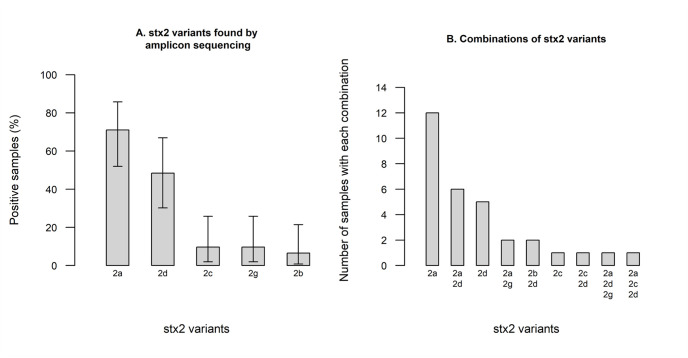
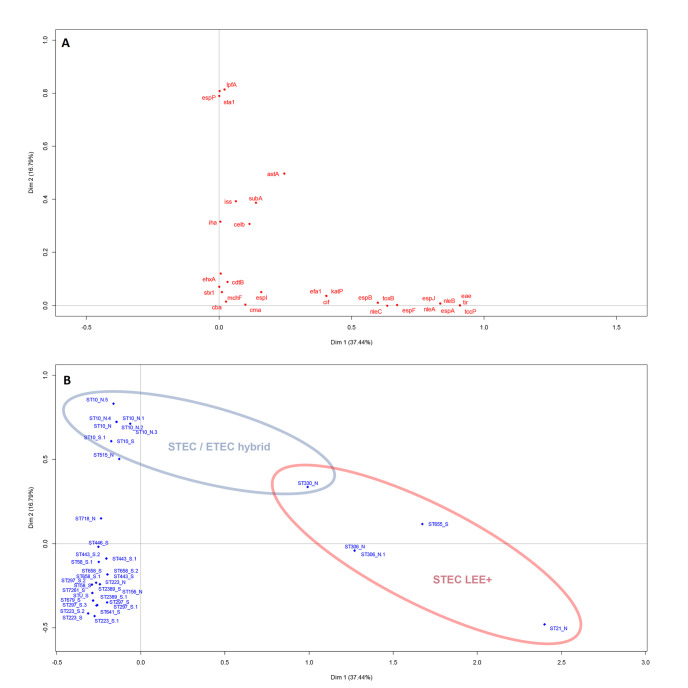
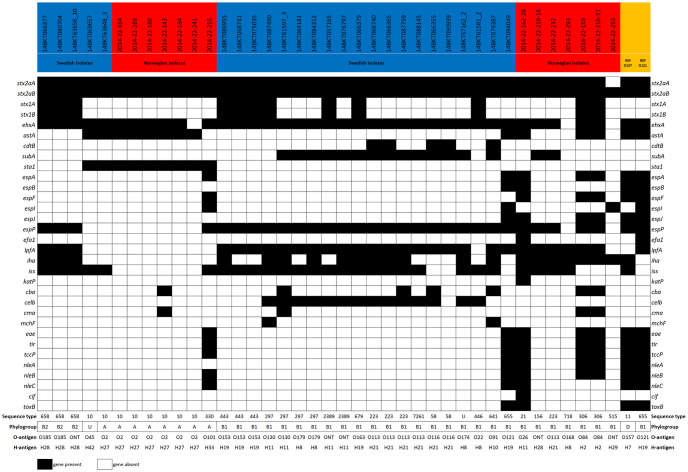
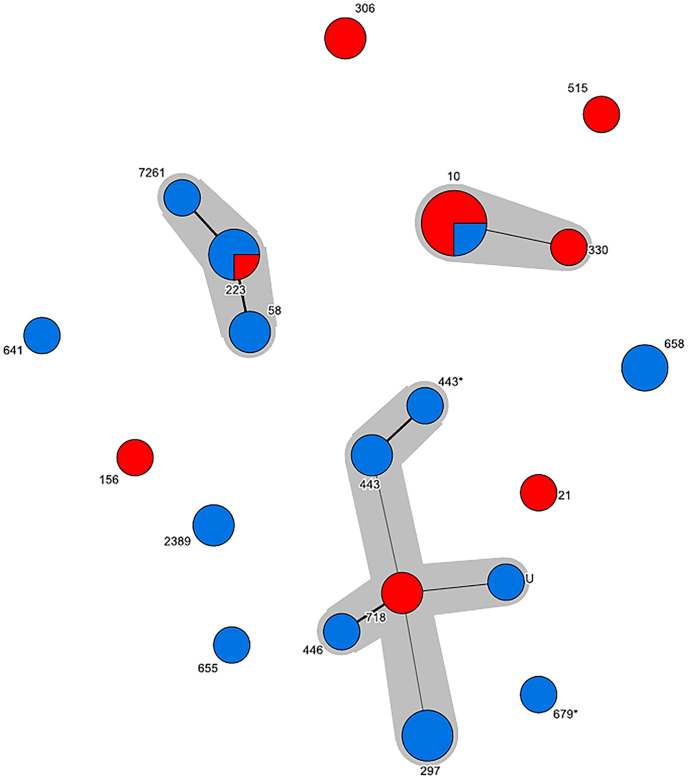
Shiga toxin-producing Escherichia coli (STEC) that cause severe disease predominantly carry the toxin gene variant stx2a. However, the role of Shiga toxin in the ruminant reservoirs of this zoonotic pathogen is poorly understood and strains that cause severe disease in humans (HUSEC) likely constitute a small and atypical subset of the overall STEC flora. The aim of this study was to investigate the presence of stx2a in samples from cattle and to isolate and characterize stx2a-positive E. coli. In nationwide surveys in Sweden and Norway samples were collected from individual cattle or from cattle herds, respectively. Samples were tested for Shiga toxin genes by real-time PCR and amplicon sequencing and stx2a-positive isolates were whole genome sequenced. Among faecal samples from Sweden, stx1 was detected in 37%, stx2 in 53% and stx2a in 5% and in skin (ear) samples in 64%, 79% and 2% respectively. In Norway, 79% of the herds were positive for stx1, 93% for stx2 and 17% for stx2a. Based on amplicon sequencing the most common stx2 types in samples from Swedish cattle were stx2a and stx2d. Multilocus sequence typing (MLST) of 39 stx2a-positive isolates collected from both countries revealed substantial diversity with 19 different sequence types. Only a few classical LEE-positive strains similar to HUSEC were found among the stx2a-positive isolates, notably a single O121:H19 and an O26:H11. Lineages known to include LEE-negative HUSEC were also recovered including, such as O113:H21 (sequence type ST-223), O130:H11 (ST-297), and O101:H33 (ST-330). We conclude that E. coli encoding stx2a in cattle are ranging from strains similar to HUSEC to unknown STEC variants. Comparison of isolates from human HUS cases to related STEC from the ruminant reservoirs can help identify combinations of virulence attributes necessary to cause HUS, as well as provide a better understanding of the routes of infection for rare and emerging pathogenic STEC.
产志贺毒素大肠杆菌(STEC)可引起严重疾病,主要携带毒素基因变体 stx2a。然而,这种人畜共患病病原体在反刍动物宿主中的作用知之甚少,可能导致人类严重疾病的志贺毒素(HUSEC)菌株构成了整个 STEC 菌群的一小部分和非典型子集。本研究旨在调查牛群中 stx2a 的存在情况,并分离和鉴定 stx2a 阳性大肠杆菌。在瑞典和挪威的全国性调查中,分别从个体牛或牛群中采集样本。通过实时 PCR 和扩增子测序检测样品中的志贺毒素基因,stx2a 阳性分离株进行全基因组测序。在瑞典的粪便样本中,stx1 的检出率为 37%,stx2 的检出率为 53%,stx2a 的检出率为 5%;在挪威的皮肤(耳朵)样本中,stx1 的检出率分别为 64%、79%和 2%,stx2 的检出率分别为 53%、93%和 17%。基于扩增子测序,瑞典牛群样本中最常见的 stx2 类型为 stx2a 和 stx2d。对来自两个国家的 39 株 stx2a 阳性分离株进行多位点序列分型(MLST)显示,存在大量多样性,有 19 种不同的序列类型。在 stx2a 阳性分离株中,仅发现少数类似 HUSEC 的经典 LEE 阳性菌株,包括一株 O121:H19 和一株 O26:H11。还恢复了包括 LEE 阴性 HUSEC 在内的已知谱系,包括 O113:H21(ST-223)、O130:H11(ST-297)和 O101:H33(ST-330)。我们得出结论,牛群中编码 stx2a 的大肠杆菌菌株从类似于 HUSEC 的菌株到未知的 STEC 变体不等。将人类 HUS 病例的分离株与来自反刍动物宿主的相关 STEC 进行比较,可以帮助确定引起 HUS 所需的毒力属性组合,同时更好地了解罕见和新兴致病性 STEC 的感染途径。