Dean McGee Eye Institute, Department of Ophthalmology, University of Oklahoma, Oklahoma City, Oklahoma, United States.
Department of Microbiology and Immunology, University of Oklahoma Health Sciences Center, Oklahoma City, Oklahoma, United States.
Invest Ophthalmol Vis Sci. 2020 Aug 3;61(10):24. doi: 10.1167/iovs.61.10.24.
Corneal opacity and neovascularization (NV) are often described as outcomes of severe herpes simplex virus type 1 (HSV-1) infection. The current study investigated the role of colony-stimulating factor 1 receptor (CSF1R)+ cells and soluble factors in the progression of HSV-1-induced corneal NV and opacity.
MaFIA mice were infected with 500 plaque-forming units of HSV-1 in the cornea following scarification. From day 10 to day 13 post-infection (pi), mice were treated with 40 µg/day of AP20187 (macrophage ablation) or vehicle intraperitoneally. For osteopontin (OPN) neutralization experiments, C57BL/6 mice were infected as above and treated with 2 µg of goat anti-mouse OPN or isotypic control IgG subconjunctivally every 2 days from day 4 to day 12 pi. Mice were euthanized on day 14 pi, and tissue was processed for immunohistochemistry to quantify NV and opacity by confocal microscopy and absorbance or detection of pro- and anti-angiogenic and inflammatory factors and cells by suspension array analysis and flow cytometry, respectively.
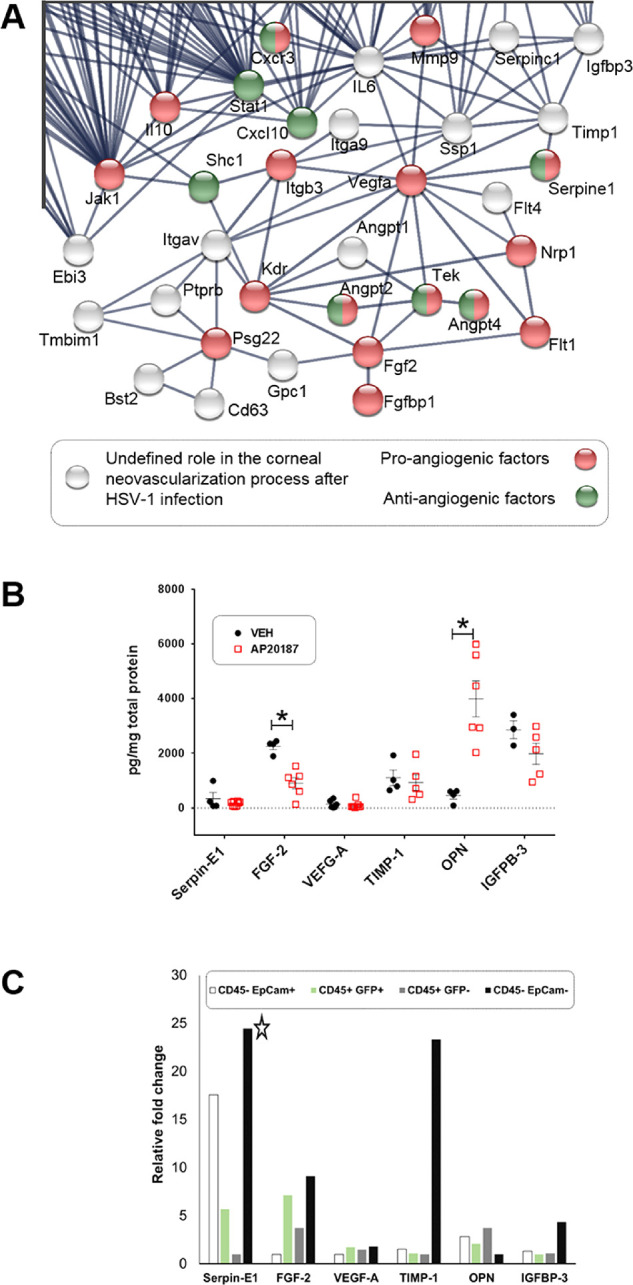
In the absence of CSF1R+ cells, HSV-1-induced blood and lymphatic vessel growth was muted. These results correlated with a loss in fibroblast growth factor type 2 (FGF-2) and an increase in OPN expression in the infected cornea. However, a reduction in OPN expression in mice did not alter corneal NV but significantly reduced opacity.
Our data suggest that CSF1R+ cell depletion results in a significant reduction in HSV-1-induced corneal NV that correlates with the loss of FGF-2 expression. A reduction in OPN expression was aligned with a significant drop in opacity associated with reduced corneal collagen disruption.
角膜混浊和新生血管(NV)常被描述为单纯疱疹病毒 1 型(HSV-1)严重感染的结果。本研究探讨了集落刺激因子 1 受体(CSF1R)+细胞和可溶性因子在 HSV-1 诱导的角膜 NV 和混浊进展中的作用。
MaFIA 小鼠经划痕后在角膜中感染 500 噬菌斑形成单位的 HSV-1。感染后第 10 天至第 13 天,小鼠每天腹膜内给予 40μg/天的 AP20187(巨噬细胞消融)或载体。为了进行骨桥蛋白(OPN)中和实验,如上所述感染 C57BL/6 小鼠,并从感染后第 4 天至第 12 天每 2 天通过结膜下给予 2μg 山羊抗小鼠 OPN 或同种型对照 IgG。感染后第 14 天处死小鼠,通过共聚焦显微镜对 NV 和混浊进行免疫组织化学量化,并通过悬浮阵列分析和流式细胞术分别检测前血管生成、抗血管生成和炎症因子和细胞。
在缺乏 CSF1R+细胞的情况下,HSV-1 诱导的血液和淋巴管生长减弱。这些结果与感染角膜中成纤维细胞生长因子 2(FGF-2)的丧失和 OPN 表达的增加相关。然而,在小鼠中降低 OPN 表达并没有改变角膜 NV,但显著降低了混浊度。
我们的数据表明,CSF1R+细胞耗竭导致 HSV-1 诱导的角膜 NV 显著减少,这与 FGF-2 表达的丧失相关。OPN 表达的减少与与角膜胶原破坏减少相关的显著混浊度下降相关。