Cancer Prevention and Control, Fox Chase Cancer Center, Philadelphia, Pennsylvania, United States of America.
Department of Clinical Genetics, Fox Chase Cancer Center, Philadelphia, Pennsylvania, United States of America.
PLoS One. 2020 Aug 13;15(8):e0237332. doi: 10.1371/journal.pone.0237332. eCollection 2020.
Neighborhood socioeconomic (nSES) factors have been implicated in prostate cancer (PCa) disparities. In line with the Precision Medicine Initiative that suggests clinical and socioenvironmental factors can impact PCa outcomes, we determined whether nSES variables are associated with time to PCa diagnosis and could inform PCa clinical risk assessment.
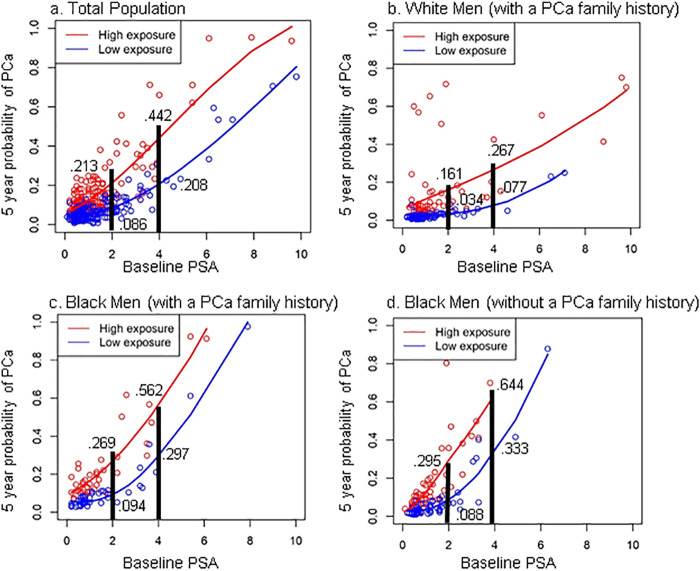
The study sample included 358 high risk men (PCa family history and/or Black race), aged 35-69 years, enrolled in an early detection program. Patient variables were linked to 78 nSES variables (employment, income, etc.) from previous literature via geocoding. Patient-level models, including baseline age, prostate specific antigen (PSA), digital rectal exam, as well as combined models (patient plus nSES variables) by race/PCa family history subgroups were built after variable reduction methods using Cox regression and LASSO machine-learning. Model fit of patient and combined models (AIC) were compared; p-values<0.05 were significant. Model-based high/low nSES exposure scores were calculated and the 5-year predicted probability of PCa was plotted against PSA by high/low neighborhood score to preliminarily assess clinical relevance.
In combined models, nSES variables were significantly associated with time to PCa diagnosis. Workers mode of transportation and low income were significant in White men with a PCa family history. Homeownership (%owner-occupied houses with >3 bedrooms) and unemployment were significant in Black men with and without a PCa family history, respectively. The 5-year predicted probability of PCa was higher in men with a high neighborhood score (weighted combination of significant nSES variables) compared to a low score (e.g., Baseline PSA level of 4ng/mL for men with PCa family history: White-26.7% vs 7.7%; Black-56.2% vs 29.7%).
Utilizing neighborhood data during patient risk assessment may be useful for high risk men affected by disparities. However, future studies with larger samples and validation/replication steps are needed.
邻里社会经济(nSES)因素与前列腺癌(PCa)的差异有关。根据精准医学倡议,临床和社会环境因素会影响 PCa 的结果,我们确定 nSES 变量是否与 PCa 的诊断时间相关,并为 PCa 的临床风险评估提供信息。
研究样本包括 358 名高危男性(有 PCa 家族史和/或黑人种族),年龄在 35-69 岁之间,参加了早期检测计划。通过地理编码,将患者变量与来自之前文献的 78 个 nSES 变量(就业、收入等)相关联。在使用 Cox 回归和 LASSO 机器学习进行变量缩减方法后,建立了患者水平模型,包括基线年龄、前列腺特异性抗原(PSA)、直肠指检,以及按种族/PCa 家族史亚组的联合模型(患者加 nSES 变量)。比较了患者和联合模型的模型拟合(AIC);p 值<0.05 为显著。计算了基于模型的高/低 nSES 暴露评分,并根据高/低邻里评分绘制了 5 年预测的 PCa 概率与 PSA 的关系,初步评估临床相关性。
在联合模型中,nSES 变量与 PCa 诊断时间显著相关。有 PCa 家族史的白人男性中,工作交通方式和低收入是显著的。有和没有 PCa 家族史的黑人男性中,住房拥有率(拥有>3 间卧室的业主自住房屋的百分比)和失业是显著的。与低评分相比,高邻里评分(显著 nSES 变量的加权组合)的男性 5 年预测 PCa 概率更高(例如,有 PCa 家族史的男性 PSA 基线水平为 4ng/mL:白人-26.7%比 7.7%;黑人-56.2%比 29.7%)。
在患者风险评估中利用邻里数据可能对受差异影响的高危男性有用。然而,需要进行具有更大样本量和验证/复制步骤的未来研究。