Branham Sandra E, Daley James, Levi Amnon, Hassell Richard, Wechter W Patrick
U.S. Vegetable Laboratory, Agricultural Research Service, U.S. Department of Agriculture, Charleston, SC, United States.
Coastal Research and Education Center, Clemson University, Charleston, SC, United States.
Front Plant Sci. 2020 Jul 22;11:1097. doi: 10.3389/fpls.2020.01097. eCollection 2020.
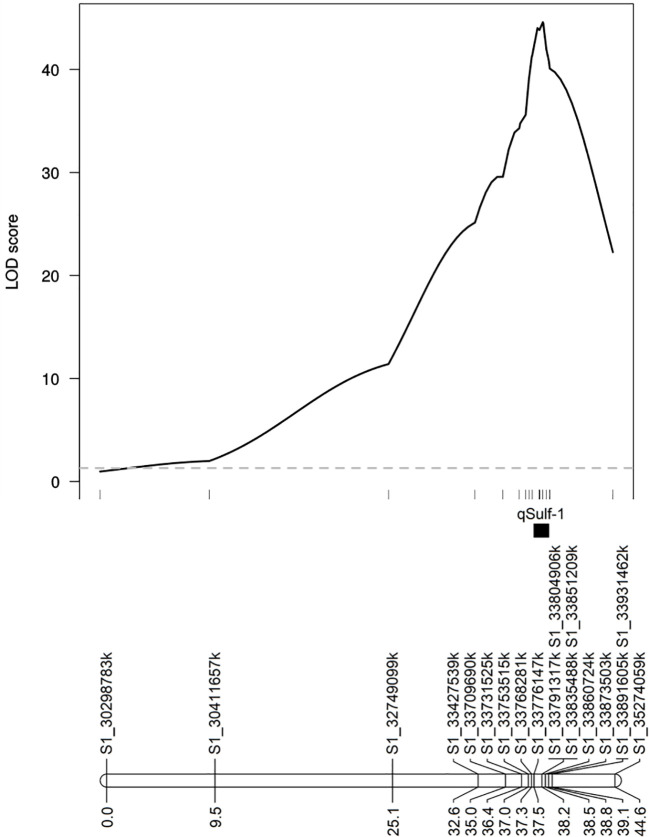
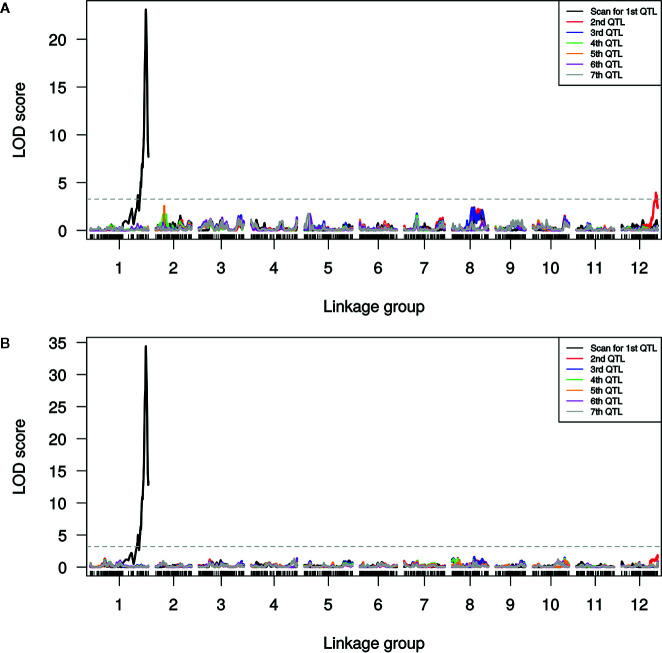
Elemental sulfur is an effective, inexpensive fungicide for many foliar pathogens, but severe phytotoxicity prohibits its use on many melon varieties. Sulfur phytotoxicity causes chlorosis and necrosis of leaf tissue, leading to plant death in the most sensitive lines, while other varieties have little to no damage. A high-density, genotyping-by-sequencing (GBS)-based genetic map of a recombinant inbred line (RIL) population segregating for sulfur tolerance was used for a quantitative trait loci (QTL) mapping study of sulfur phytotoxicity in melon. One major (qSulf-1) and two minor (qSulf-8 and qSulf-12) QTL were associated with sulfur tolerance in the population. The development of Kompetitive Allele-Specific PCR (KASP) markers developed across qSulf-1 decreased the QTL interval from 239 kb (cotyledons) and 157 kb (leaves) to 97 kb (both tissues). The markers were validated for linkage to sulfur tolerance in a set of melon cultivars. These KASP markers can be incorporated into melon breeding programs for introgression of sulfur tolerance into elite melon germplasm.
元素硫对许多叶部病原菌是一种有效且廉价的杀菌剂,但严重的植物毒性使其无法用于许多甜瓜品种。硫的植物毒性会导致叶片组织黄化和坏死,在最敏感的品系中会导致植株死亡,而其他品种几乎没有损害。利用一个基于测序的高密度基因分型(GBS)重组自交系(RIL)群体遗传图谱,该群体在硫耐受性方面存在分离,对甜瓜硫植物毒性进行数量性状位点(QTL)定位研究。该群体中有一个主要QTL(qSulf-1)和两个次要QTL(qSulf-8和qSulf-12)与硫耐受性相关。跨qSulf-1开发的竞争性等位基因特异性PCR(KASP)标记将QTL区间从239 kb(子叶)和157 kb(叶片)缩小到97 kb(两种组织)。这些标记在一组甜瓜品种中被验证与硫耐受性连锁。这些KASP标记可纳入甜瓜育种计划,以便将硫耐受性导入优良甜瓜种质。