Department of Clinical Nutrition & Dietetics, National Nutrition, and Food Technology Research Institute, Faculty of Nutrition Sciences and Food Technology, Shahid Beheshti University of Medical Sciences, No. 7, Hafezi St., Farahzadi Blvd., Qods Town, Tehran, Iran.
Cardiovascular Intervention Research Center, Rajaie Cardiovascular, Medical & Research Center, Iran University of Medical Sciences, Tehran, Iran.
Lipids Health Dis. 2020 Aug 14;19(1):183. doi: 10.1186/s12944-020-01362-z.
The potential cardioprotective benefits of olive oil (OO) and canola oil (CO) consumption have been shown in some studies. The present study compared the effects of CO and OO on plasma lipids, some inflammatory cytokines, and lipoprotein-associated phospholipase A (Lp-PLA) mass and activity in patients undergoing coronary angiography.
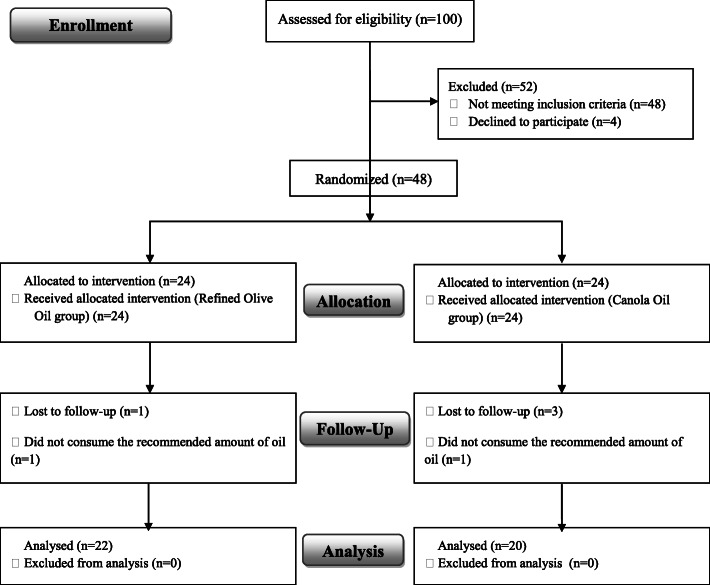
The current randomized, controlled, parallel-arm, clinical trial involved 48 patients (44 men and 4 women, aged 57.63 ± 6.34 years) with at least one classic cardiovascular risk factor (hypertension, dyslipidemia, or diabetes) who referred for coronary angiography. Patients were randomly divided into two groups and received 25 mL/day refined olive oil (n = 24) or canola oil (n = 24) for 6 weeks. Plasma lipids, some selected inflammatory markers, and Lp-PLA levels were measured at baseline and after the intervention.
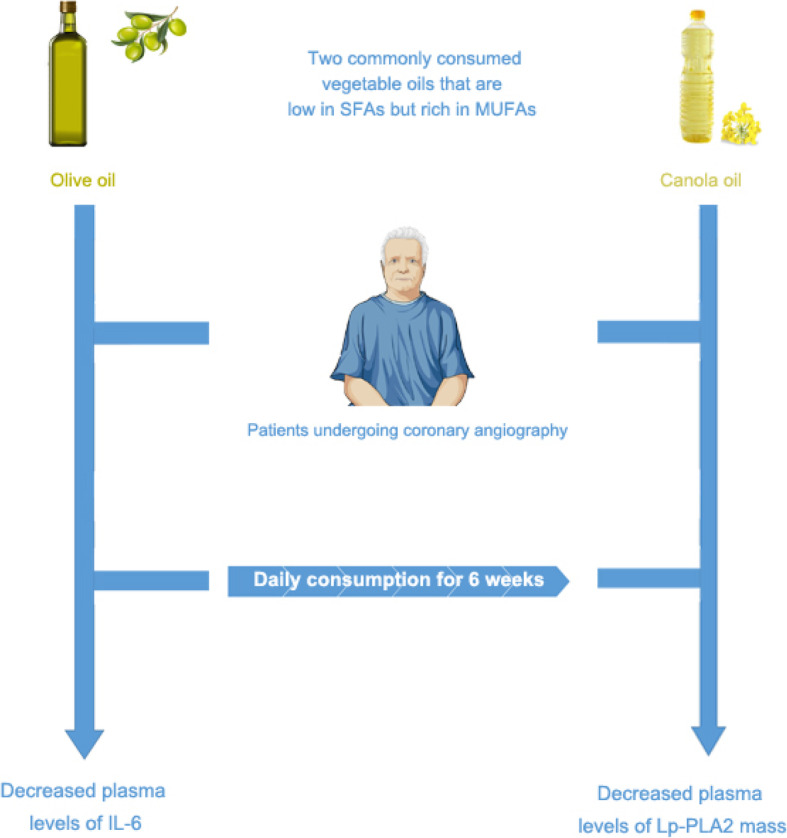
CO consumption produced a significant reduction in plasma Lp-PLA mass (- 0.97 ± 1.84 vs. 0.34 ± 1.57 ng/mL, p = 0.008 for CO and OO, respectively), whereas the mean changes in interleukine-6 concentration were significantly lower after OO consumption compared with CO (- 9.46 ± 9.46 vs. -0.90 ± 6.80 pg/mL, p = 0.008 for OO and CO, respectively). After 6 weeks of intervention, no significant changes were observed in plasma Lp-PLA activity, complement C3, C4, or lipid profiles in the two intervention groups.
Comparing the two vegetable oils in subjects with cardiovascular risk factors showed that the consumption of olive oil is more effective in reducing the level of inflammatory cytokine interleukine-6, whereas canola oil was more effective in lowering Lp-PLA levels; however, this finding should be interpreted with caution, because Lp-PLA activity did not change significantly.
IRCT20160702028742N5 at www.irct.ir (04/19/2019).
一些研究表明,橄榄油(OO)和菜籽油(CO)的潜在心脏保护益处。本研究比较了 CO 和 OO 对行冠状动脉造影术的患者的血浆脂质、一些炎症细胞因子以及脂蛋白相关磷脂酶 A(Lp-PLA)质量和活性的影响。
本随机、对照、平行臂临床试验纳入了 48 名患者(44 名男性和 4 名女性,年龄 57.63±6.34 岁),他们至少有一种经典的心血管危险因素(高血压、血脂异常或糖尿病),并接受冠状动脉造影。患者随机分为两组,每天分别接受 25ml 精制橄榄油(n=24)或菜籽油(n=24),持续 6 周。在基线和干预后测量血浆脂质、一些选定的炎症标志物和 Lp-PLA 水平。
CO 摄入可显著降低血浆 Lp-PLA 质量(-0.97±1.84 vs. 0.34±1.57ng/ml,CO 和 OO 分别为 p=0.008),而 OO 摄入后白细胞介素-6 浓度的平均变化明显低于 CO(-9.46±9.46 vs. -0.90±6.80pg/ml,OO 和 CO 分别为 p=0.008)。干预 6 周后,两组干预措施均未观察到血浆 Lp-PLA 活性、补体 C3、C4 或脂质谱的显著变化。
在具有心血管危险因素的受试者中比较两种植物油发现,橄榄油的摄入在降低炎症细胞因子白细胞介素-6 水平方面更有效,而菜籽油在降低 Lp-PLA 水平方面更有效;然而,由于 Lp-PLA 活性没有明显变化,因此应谨慎解释这一发现。
IRCT20160702028742N5 在 www.irct.ir(2019 年 4 月 19 日)。