Yahay Maryam, Heidari Zahra, Allameh Zahra, Amani Reza
Nutrition and Food Sciences, Isfahan University of Medical Sciences, Isfahan, Iran.
Metabolic Liver Disease Research Center, Isfahan University of Medical Sciences, Isfahan, Iran.
Lipids Health Dis. 2021 Jan 29;20(1):7. doi: 10.1186/s12944-021-01433-9.
Polycystic Ovarian Syndrome (PCOS) is one of the most common endocrinopathies and metabolic disorders in women during their reproductive years. It is often associated with dyslipidemia and other risk factors of cardiovascular diseases (CVD). This study was aimed to evaluate dietary intervention effects with canola and olive oils compared to sunflower oil on lipid profile and fatty liver severity among women with PCOS.
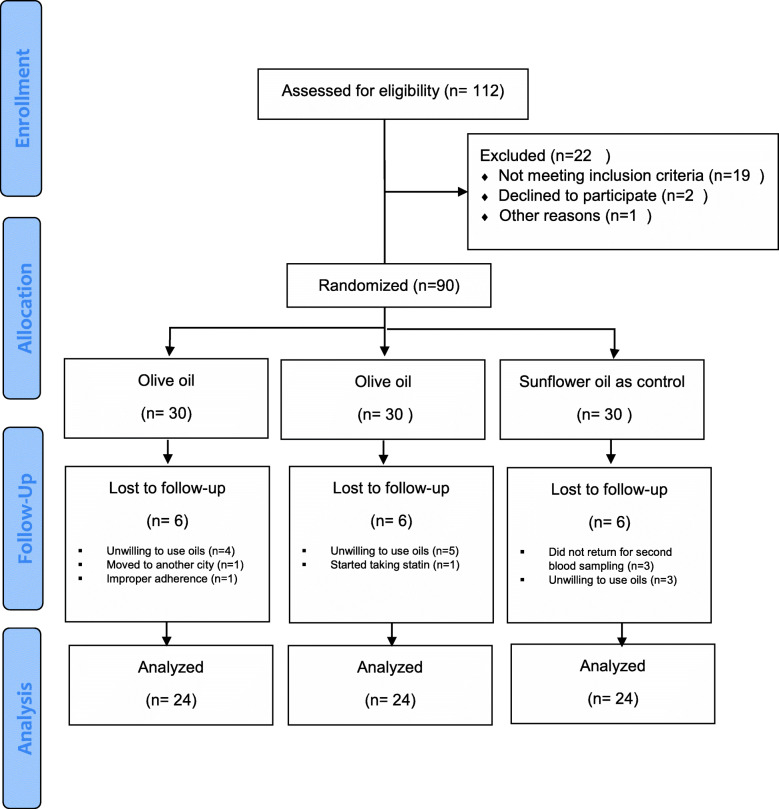
This study was a 10-week intervention including 72 women with PCOS. Patients were randomly assigned to three groups for receiving 25 g/day canola, olive, or sunflower oils for 10 weeks. The primary and secondary outcomes were to assess changes in lipid profile and in fatty liver severity, respectively.
At the end of the study, 72 patients with a mean age of 29.31 were analysed. Canola oil consumption resulted in a significant reduction in serum levels of TG (P = 0.002) and TC/HDL (P = 0.021), LDL/HDL (P = 0.047), and TG/HDL (P = 0.001) ratios, however, there was no significant reduction in lipid profile following olive oil consumption. Canola (P < 0.001) and olive oils (P = 0.005) could significantly reduce the fatty liver grade. Moreover, HOMA-IR in both canola (P < 0.001) and olive (P = 0.004) groups was significantly decreased.
In total, compared to olive and sunflower oils, significant improvements in lipid profile, liver function, and HOMA-IR were observed following canola oil consumption in women with PCOS.
IR.MUI.
REC.1397.315. Registered 30 JUNE 2019 - Retrospectively registered, https://www.irct.ir/trial/38684.
多囊卵巢综合征(PCOS)是育龄期女性最常见的内分泌疾病和代谢紊乱之一。它常与血脂异常及其他心血管疾病(CVD)风险因素相关。本研究旨在评估与葵花籽油相比,食用菜籽油和橄榄油对PCOS女性血脂谱及脂肪肝严重程度的饮食干预效果。
本研究为一项为期10周的干预研究,纳入72例PCOS女性。患者被随机分为三组,分别接受每天25克菜籽油、橄榄油或葵花籽油,持续10周。主要和次要结局分别是评估血脂谱变化和脂肪肝严重程度变化。
研究结束时,分析了72例平均年龄为29.31岁的患者。食用菜籽油可使血清甘油三酯(TG)水平(P = 0.002)、总胆固醇/高密度脂蛋白(TC/HDL)(P = 0.021)、低密度脂蛋白/高密度脂蛋白(LDL/HDL)(P = 0.047)和甘油三酯/高密度脂蛋白(TG/HDL)(P = 0.001)比值显著降低,然而,食用橄榄油后血脂谱无显著降低。菜籽油(P < 0.001)和橄榄油(P = 0.005)均可显著降低脂肪肝等级。此外,菜籽油组(P < 0.001)和橄榄油组(P = 0.004)的胰岛素抵抗指数(HOMA-IR)均显著降低。
总体而言,与橄榄油和葵花籽油相比,PCOS女性食用菜籽油后血脂谱、肝功能和HOMA-IR有显著改善。
IR.MUI.REC.1397.315。于2019年6月30日注册——回顾性注册,https://www.irct.ir/trial/38684。