Dept of Anaesthesiology, Critical Care and Pain Medicine, Greifswald University Medical Centre, Greifswald, Germany.
Emergency Medical Services of the Hradec Kralove Region, Hradec Kralove, Czech Republic.
Scand J Trauma Resusc Emerg Med. 2020 Aug 14;28(1):79. doi: 10.1186/s13049-020-00774-1.
Blood products are a lifesaving commodity in the treatment of major trauma. Although there is little evidence for use of pre-hospital blood products (PHBP) in seriously injured patients, an increasing number of emergency medical services have started using PHBP for treatment of major haemorrhage. The primary aim of this survey was to establish the degree of prehospital blood product use throughout Europe and discover main indications. The secondary aim was to evaluate opinions about PHBP and also the experience and the personal views of its users.
The subcommittee for Critical Emergency Medicine of the European Society of Anaesthesiology (ESA) held an online survey of European Helicopter Emergency Services (HEMS) and all French Services d'Aide Médicale Urgente (SAMU) regions. It contained 13 questions both open and multiple-choice about the frequency transfusions are carried out, the PHBP used and the perceived benefit. The survey was distributed to the corresponding HEMS leads in 14 European countries.
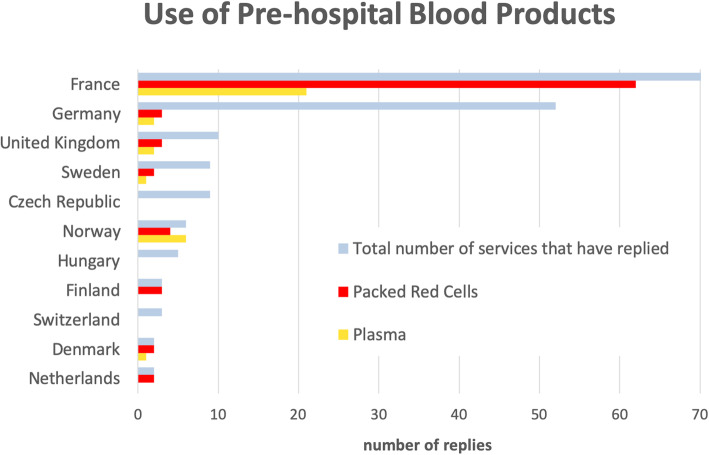
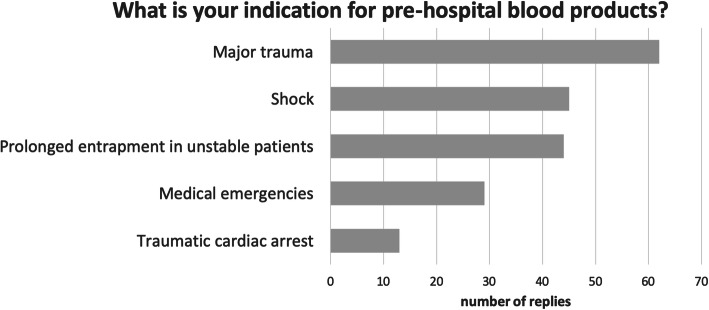
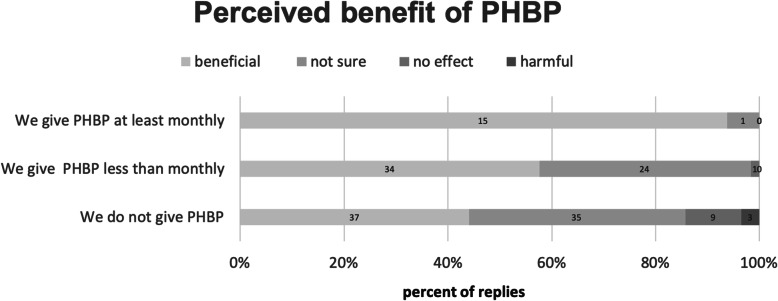
In total there were 172 valid responses; overall 48% of all respondents have prehospital access to packed red cells, 22% to fresh plasma and 14% use lyophilised plasma. Besides blood product administration, 94% of all services use tranexamic acid. Sixty five percent of all replies came from French and from German services (37 and 28% respectively). PHBP were mainly used for trauma related emergencies. France has the highest uptake of use of blood products at 89%, whereas the rate in Germany was far lower at 6%. Fifty five percent of the service leads felt that PHBP are beneficial, and even lifesaving in individual cases despite being needed infrequently.
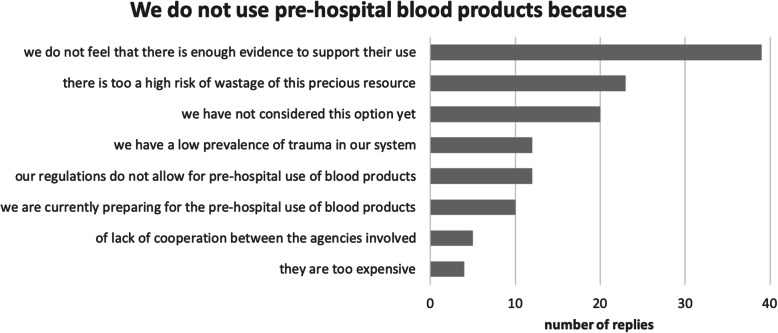
We found remarkable dissimilarities in practice between the different European countries. Even if there is not an absolute consensus amongst providers on the benefit of PHBP, the majority feel they are beneficial. The difference in practice is possibly related to the perceived lack of evidence on prehospital blood transfusion. We suggest to include the use of PHBP in trauma registries in order to consolidate the existing evidence.
血液制品是治疗重大创伤的救命商品。尽管在严重受伤的患者中使用院前血液制品(PHBP)的证据很少,但越来越多的紧急医疗服务机构开始使用 PHBP 治疗大出血。本次调查的主要目的是确定欧洲各地院前血液制品使用的程度,并发现主要的适应证。次要目的是评估对 PHBP 的看法,以及其使用者的经验和个人意见。
欧洲麻醉学会(ESA)危重病医学小组委员会对欧洲直升机紧急服务(HEMS)和所有法国紧急医疗援助服务(SAMU)地区进行了在线调查。它包含了 13 个关于输血频率、使用的 PHBP 和感知益处的开放性和多项选择题。该调查分发给了 14 个欧洲国家的相应 HEMS 负责人。
共有 172 份有效回复;总体而言,48%的受访者可在院前获得浓缩红细胞,22%可获得新鲜血浆,14%可使用冻干血浆。除了血液制品的使用,94%的服务都使用氨甲环酸。所有回复中有 65%来自法国和德国的服务(分别为 89%和 28%)。PHBP 主要用于与创伤相关的紧急情况。法国的血液制品使用率最高,为 89%,而德国的使用率则低得多,为 6%。55%的服务负责人认为 PHBP 在某些情况下是有益的,甚至是救命的,尽管它们的使用频率较低。
我们发现不同欧洲国家的实践之间存在显著差异。即使提供者对 PHBP 的益处没有绝对的共识,但大多数人认为它们是有益的。实践上的差异可能与院前输血缺乏证据有关。我们建议将 PHBP 的使用纳入创伤登记处,以巩固现有的证据。