Jin Qingping, Chen Peixia, Gao Yonghong, Du Aihua, Liu Dongxu, Sun Lizhi
School of Urban Construction, Wuhan University of Science and Technology, Wuhan 430065, China.
School of Civil Engineering, Shandong Jianzhu University, Jinan 250101, China.
Materials (Basel). 2020 Aug 11;13(16):3533. doi: 10.3390/ma13163533.
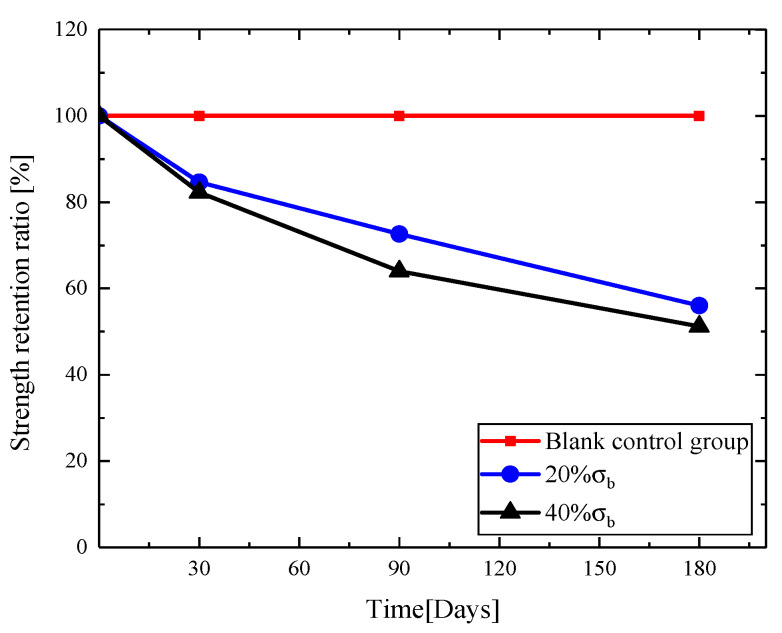
Mechanical properties of glass fiber reinforced polymer (GFRP) composites degrade under the combined effects of mechanical load and alkaline solution, affecting the service ability and safety of GFRP reinforced structures. In this study, GFRP bars were loaded with cyclic tension at different stress levels and immersed in alkaline solution for days to investigate the tensile properties and degradation law of GFRP bars. The degradation mechanisms were studied at micro-, meso- and macro-scales with scanning electron microscopy (SEM) and three-dimensional X-ray microscopy, respectively. The results show that tensile strength and degradation rate of GFRP bars are mainly dependent on the different stress levels and alkaline solution. When stress level is higher, the tensile strength degrades more quickly, especially in the early stages of soaking. With the loading and immersion time, the elastic modulus and Poisson's ratio increase at first and then decrease. The ultimate tensile strain is relatively stable, whereas the ultimate elongation is significantly reduced. A strength-degradation model was proposed and fit well with experimental data, demonstrating that the model can be applied to predict tensile strength degradation under combined effects of the load and alkaline solution.
玻璃纤维增强聚合物(GFRP)复合材料的力学性能在机械载荷和碱性溶液的共同作用下会退化,这会影响GFRP增强结构的使用性能和安全性。在本研究中,对GFRP筋在不同应力水平下进行循环拉伸加载,并将其浸泡在碱性溶液中数天,以研究GFRP筋的拉伸性能和退化规律。分别利用扫描电子显微镜(SEM)和三维X射线显微镜在微观、细观和宏观尺度上研究了其退化机理。结果表明,GFRP筋的抗拉强度和退化速率主要取决于不同的应力水平和碱性溶液。当应力水平较高时,抗拉强度退化更快,尤其是在浸泡初期。随着加载和浸泡时间的增加,弹性模量和泊松比先增大后减小。极限拉伸应变相对稳定,而极限伸长率显著降低。提出了一个强度退化模型,该模型与实验数据拟合良好,表明该模型可用于预测在载荷和碱性溶液共同作用下的抗拉强度退化。