Zhang Yuanjun, Yan Zishen, Xia Xingyu, Lin Yuan
HKU-Shenzhen Institute of Research and Innovation (HKU-SIRI), Guangdong 518057, China.
Department of Mechanical Engineering, The University of Hong Kong, Hong Kong SAR, China.
Micromachines (Basel). 2020 Aug 11;11(8):767. doi: 10.3390/mi11080767.
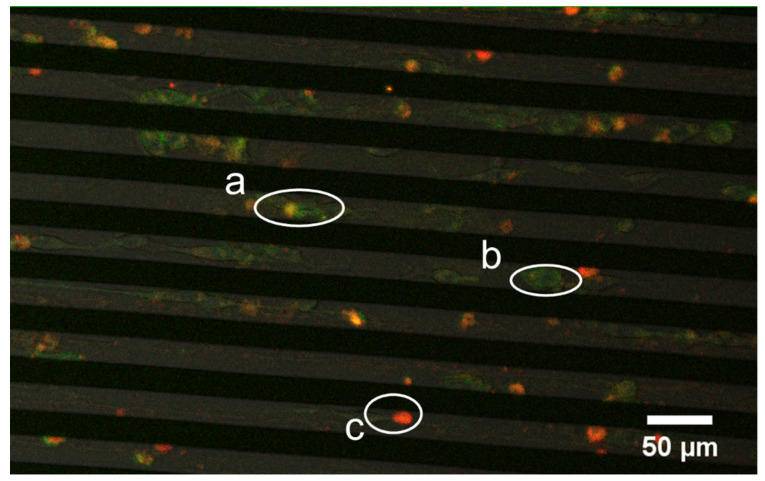
A novel electroporation system was developed to introduce transient membrane pores to cells in a spatially and temporally controlled manner, allowing us to achieve fast electrotransfection and live cell staining as well as to systematically interrogate the dynamics of the cell membrane. Specifically, using this platform, we showed that both reversible and irreversible electroporation could be induced in the cell population, with nano-sized membrane pores in the former case being able to self-reseal in ~10 min. In addition, green fluorescent protein(GFP)-vinculin plasmid and 543 phalloidin have been delivered successively into fibroblast cells, which enables us to monitor the distinct roles of vinculin and F-actin in cell adhesion and migration as well as their possible interplay during these processes. Compared to conventional bulk electroporation and staining methods, the new system offers advantages such as low-voltage operation, cellular level manipulation and testing, fast and adjustable transfection/staining and real-time monitoring; the new system therefore could be useful in different biophysical studies in the future.
我们开发了一种新型电穿孔系统,能够以空间和时间可控的方式在细胞中引入瞬时膜孔,这使我们能够实现快速电转染和活细胞染色,并系统地探究细胞膜的动力学。具体而言,利用该平台,我们发现细胞群体中既可以诱导可逆电穿孔,也可以诱导不可逆电穿孔,在前一种情况下,纳米级的膜孔能够在约10分钟内自行封闭。此外,绿色荧光蛋白(GFP)-纽蛋白质粒和543鬼笔环肽已先后导入成纤维细胞,这使我们能够监测纽蛋白和F-肌动蛋白在细胞黏附和迁移中的不同作用,以及它们在这些过程中可能的相互作用。与传统的批量电穿孔和染色方法相比,新系统具有低电压操作、细胞水平操作和测试、快速且可调节的转染/染色以及实时监测等优点;因此,新系统在未来不同的生物物理研究中可能会很有用。