Faculty of Mechanical Engineering, Micro- and Nanofluidics Laboratory, Technion-Israel Institute of Technology, Haifa 32000, Israel.
Technion Integrated Cancer Center, Rappaport Faculty of Medicine and Research Institute, Technion-Israel Institute of Technology, Haifa 3109602, Israel.
Sci Adv. 2020 Jan 29;6(5):eaay4412. doi: 10.1126/sciadv.aay4412. eCollection 2020 Jan.
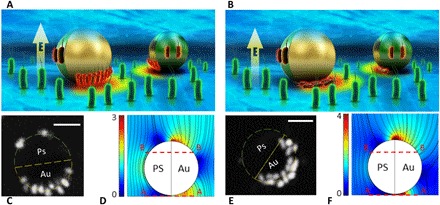
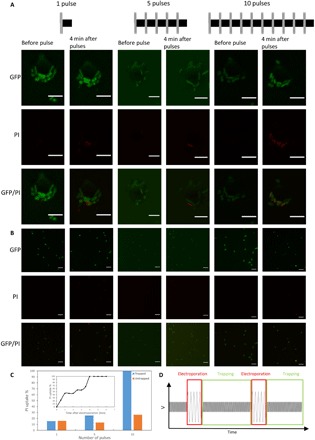
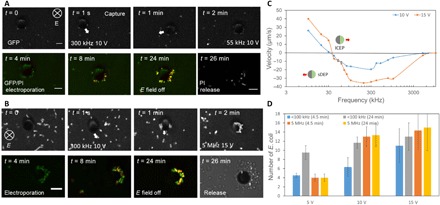
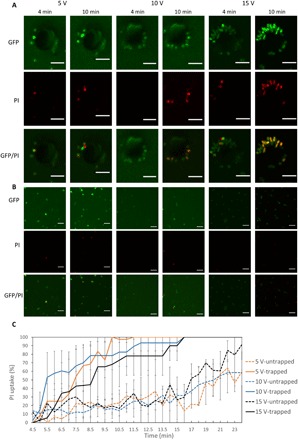
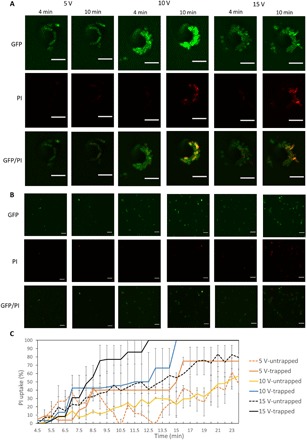
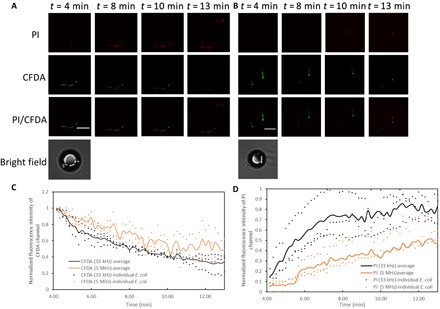
Self-propelling micromotors are emerging as a promising micro- and nanoscale tool for single-cell analysis. We have recently shown that the field gradients necessary to manipulate matter via dielectrophoresis can be induced at the surface of a polarizable active ("self-propelling") metallodielectric Janus particle (JP) under an externally applied electric field, acting essentially as a mobile floating microelectrode. Here, we successfully demonstrated that the application of an external electric field can singularly trap and transport bacteria and can selectively electroporate the trapped bacteria. Selective electroporation, enabled by the local intensification of the electric field induced by the JP, was obtained under both continuous alternating current and pulsed signal conditions. This approach is generic and applicable to bacteria and JP, as well as a wide range of cell types and micromotor designs. Hence, it constitutes an important and novel experimental tool for single-cell analysis and targeted delivery.
自主推进的微马达作为一种有前途的微纳尺度工具,正在出现,用于单细胞分析。我们最近表明,通过介电泳操纵物质所需的场梯度可以在外加电场作用下在可极化活性(“自主推进”)的金属电介质詹纳斯粒子(JP)的表面上诱导,实际上充当可移动的浮动微电极。在这里,我们成功地证明了施加外部电场可以单独捕获和运输细菌,并可以选择性地电穿孔捕获的细菌。通过 JP 诱导的电场的局部强化来实现选择性电穿孔,在连续交流和脉冲信号条件下都可以获得。这种方法是通用的,适用于细菌和 JP,以及广泛的细胞类型和微马达设计。因此,它构成了单细胞分析和靶向递送的重要和新颖的实验工具。