College of Animal Science and Technology, Hunan Agricultural University, Changsha, Hunan, China.
Biostatistics and Bioinformatics, Neogen GeneSeek, Lincoln, NE, United States of America.
PLoS One. 2020 Aug 14;15(8):e0236629. doi: 10.1371/journal.pone.0236629. eCollection 2020.
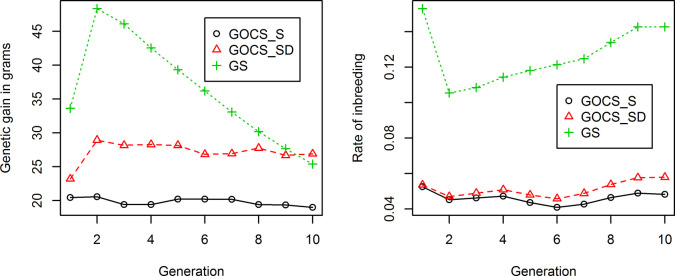
An important economic reason for the loss of local breeds is that they tend to be less productive, and hence having less market value than commercial breeds. Nevertheless, local breeds often have irreplaceable values, genetically and sociologically. In the breeding programs with local breeds, it is crucial to balance the selection for genetic gain and the maintaining of genetic diversity. These two objectives are often conflicting, and finding the optimal point of the trade-off has been a challenge for breeders. Genomic selection (GS) provides a revolutionary tool for the genetic improvement of farm animals. At the same time, it can increase inbreeding and produce a more rapid depletion of genetic variability of the selected traits in future generations. Optimum-contribution selection (OCS) represents an approach to maximize genetic gain while constraining inbreeding within a targeted range. In the present study, 515 Ningxiang pigs were genotyped with the Illumina Porcine SNP60 array or the GeneSeek Genomic Profiler Porcine 50K array. The Ningxiang pigs were found to be highly inbred at the genomic level. Average locus-wise inbreeding coefficients were 0.41 and 0.37 for the two SNP arrays used, whereas genomic inbreeding coefficients based on runs of homozygosity were 0.24 and 0.25, respectively. Simulated phenotypic data were used to assess the utility of genomic OCS (GOCS) in comparison with GS without inbreeding control. GOCS was conducted under two scenarios, selecting sires only (GOCS_S) or selecting sires and dams (GOCS_SD), while kinships were constrained on selected parents. The genetic gain for average daily body weight gain (ADG) per generation was between 18.99 and 20.55 g with GOCS_S, and between 23.20 and 28.92 with GOCS_SD, and it varied from 25.38 to 48.38 g under GS without controlling inbreeding. While the rate of genetic gain per generation obtained using GS was substantially larger than that obtained by the two scenarios of genomic OCS in the beginning generations of selection, the difference in the genetic gain of ADG between GS and GOCS reduced quickly in latter generations. At generation ten, the difference in the realized rates of genetic gain between GS and GOCS_SD diminished and ended up with even a slightly higher genetic gain with GOCS_SD, due to the rapid loss of genetic variance with GS and fixation of causative genes. The rate of inbreeding was mostly maintained below 5% per generation with genomic OCS, whereas it increased to between 10.5% and 15.3% per generation with GS. Therefore, genomic OCS appears to be a sustainable strategy for the genetic improvement of local breeds such as Ningxiang pigs, but keeping mind that a variety of GOCS methods exist and the optimal forms remain to be exploited further.
一个重要的经济原因,导致地方品种的消失,是因为它们往往生产力较低,因此市场价值低于商业品种。然而,地方品种通常具有不可替代的价值,从遗传和社会角度来看都是如此。在地方品种的选育计划中,平衡遗传增益的选择和遗传多样性的维持至关重要。这两个目标往往是相互冲突的,寻找这种权衡的最佳平衡点一直是饲养者面临的挑战。基因组选择(GS)为农场动物的遗传改良提供了一种革命性的工具。同时,它可以增加近交,并在未来几代中导致选择性状的遗传变异性更快地耗尽。最优贡献选择(OCS)代表了一种在目标范围内最大化遗传增益的同时限制近交的方法。在本研究中,使用 Illumina Porcine SNP60 阵列或 GeneSeek Genomic Profiler Porcine 50K 阵列对 515 头宁乡猪进行了基因分型。研究发现,宁乡猪在基因组水平上高度近交。两种 SNP 阵列的平均座位近交系数分别为 0.41 和 0.37,而基于纯合子运行的基因组近交系数分别为 0.24 和 0.25。使用模拟表型数据评估了基因组 OCS(GOCS)与不进行近交控制的 GS 相比的实用性。在两种情况下进行了 GOCS 选择,只选择公猪(GOCS_S)或同时选择公猪和母猪(GOCS_SD),同时限制选择的亲本之间的亲缘关系。使用 GOCS_S 每代的平均日增重(ADG)遗传增益在 18.99 到 20.55g 之间,而 GOCS_SD 的遗传增益在 23.20 到 28.92g 之间,而不进行近交控制的 GS 的遗传增益在 25.38 到 48.38g 之间。虽然在选择的早期世代,使用 GS 获得的每代遗传增益的速度大大大于基因组 OCS 的两种情况,但 GS 和 GOCS 之间 ADG 的遗传增益差异在后期世代迅速减少。在第 10 代,GS 和 GOCS_SD 之间的实际遗传增益率差异缩小,最终 GOCS_SD 甚至略微提高了遗传增益,这是由于 GS 导致遗传方差迅速减少和因果基因固定。使用基因组 OCS,近交率大多维持在每代 5%以下,而使用 GS,近交率增加到每代 10.5%至 15.3%。因此,基因组 OCS 似乎是宁乡猪等地方品种遗传改良的可持续策略,但需要注意的是,存在多种 GOCS 方法,最佳形式仍有待进一步探索。