Centre of Experimental Medicine and Surgery, Institute of Medical Sciences, Banaras Hindu University, Varanasi, 221005, India.
Department of Microbial Biotechnology, Panjab University, Chandigarh, 160014, India.
Aging Clin Exp Res. 2020 Aug;32(8):1609-1612. doi: 10.1007/s40520-020-01619-8. Epub 2020 Aug 14.
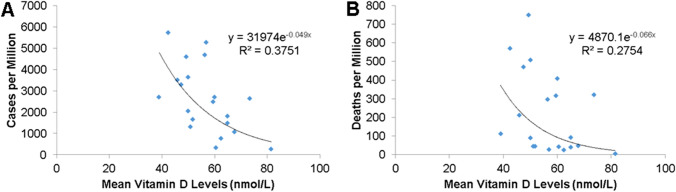
Various studies are underway to identify protective variables for the COVID-19 pandemic. We hypothesized that if indeed the vitamin D levels would be protective in the European population, as recently proposed, the correlation would become more robust when the countries had passed the infection peak as on May 12 2020, compared to April 8 2020, when the majority had not. Comparative analysis of data from the mentioned stages indicated a significant increase in negative correlation of vitamin D levels with COVID-19 cases per million population in later stage (r(20): -0.5504; R = 0.3029; p value: 0.0119 vs r(20): -0.4435; R = 0.1967; p value: 0.0501), whereas the correlation with deaths per million population became insignificant (r(20): -0.3935; R = 0.1549; p value: 0.0860 vs r(20): -0.4378; R = 0.1917; p value: 0.0535). Considering divergence of vitamin D levels from the mean in subgroups, e.g. children, women, aged, dedicated exploratory studies with carefully chosen matched target groups is advisable.
目前正在进行各种研究,以确定针对 COVID-19 大流行的保护变量。我们假设,如果维生素 D 水平确实如最近所提议的那样对欧洲人群具有保护作用,那么与大多数国家尚未达到感染高峰的 2020 年 4 月 8 日相比,当各国在 2020 年 5 月 12 日达到感染高峰时,这种相关性将更加可靠。对来自上述两个阶段的数据进行比较分析表明,在后一阶段,维生素 D 水平与每百万人口 COVID-19 病例的负相关关系显著增加(r(20):-0.5504;R = 0.3029;p 值:0.0119 与 r(20):-0.4435;R = 0.1967;p 值:0.0501),而与每百万人口死亡人数的相关性变得不显著(r(20):-0.3935;R = 0.1549;p 值:0.0860 与 r(20):-0.4378;R = 0.1917;p 值:0.0535)。考虑到维生素 D 水平从平均值的差异(例如儿童、女性、老年人),建议进行专门的探索性研究,并选择精心匹配的目标群体。