Department of Clinical Oncology, The Christie NHS Foundation Trust, Manchester, United Kingdom; Division of Cancer Sciences, University of Manchester, Manchester, United Kingdom.
Department of Radiation Oncology, University of California San Francisco, San Francisco, California.
Int J Radiat Oncol Biol Phys. 2020 Oct 1;108(2):379-389. doi: 10.1016/j.ijrobp.2020.06.054. Epub 2020 Aug 11.
Numerous publications during the COVID-19 pandemic recommended the use of hypofractionated radiation therapy. This project assessed aggregate changes in the quality of the evidence supporting these schedules to establish a comprehensive evidence base for future reference and highlight aspects for future study.
Based on a systematic review of published recommendations related to dose fractionation during the COVID-19 pandemic, 20 expert panelists assigned to 14 disease groups named and graded the highest quality of evidence schedule(s) used routinely for each condition and also graded all COVID-era recommended schedules. The American Society for Radiation Oncology quality of evidence criteria were used to rank the schedules. Process-related statistics and changes in distributions of quality ratings of the highest-rated versus recommended COVID-19 era schedules were described by disease groups and for specific clinical scenarios.
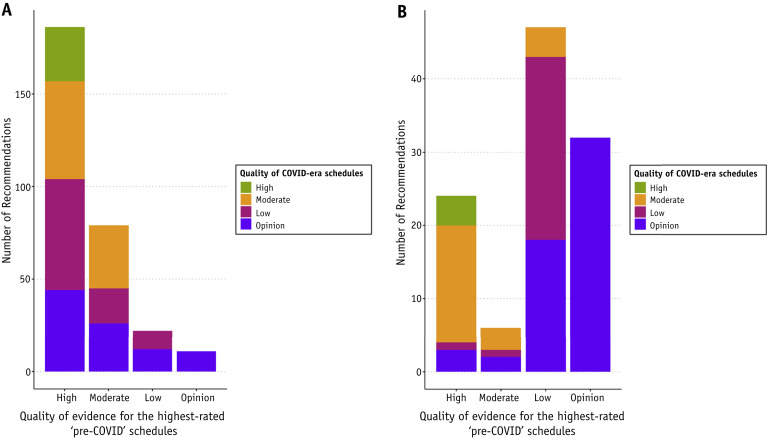
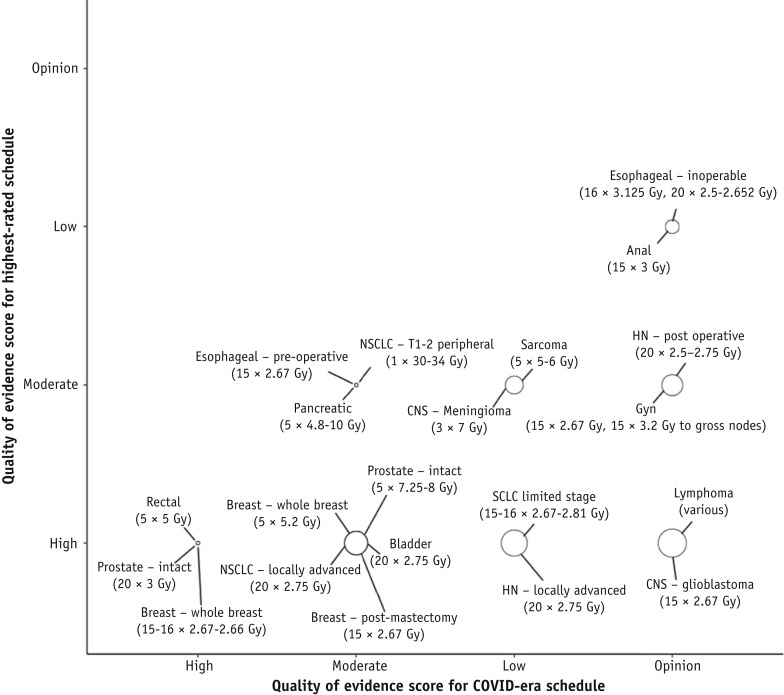
From January to May 2020 there were 54 relevant publications, including 233 recommended COVID-19-adapted dose fractionations. For site-specific curative and site-specific palliative schedules, there was a significant shift from established higher-quality evidence to lower-quality evidence and expert opinions for the recommended schedules (P = .022 and P < .001, respectively). For curative-intent schedules, the distribution of quality scores was essentially reversed (highest levels of evidence "pre-COVID" vs "in-COVID": high quality, 51.4% vs 4.8%; expert opinion, 5.6% vs 49.3%), although there was variation in the magnitude of shifts between disease sites and among specific indications.
A large number of publications recommended hypofractionated radiation therapy schedules across numerous major disease sites during the COVID-19 pandemic, which were supported by a lower quality of evidence than the highest-quality routinely used dose fractionation schedules. This work provides an evidence-based assessment of these potentially practice-changing recommendations and informs individualized decision-making and counseling of patients. These data could also be used to support radiation therapy practices in the event of second waves or surges of the pandemic in new regions of the world.
在 COVID-19 大流行期间,许多出版物建议使用分割剂量放射治疗。本项目评估了支持这些方案的证据质量的综合变化,为未来提供了全面的证据基础,并强调了未来研究的方面。
根据对 COVID-19 大流行期间剂量分割相关出版物的系统评价,20 名专家小组成员被分配到 14 个疾病组,为每个疾病组指定并评定常规使用的最高质量证据方案,并对所有 COVID-19 时代推荐的方案进行了评定。使用美国放射肿瘤学会的证据质量标准对方案进行排名。按疾病组和特定临床情况描述了与过程相关的统计数据以及最高质量评级方案与 COVID-19 时代推荐方案之间质量评级分布的变化。
从 2020 年 1 月到 5 月,共有 54 篇相关出版物,包括 233 项 COVID-19 适应剂量分割建议。对于局部根治性和局部姑息性方案,推荐方案的证据质量从既定的高质量证据向低质量证据和专家意见转移(分别为 P =.022 和 P <.001)。对于根治性意图方案,质量评分的分布基本逆转(“COVID-19 前”与“COVID-19 期间”最高质量证据:高,51.4%对 4.8%;专家意见,5.6%对 49.3%),尽管不同疾病部位和特定适应证之间的转移幅度存在差异。
在 COVID-19 大流行期间,许多主要疾病部位的大量出版物推荐了分割剂量放射治疗方案,这些方案的证据质量低于常规使用的最高质量剂量分割方案。这项工作对这些潜在的实践改变建议进行了基于证据的评估,并为患者的个体化决策和咨询提供了信息。这些数据还可以用于支持世界新地区的放射治疗实践,如果再次出现疫情或疫情激增。