Institute of Virology, Technical University of Munich, School of Medicine/Helmholtz Zentrum München, Munich, Germany.
Technical University of Munich, Institute for Advanced Study, Munich, Germany.
Cell Microbiol. 2020 Dec;22(12):e13250. doi: 10.1111/cmi.13250. Epub 2020 Sep 28.
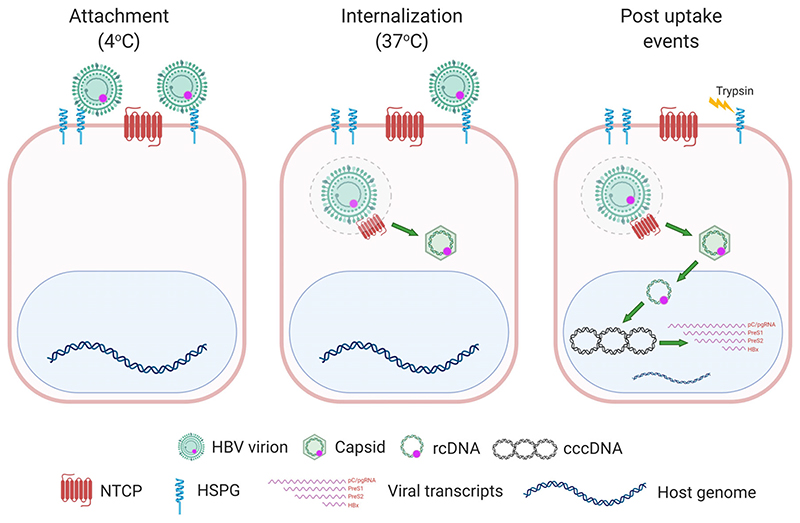
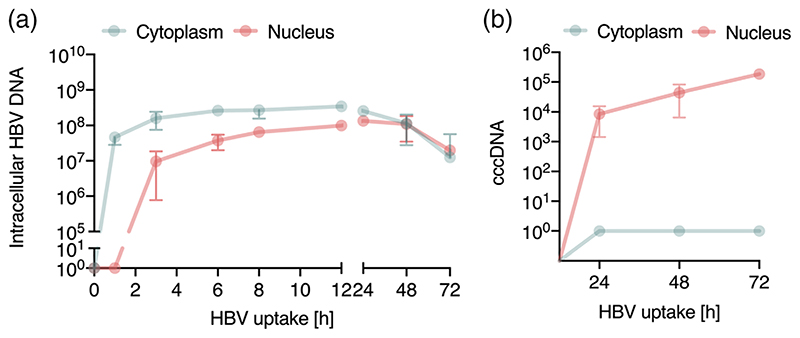
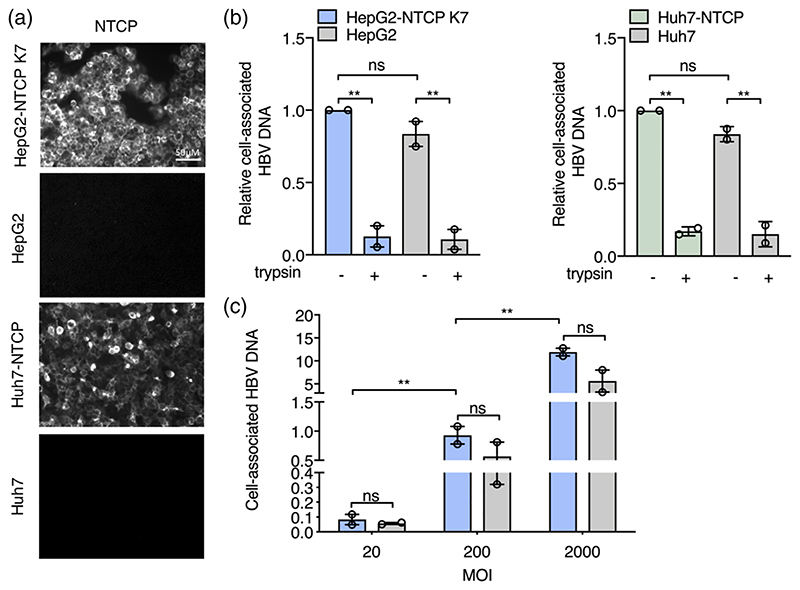
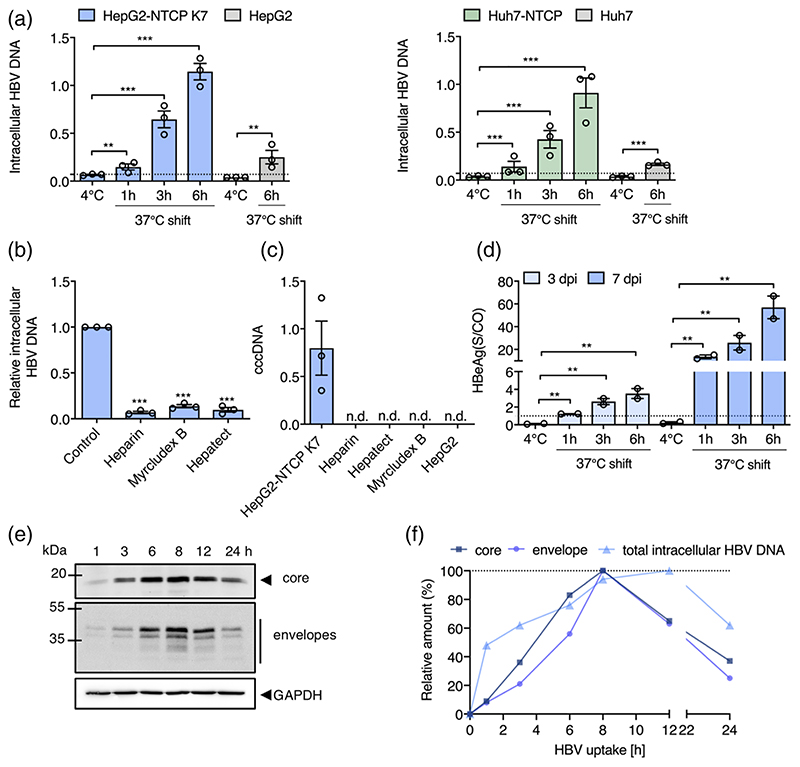
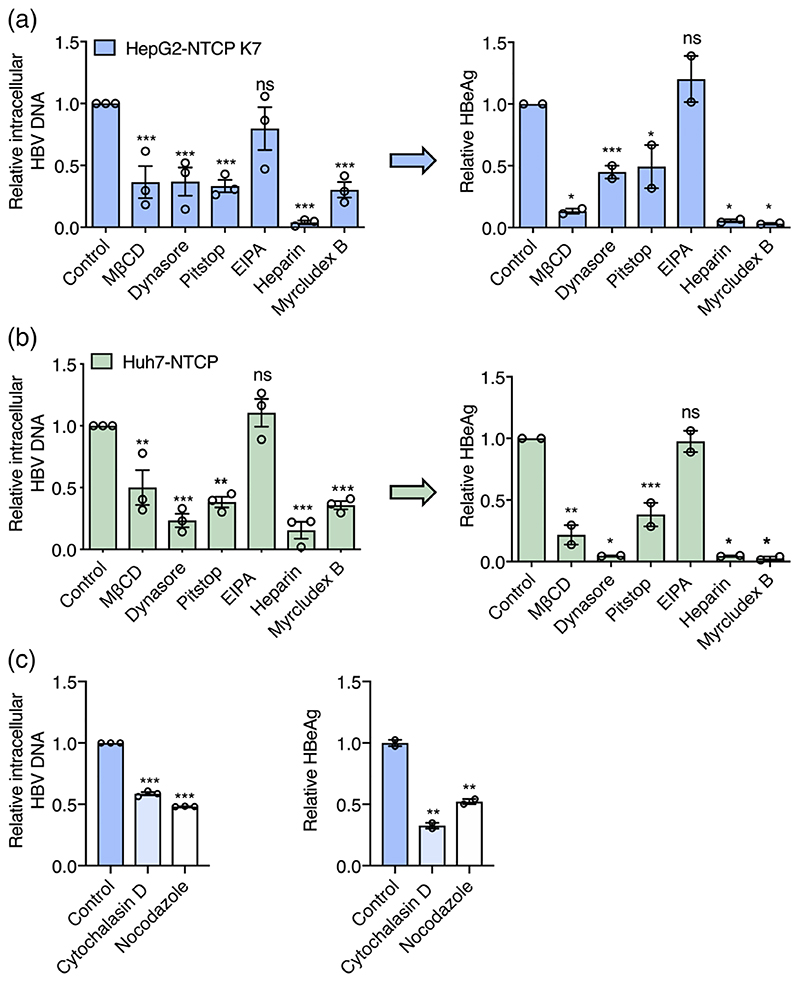
Hepatitis B virus (HBV) is an enveloped DNA virus that contains a partially double-stranded relaxed circular (rc) DNA. Upon infection, rcDNA is delivered to the nucleus where it is repaired to covalently closed circular (ccc) DNA that serves as the transcription template for all viral RNAs. Our understanding of HBV particle entry dynamics and host pathways regulating intracellular virus trafficking and cccDNA formation is limited. The discovery of sodium taurocholate co-transporting peptide (NTCP) as the primary receptor allows studies on these early steps in viral life cycle. We employed a synchronised infection protocol to quantify HBV entry kinetics. HBV attachment to cells at 4°C is independent of NTCP, however, subsequent particle uptake is NTCP-dependent and reaches saturation at 12 h post-infection. HBV uptake is clathrin- and dynamin dependent with actin and tubulin playing a role in the first 6 h of infection. Cellular fractionation studies demonstrate HBV DNA in the nucleus within 6 h of infection and cccDNA was first detected at 24 h post-infection. Our studies show the majority (83%) of cell bound particles enter HepG2-NTCP cells, however, only a minority (<1%) of intracellular rcDNA was converted to cccDNA, highlighting this as a rate-limiting in establishing infection in vitro. This knowledge highlights the deficiencies in our in vitro cell culture systems and will inform the design and evaluation of physiologically relevant models that support efficient HBV replication.
乙型肝炎病毒 (HBV) 是一种包膜 DNA 病毒,包含部分双链松弛环状 (rc) DNA。感染后,rcDNA 被递送到细胞核,在那里它被修复为共价闭合环状 (ccc) DNA,cccDNA 作为所有病毒 RNA 的转录模板。我们对 HBV 颗粒进入动力学和宿主途径调节细胞内病毒运输和 cccDNA 形成的理解是有限的。钠牛磺胆酸盐共转运肽 (NTCP) 作为主要受体的发现允许研究病毒生命周期的这些早期步骤。我们采用同步感染方案来量化 HBV 进入动力学。HBV 在 4°C 下与细胞的附着不依赖于 NTCP,但随后的颗粒摄取依赖于 NTCP,在感染后 12 小时达到饱和。HBV 摄取依赖于网格蛋白和动力蛋白,肌动蛋白和微管在感染的前 6 小时起作用。细胞分级分离研究表明,HBV DNA 在感染后 6 小时内进入细胞核,cccDNA 是在感染后 24 小时首次检测到的。我们的研究表明,大多数 (83%) 结合在细胞上的颗粒进入 HepG2-NTCP 细胞,然而,只有少数 (<1%) 细胞内 rcDNA 转化为 cccDNA,这突出表明这是在体外建立感染的限速步骤。这些知识突出了我们体外细胞培养系统的不足,并将为支持高效 HBV 复制的生理相关模型的设计和评估提供信息。