Division of Rheumatology, Department of Internal Medicine, Yonsei University College of Medicine, 50-1 Yonsei-ro, Seodaemun-gu, Seoul, Republic of Korea, 03722.
Institute for Immunology and Immunological Diseases, Yonsei University College of Medicine, Seoul, Republic of Korea.
Lipids Health Dis. 2020 Aug 14;19(1):184. doi: 10.1186/s12944-020-01360-1.
To investigate whether atherogenic index of plasma (AIP) at diagnosis is associated with the occurrence of cerebrovascular accident (CVA) or coronary artery disease (CAD) in antineutrophil cytoplasmic antibody-associated vasculitis (AAV).
The medical records of 167 AAV patients on initial diagnosis was reviewed, and 300 healthy controls were included. AIP was calculated using the following equation: AIP = Log (triglyceride [mg/dL] / high-density lipoprotein cholesterol [mg/dL]). AAV patients were divided into two groups according to the AIP cut-off of 0.11. The event of stroke, transient ischemic attack, and cerebral hemorrhage was recorded as CVA, and CAD events consisted of either myocardial infarction and angina pectoris. CVA- and CAD- free survival rate between those with AIP ≥ 0.11 and < 0.11 were compared by the Kaplan-Meier analysis, and Cox hazard analysis was conducted to identify predictors of CVA.
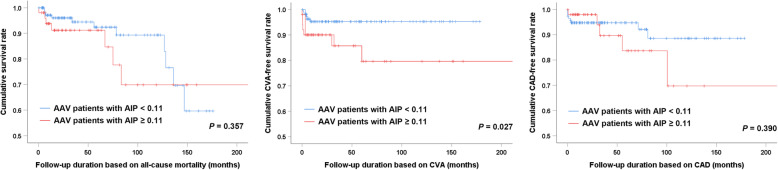
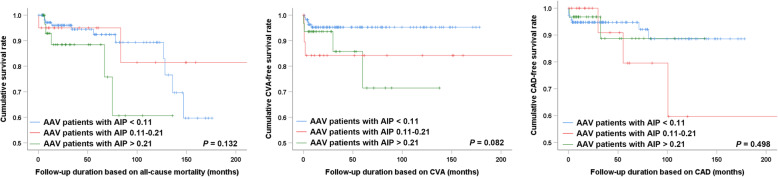
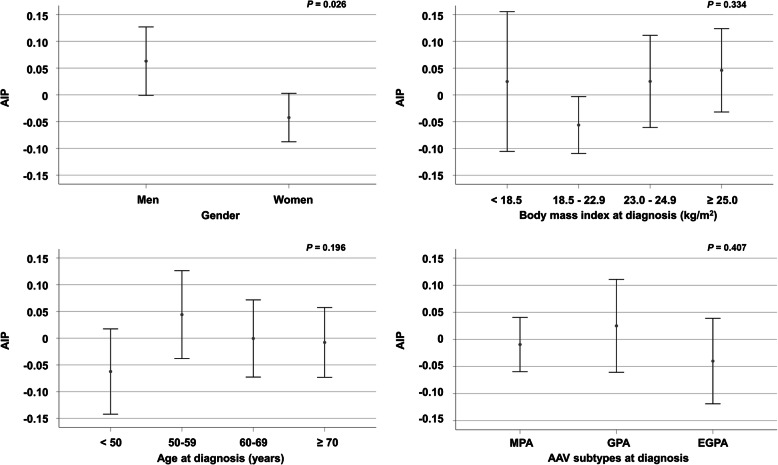
The median age of AAV patients were 59.0 years, and 54 (32.3%) patients were male. One-hundred and fifteen (68.9%) patients had AIP < 0.11 and 52 (31.1%) had AIP ≥ 0.11. The mean Birmingham vasculitis activity score in AAV patients with AIP < 0.11 was lower than that seen in patients with AIP ≥ 0.11 (12.0 vs. 14.0, P = 0.041). AAV patients had a significantly higher AIP compared to controls (mean - 0.01 vs. -0.10, P < 0.001). During follow-up, the occurrence of CVA and CAD was observed in 16 (9.6%) and 14 (8.4%) patients, respectively. In Kaplan-Meier analysis, AAV patients with AIP ≥ 0.11 had significantly lower CVA-free survival rates than in those with AIP < 0.11 (P = 0.027), whereas there was no difference in CAD according to AIP (P = 0.390). Multivariable Cox analysis indicated that AIP ≥ 0.11 at diagnosis was the sole predictor of CVA (Hazard ratio 3.392, 95% confidence interval 1.076, 10.696, P = 0.037).
AIP is significantly higher in AAV patients than in healthy controls, and AIP ≥ 0.11 at diagnosis is a significant predictor of CVA during follow-up. Stringent surveillance should be provided in AAV patients with AIP ≥ 0.11 regarding the occurrence of CVA.
Retrospectively registered (4-2017-0673).
探讨载脂蛋白血浆指数(AIP)在诊断时是否与抗中性粒细胞胞浆抗体相关性血管炎(AAV)患者发生脑血管意外(CVA)或冠状动脉疾病(CAD)有关。
回顾性分析了 167 例初诊 AAV 患者的病历,并纳入了 300 名健康对照者。使用以下公式计算 AIP:AIP=Log(甘油三酯[mg/dL] / 高密度脂蛋白胆固醇[mg/dL])。根据 AIP 截断值 0.11,将 AAV 患者分为两组。将中风、短暂性脑缺血发作和脑出血记录为 CVA,CAD 事件包括心肌梗死和心绞痛。通过 Kaplan-Meier 分析比较 AIP≥0.11 和 AIP<0.11 的患者之间的 CVA 和 CAD 无事件生存率,并用 Cox 风险分析确定 CVA 的预测因素。
AAV 患者的中位年龄为 59.0 岁,54 名(32.3%)患者为男性。115 名(68.9%)患者的 AIP<0.11,52 名(31.1%)患者的 AIP≥0.11。AIP<0.11 的 AAV 患者的 Birmingham 血管炎活动评分均值低于 AIP≥0.11 的患者(12.0 比 14.0,P=0.041)。与对照组相比,AAV 患者的 AIP 明显升高(平均-0.01 比-0.10,P<0.001)。在随访期间,16 名(9.6%)和 14 名(8.4%)患者分别发生了 CVA 和 CAD。在 Kaplan-Meier 分析中,AIP≥0.11 的 AAV 患者的 CVA 无事件生存率明显低于 AIP<0.11 的患者(P=0.027),而根据 AIP 则无 CAD 差异(P=0.390)。多变量 Cox 分析表明,诊断时 AIP≥0.11 是 CVA 的唯一预测因素(风险比 3.392,95%置信区间 1.076,10.696,P=0.037)。
AAV 患者的 AIP 明显高于健康对照组,诊断时 AIP≥0.11 是随访期间发生 CVA 的显著预测因素。对于 AIP≥0.11 的 AAV 患者,应密切监测 CVA 的发生。
回顾性注册(4-2017-0673)。