The Bateman Horne Center of Excellence, 24 South 1100 East, Suite 205, Salt Lake City, UT, 84102, USA.
Jackson Laboratory for Genomic Medicine and University of Connecticut School of Medicine, Farmington, CT, 06032, USA.
J Transl Med. 2020 Aug 15;18(1):314. doi: 10.1186/s12967-020-02481-y.
Lightheadedness, fatigue, weakness, heart palpitations, cognitive dysfunction, muscle pain, and exercise intolerance are some of the symptoms of orthostatic intolerance (OI). There is substantial comorbidity of OI in ME/CFS (Myalgic Encephalomyelitis/Chronic Fatigue Syndrome). The 10-minute NASA Lean Test (NLT) is a simple, point-of-care method that can aid ME/CFS diagnosis and guide management and treatment of OI. The objective of this study was to understand the hemodynamic changes that occur in ME/CFS patients during the 10-minute NLT.
A total of 150 ME/CFS patients and 75 age, gender and race matched healthy controls (HCs) were enrolled. We recruited 75 ME/CFS patients who had been sick for less than 4 years (< 4 ME/CFS) and 75 ME/CFS patients sick for more than 10 years (> 10 ME/CFS). The 10-minute NLT involves measurement of blood pressure and heart rate while resting supine and every minute for 10 min while standing with shoulder-blades on the wall for a relaxed stance. Spontaneously reported symptoms are recorded during the test. ANOVA and regression analysis were used to test for differences and relationships in hemodynamics, symptoms and upright activity between groups.
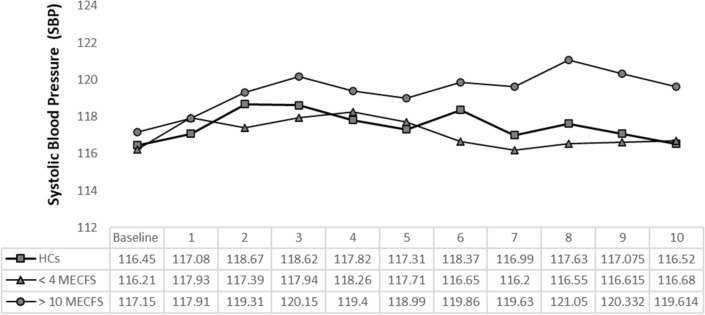
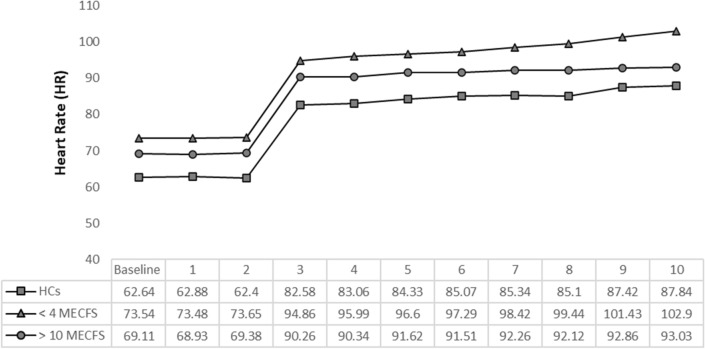
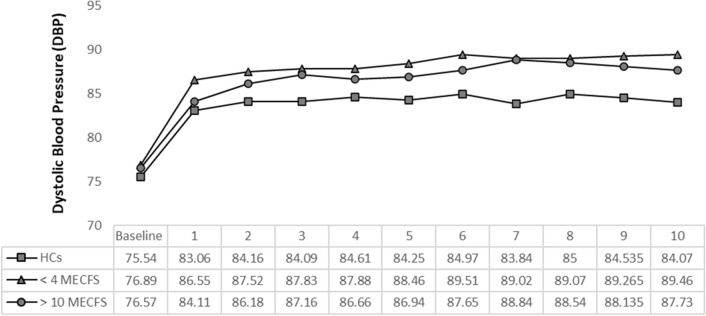
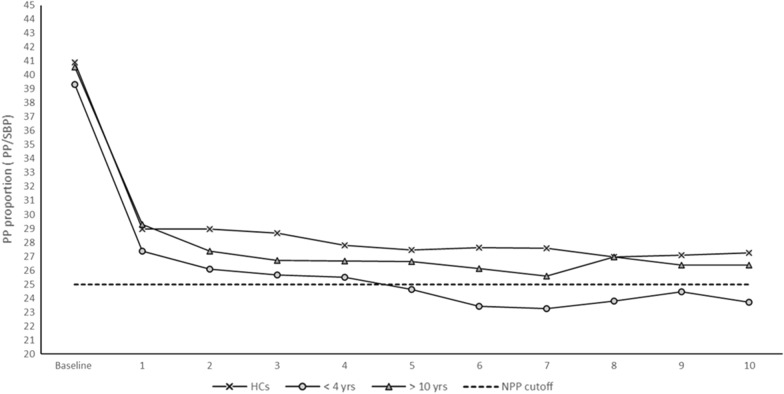
At least 5 min of the 10-minute NLT were required to detect hemodynamic changes. The < 4 ME/CFS group had significantly higher heart rate and abnormally narrowed pulse pressure compared to > 10 ME/CFS and HCs. The < 4 ME/CFS group experienced significantly more OI symptoms compared to > 10 ME/CFS and HCs. The circulatory decompensation observed in the < 4 ME/CFS group was not related to age or medication use.
Circulatory decompensation characterized by increased heart rate and abnormally narrow pulse pressure was identified in a subgroup of ME/CFS patients who have been sick for < 4 years. This suggests inadequate ventricular filling from low venous pressure. The 10-minute NLT can be used to diagnose and treat the circulatory decompensation in this newly recognized subgroup of ME/CFS patients. The > 10 ME/CFS group had less pronounced hemodynamic changes during the NLT possibly from adaptation and compensation that occurs over time. The 10-minute NLT is a simple and clinically useful point-of-care method that can be used for early diagnosis of ME/CFS and help guide OI treatment.
头晕、疲劳、虚弱、心悸、认知功能障碍、肌肉疼痛和运动不耐受是直立不耐受(OI)的一些症状。慢性疲劳综合征(ME/CFS)中 OI 存在大量共病。10 分钟 NASA 倾斜测试(NLT)是一种简单的、即时护理方法,可以辅助 ME/CFS 诊断,并指导 OI 的管理和治疗。本研究的目的是了解 ME/CFS 患者在 10 分钟 NLT 期间发生的血液动力学变化。
共纳入 150 名 ME/CFS 患者和 75 名年龄、性别和种族匹配的健康对照者(HCs)。我们招募了 75 名患病时间少于 4 年(<4 ME/CFS)的 ME/CFS 患者和 75 名患病时间超过 10 年(>10 ME/CFS)的 ME/CFS 患者。10 分钟 NLT 包括在仰卧位休息时测量血压和心率,然后在站立位靠墙保持放松姿势的情况下每分钟测量一次,共 10 分钟。在测试过程中记录自发报告的症状。采用 ANOVA 和回归分析来测试组间血液动力学、症状和直立活动的差异和关系。
至少需要 10 分钟 NLT 的 5 分钟才能检测到血液动力学变化。<4 ME/CFS 组的心率明显升高,脉搏压明显变窄,与>10 ME/CFS 和 HCs 相比。<4 ME/CFS 组的 OI 症状明显多于>10 ME/CFS 和 HCs。在<4 ME/CFS 组中观察到的循环代偿失调与年龄或药物使用无关。
在患病时间少于 4 年的 ME/CFS 患者亚组中发现了以心率增加和脉搏压异常变窄为特征的循环代偿失调。这表明心室充盈不足,静脉压低。10 分钟 NLT 可用于诊断和治疗新发现的这组 ME/CFS 患者的循环代偿失调。在 NLT 期间,>10 ME/CFS 组的血液动力学变化不那么明显,可能是由于随时间推移而发生的适应和代偿。10 分钟 NLT 是一种简单且具有临床应用价值的即时护理方法,可用于 ME/CFS 的早期诊断,并有助于指导 OI 治疗。