Wang Di, Zhang Xia, Gao Yajie, Cui Xiaonan, Yang Yanqin, Mao Weifeng, Li Minghuan, Zhang Bin, Yu Jinming
Department of Oncology, The First Affiliated Hospital of Dalian Medical University, Dalian, People's Republic of China.
Department of Oncology, The Fifth People's Hospital of Dalian, Dalian, People's Republic of China.
Cancer Manag Res. 2020 Aug 3;12:6695-6706. doi: 10.2147/CMAR.S245426. eCollection 2020.
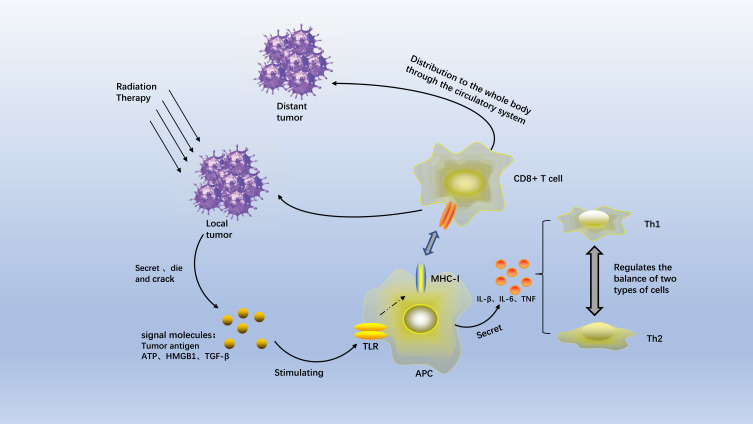
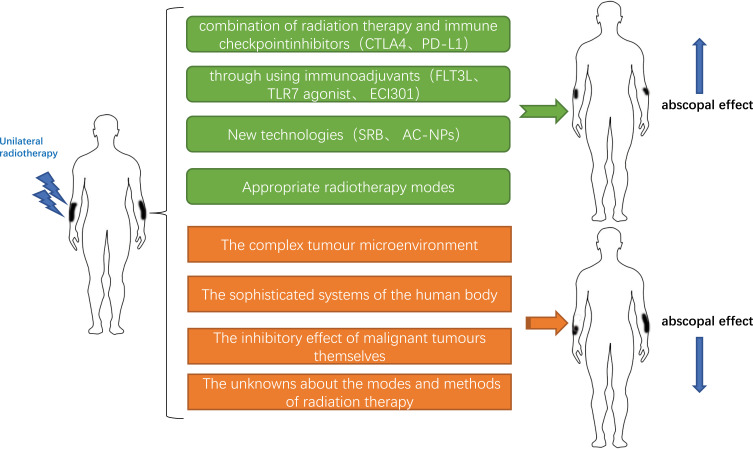
Radiation therapy plays a vital role in the treatment of tumours. In particular, the occurrence of the "abscopal effect" brings about a favourable turn for the treatment of patients with advanced metastatic malignant tumours. Because of the abscopal effect, non-irradiated areas are also treated. However, the abscopal effect occurs by chance, not through seeking. Although the abscopal effect has been studied enthusiastically, the desired result does not appear to be achieved. Moreover, its combination with immunotherapy appears to be overwhelming. There is an opinion that abscopal effect is difficult to achieve by irradiation of a single tumour, and irradiation of multiple or total lesions is advocated to increase the possibility of obtaining clinically meaningful outcomes. Obviously, there are still questions about the mechanism, condition and possibility underlying the occurrence of the abscopal effect. Can the abscopal effect truly change the future treatment strategy as the researchers expect? What are the current problems? This article reviewed the research in recent years to explore the progress and controversy surrounding the abscopal effect of radiation therapy.
放射治疗在肿瘤治疗中发挥着至关重要的作用。特别是,“远隔效应”的出现为晚期转移性恶性肿瘤患者的治疗带来了转机。由于远隔效应,未受照射的区域也得到了治疗。然而,远隔效应是偶然发生的,并非刻意寻求而来。尽管对远隔效应进行了热烈的研究,但似乎并未达到预期的效果。此外,它与免疫疗法的联合应用似乎效果显著。有一种观点认为,单一肿瘤的照射难以实现远隔效应,主张对多个或全部病灶进行照射以增加获得具有临床意义结果的可能性。显然,关于远隔效应发生的机制、条件和可能性仍然存在问题。远隔效应能否真如研究人员所期望的那样改变未来的治疗策略?目前存在哪些问题?本文回顾了近年来的研究,以探讨围绕放射治疗远隔效应的进展和争议。