School of Medicine and Life Sciences, University of Jinan-Shandong Academy of Medical Sciences, Jinan, Shandong, China.
Department of Radiation Oncology, Shandong Cancer Hospital affiliated to Shandong University, Shandong Academy of Medical Sciences, 440 Jiyan Road, Jinan, 250117, Shandong, China.
J Hematol Oncol. 2018 Aug 16;11(1):104. doi: 10.1186/s13045-018-0647-8.
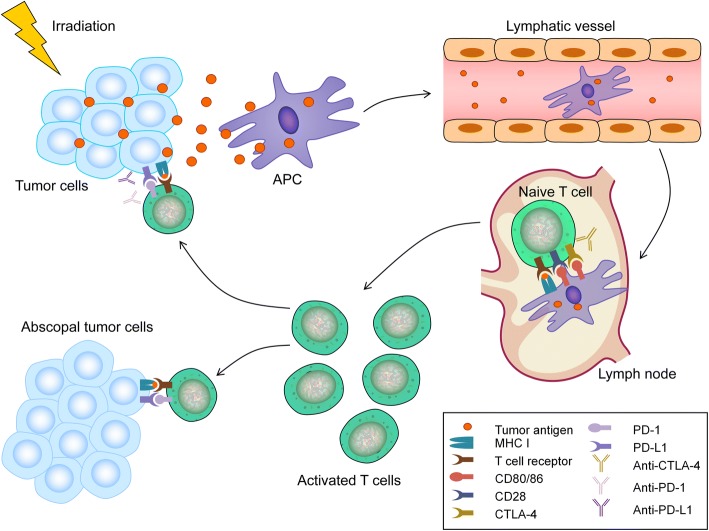
Radiotherapy (RT) is used routinely as a standard treatment for more than 50% of patients with malignant tumors. The abscopal effect induced by local RT, which is considered as a systemic anti-tumor immune response, reflects the regression of non-irradiated metastatic lesions at a distance from the primary site of irradiation. Since the application of immunotherapy, especially with immune checkpoint inhibitors, can enhance the systemic anti-tumor response of RT, the combination of RT and immunotherapy has drawn extensive attention by oncologists and cancer researchers. Nevertheless, the exact underlying mechanism of the abscopal effect remains unclear. In general, we speculate that the immune mechanism of RT is responsible for, or at least associated with, this effect. In this review, we discuss the anti-tumor effect of RT and immune checkpoint blockade and discuss some published studies on the abscopal effect for this type of combination therapy. In addition, we also evaluate the most appropriate time window for the combination of RT and immune checkpoint blockade, as well as the optimal dose and fractionation of RT in the context of the combined treatment. Finally, the most significant purpose of this review is to identify the potential predictors of the abscopal effect to help identify the most appropriate patients who would most likely benefit from the combination treatment modality.
放疗(RT)被常规用于超过 50%的恶性肿瘤患者的标准治疗。局部 RT 诱导的远隔效应被认为是一种全身抗肿瘤免疫反应,反映了照射野以外的非照射转移病灶的消退。自从免疫疗法,特别是免疫检查点抑制剂的应用,能够增强 RT 的全身抗肿瘤反应以来,RT 与免疫疗法的联合治疗引起了肿瘤学家和癌症研究人员的广泛关注。然而,远隔效应的确切潜在机制仍不清楚。一般来说,我们推测 RT 的免疫机制是导致或至少与这种效应相关的原因。在这篇综述中,我们讨论了 RT 和免疫检查点阻断的抗肿瘤作用,并讨论了一些关于这种联合治疗的远隔效应的已发表研究。此外,我们还评估了 RT 与免疫检查点阻断联合治疗的最适时间窗,以及联合治疗中 RT 的最佳剂量和分割。最后,本综述的最重要目的是确定远隔效应的潜在预测因素,以帮助确定最有可能从联合治疗模式中获益的最合适患者。