Vu Giap H, Azzolini Anthony, Humphries Laura S, Mazzaferro Daniel M, Kalmar Christopher L, Zimmerman Carrie E, Swanson Jordan W, Taylor Jesse A, Bartlett Scott P
Division of Plastic and Reconstructive Surgery, Children's Hospital of Philadelphia, Philadelphia, Pa.
Plast Reconstr Surg Glob Open. 2020 Jul 15;8(7):e2902. doi: 10.1097/GOX.0000000000002902. eCollection 2020 Jul.
This study investigates laypersons' perceptions of congenital ear deformities and preferences for treatment, particularly with ear molding therapy-an effective, noninvasive, yet time-sensitive treatment.
Laypersons were recruited via crowdsourcing to view photographs of normal ears or one of the following ear deformities, pre- and post-molding: constricted, cryptotia, cupped/lopped, helical rim deformity, prominent, and Stahl. Participants answered questions regarding perceptions and treatment preferences for the ear. Statistical analyses included multiple linear and logistic regressions and Wilcoxon signed-rank tests.
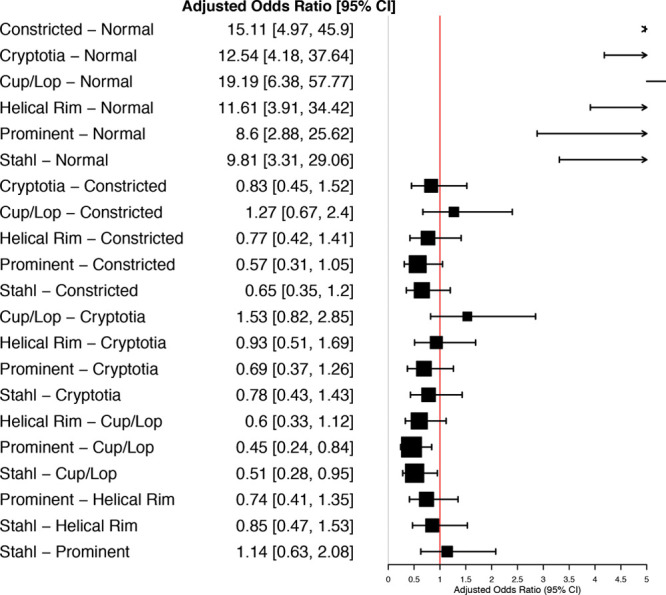
A total of 983 individuals participated in the study. All deformities were perceived as significantly abnormal, likely to impair hearing, and associated with lower psychosocial quality of life (all < 0.001). For all deformities, participants were likely to choose ear molding over surgery despite the logistical and financial implications of ear molding (all < 0.02). Participants were significantly more satisfied with the outcome of ear molding in all deformities compared with control, except constricted ears (all < 0.002, except P = 0.073). Concern for hearing impairment due to ear deformity was associated with increased likelihoods of seeing a physician ( < 0.001) and choosing ear molding despite treatment logistics and costs (all < 0.001).
Laypersons perceived all ear deformities as abnormal and associated with low psychosocial quality of life. Despite logistical and financial implications, laypersons generally desired molding therapy for ear deformities; treatment outcomes were satisfactory for all deformities except constricted ears. Timely diagnosis of this condition is crucial to reaping the benefits of ear molding therapy.
本研究调查了外行人对先天性耳部畸形的认知以及对治疗的偏好,特别是耳模疗法——一种有效、无创但对时间敏感的治疗方法。
通过众包招募外行人,让他们观看正常耳朵或以下耳部畸形之一(耳模治疗前后)的照片:狭窄耳、隐耳、杯状/垂耳、耳轮畸形、招风耳和斯塔尔耳。参与者回答有关耳部认知和治疗偏好的问题。统计分析包括多元线性和逻辑回归以及威尔科克森符号秩检验。
共有983人参与了该研究。所有畸形都被认为明显异常,可能损害听力,并与较低的心理社会生活质量相关(均P<0.001)。对于所有畸形,尽管耳模治疗存在后勤和经济方面的问题,但参与者仍比手术更倾向于选择耳模治疗(均P<0.02)。与对照组相比,除狭窄耳外,参与者对所有畸形的耳模治疗结果满意度明显更高(除P = 0.073外,均P<0.002)。因耳部畸形而对听力损害的担忧与看医生的可能性增加相关(P<0.001),并且尽管存在治疗后勤和费用问题,仍选择耳模治疗(均P<0.001)。
外行人认为所有耳部畸形都是异常的,并与低心理社会生活质量相关。尽管存在后勤和经济方面的问题,但外行人通常希望对耳部畸形进行耳模治疗;除狭窄耳外,所有畸形的治疗结果都令人满意。及时诊断这种情况对于获得耳模治疗的益处至关重要。