Affleck Andrew J, Sachdev Perminder S, Stevens Julia, Halliday Glenda M
Neuroscience Research Australia (NeuRA) Sydney Australia.
School of Psychiatry University of New South Wales Sydney Australia.
Alzheimers Dement (N Y). 2020 Aug 13;6(1):e12060. doi: 10.1002/trc2.12060. eCollection 2020.
Mounting evidence supports an association between antihypertensive medication use and reduced risk of Alzheimer's disease (AD). Consensus on possible pathological mechanisms remains elusive.
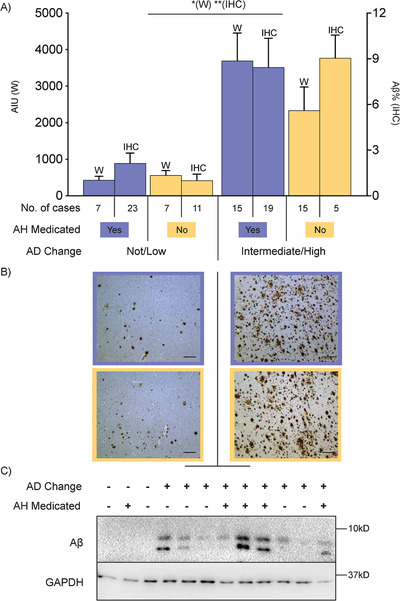
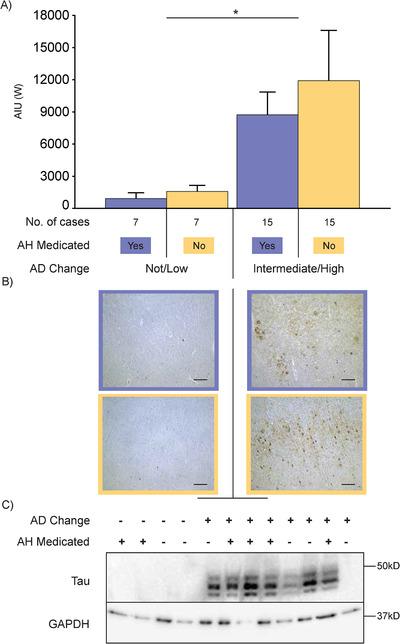
Human brain tissue from a cohort followed to autopsy that included 96 cases of AD (46 medicated for hypertension) and 53 pathological controls (33 also medicated) matched for cerebrovascular disease was available from the New South Wales Brain Banks. Quantified frontal cortex amyloid beta (Aβ) and tau proteins plus Alzheimer's neuropathologic change scores were analyzed.
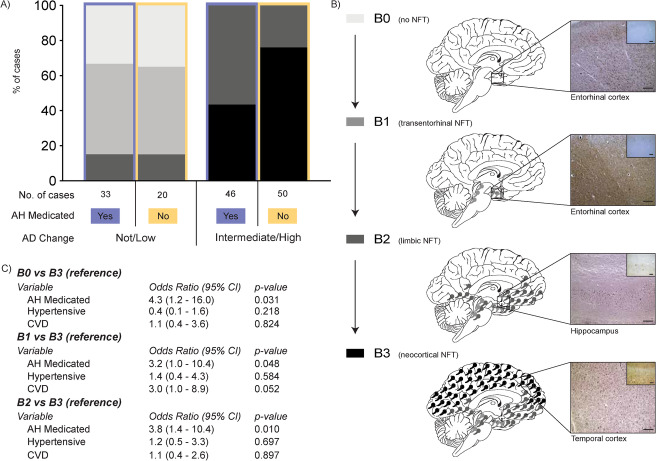
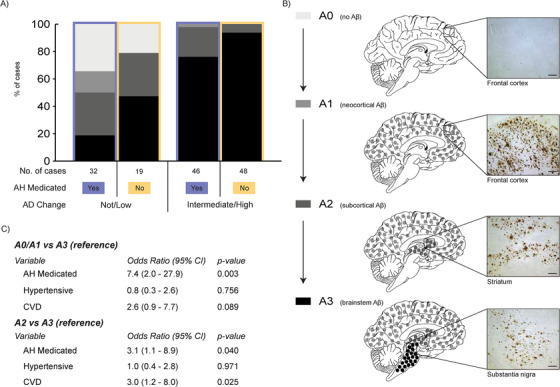
Univariate analyses found no difference in amounts of AD proteins in the frontal cortex between medication users, but multivariate analyses showed that antihypertensive medication use was associated with a less extensive spread of AD proteins throughout the brain.
The heterogeneous nature of the antihypertensive medications is consistent with downstream beneficial effects of blood pressure lowering and/or management being associated with the reduced spreading of AD pathology observed.
越来越多的证据支持使用抗高血压药物与降低患阿尔茨海默病(AD)风险之间存在关联。关于可能的病理机制尚未达成共识。
从新南威尔士州脑库可获得来自一个队列的人脑组织,该队列随访至尸检,包括96例AD病例(46例接受高血压治疗)和53例病理对照(33例也接受治疗),这些病例在脑血管疾病方面相匹配。对额叶皮质淀粉样β蛋白(Aβ)和tau蛋白进行定量分析,并分析阿尔茨海默病神经病理变化评分。
单因素分析发现用药者额叶皮质中AD蛋白量无差异,但多因素分析表明,使用抗高血压药物与AD蛋白在全脑的扩散范围较小有关。
抗高血压药物的异质性与观察到的血压降低和/或管理的下游有益作用一致,这些作用与AD病理扩散的减少有关。