Siedner Mark J, Harling Guy, Derache Anne, Smit Theresa, Khoza Thandeka, Gunda Resign, Mngomezulu Thobeka, Gareta Dickman, Majozi Nomathamsanqa, Ehlers Eugene, Dreyer Jaco, Nxumalo Siyabonga, Dayi Njabulo, Ording-Jesperson Gregory, Ngwenya Nothando, Wong Emily, Iwuji Collins, Shahmanesh Maryam, Seeley Janet, De Oliveira Tulio, Ndung'u Thumbi, Hanekom Willem, Herbst Kobus
Africa Health Research Institute, Durban, KwaZulu-Natal, South Africa.
Massachusetts General Hospital, Boston, MA, USA.
Wellcome Open Res. 2020 Aug 25;5:109. doi: 10.12688/wellcomeopenres.15949.2. eCollection 2020.
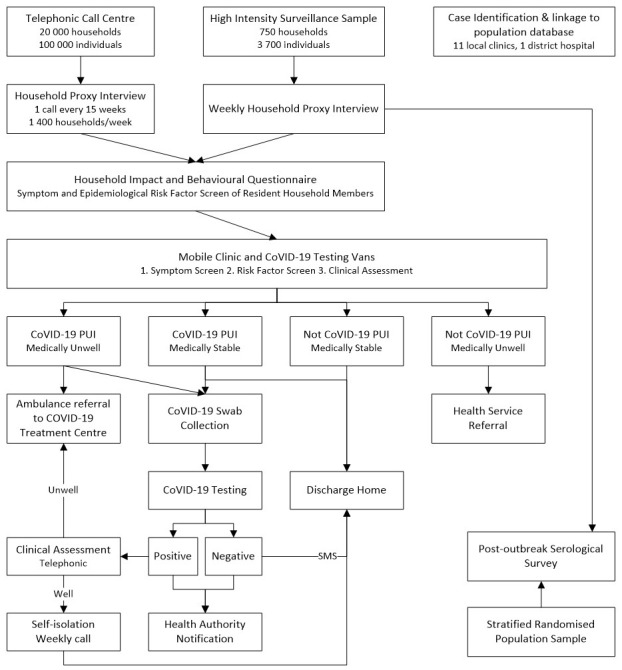
A coordinated system of disease surveillance will be critical to effectively control the coronavirus disease 2019 (Covid-19) pandemic. Such systems enable rapid detection and mapping of epidemics and inform allocation of scarce prevention and intervention resources. Although many lower- and middle-income settings lack infrastructure for optimal disease surveillance, health and demographic surveillance systems (HDSS) provide a unique opportunity for epidemic monitoring. This protocol describes a surveillance program at the Africa Health Research Institute's Population Intervention Platform site in northern KwaZulu-Natal. The program leverages a longstanding HDSS in a rural, resource-limited setting with very high prevalence of HIV and tuberculosis to perform Covid-19 surveillance. Our primary aims include: describing the epidemiology of the Covid-19 epidemic in rural KwaZulu-Natal; determining the impact of the Covid-19 outbreak and non-pharmaceutical control interventions (NPI) on behaviour and wellbeing; determining the impact of HIV and tuberculosis on Covid-19 susceptibility; and using collected data to support the local public-sector health response. The program involves telephone-based interviews with over 20,000 households every four months, plus a sub-study calling 750 households every two weeks. Each call asks a household representative how the epidemic and NPI are affecting the household and conducts a Covid-19 risk screen for all resident members. Any individuals screening positive are invited to a clinical screen, potential test and referral to necessary care - conducted in-person near their home following careful risk minimization procedures. In this protocol we report the details of our cohort design, questionnaires, data and reporting structures, and standard operating procedures in hopes that our project can inform similar efforts elsewhere.
一个协调的疾病监测系统对于有效控制2019冠状病毒病(Covid-19)大流行至关重要。这样的系统能够快速检测和绘制疫情图谱,并为稀缺的预防和干预资源的分配提供依据。尽管许多低收入和中等收入地区缺乏进行最佳疾病监测的基础设施,但健康与人口监测系统(HDSS)为疫情监测提供了独特的机会。本方案描述了在夸祖鲁-纳塔尔省北部非洲健康研究所人口干预平台站点开展的一项监测计划。该计划利用了一个长期存在的HDSS,该系统位于一个资源有限的农村地区,艾滋病毒和结核病的患病率非常高,以开展Covid-19监测。我们的主要目标包括:描述夸祖鲁-纳塔尔省农村地区Covid-19疫情的流行病学情况;确定Covid-19疫情和非药物控制干预措施(NPI)对行为和健康的影响;确定艾滋病毒和结核病对Covid-19易感性的影响;以及利用收集到的数据支持当地公共部门的卫生应对措施。该计划包括每四个月对20000多个家庭进行电话访谈,另外还有一项子研究,每两周对750个家庭进行电话访谈。每次通话都会询问家庭代表疫情和NPI对家庭的影响,并对所有居住成员进行Covid-19风险筛查。任何筛查呈阳性的个体都会被邀请进行临床筛查、可能的检测,并根据仔细的风险最小化程序在其家附近进行必要护理的转诊。在本方案中,我们报告了我们的队列设计、问卷、数据和报告结构以及标准操作程序的详细信息,希望我们的项目能够为其他地方的类似工作提供参考。