Harling Guy, Gómez-Olivé Francesc Xavier, Tlouyamma Joseph, Mutevedzi Tinofa, Kabudula Chodziwadziwa Whiteson, Mahlako Ruth, Singh Urisha, Ohene-Kwofie Daniel, Buckland Rose, Ndagurwa Pedzisai, Gareta Dickman, Gunda Resign, Mngomezulu Thobeka, Nxumalo Siyabonga, Wong Emily B, Kahn Kathleen, Siedner Mark J, Maimela Eric, Tollman Stephen, Collinson Mark, Herbst Kobus
Africa Health Research Institute, KwaZulu-Natal, South Africa.
Institute for Global Health, University College London, London, United Kingdom.
medRxiv. 2020 Nov 15:2020.11.12.20230136. doi: 10.1101/2020.11.12.20230136.
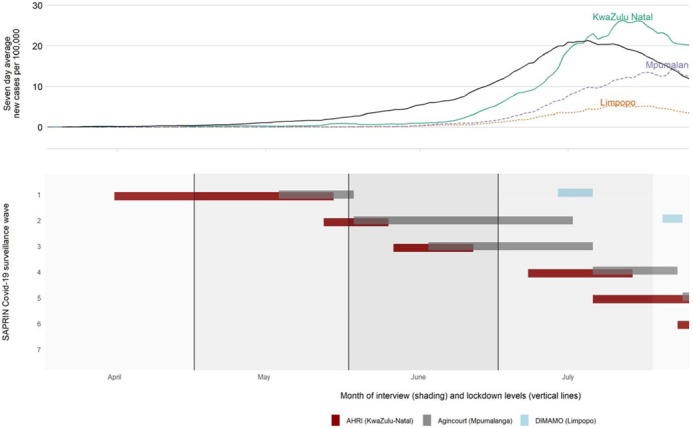
In March 2020 South Africa implemented strict non-pharmaceutical interventions (NPIs) to contain Covid-19. Over the subsequent five months NPIs were eased in stages according to national strategy. Covid-19 spread throughout the country heterogeneously, reaching rural areas by July and peaking in July-August. Data on the impact of NPI policies on social and economic wellbeing and access to healthcare is limited. We therefore analysed how rural residents of three South African provinces changed their behaviour during the first epidemic wave.
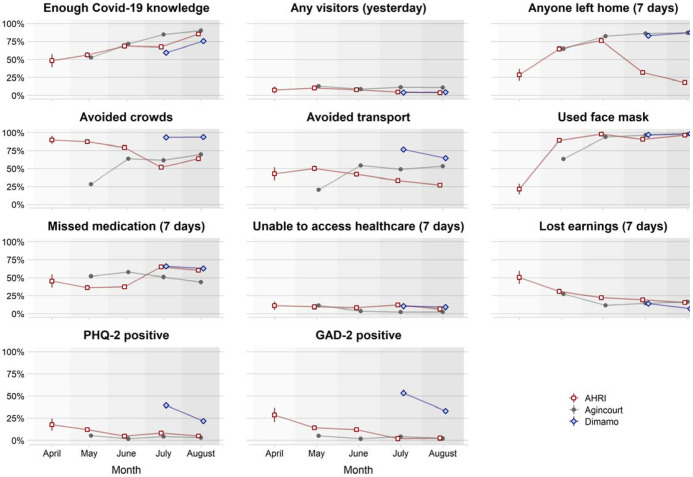
The South African Population Research Infrastructure Network (SAPRIN) nodes in Mpumalanga (Agincourt), KwaZulu-Natal (AHRI) and Limpopo (DIMAMO) provinces conducted longitudinal telephone surveys among randomly sampled households from rural and peri-urban surveillance populations every 2-3 weeks. Interviews included questions on: Covid-19 knowledge and behaviours; health and economic impact of NPIs; and mental health.
2262 households completed 10,966 interviews between April and August 2020. By August, self-reported satisfaction with Covid-19 knowledge had risen from 48% to 85% and facemask use to over 95%. As selected NPIs were eased mobility increased, and economic losses and anxiety and depression symptoms fell. When Covid-19 cases spiked at one node in July, movement dropped rapidly, and missed daily medication rates doubled. Economic concerns and mental health symptoms were lower in households receiving a greater number of government-funded old-age pensions.
South Africans reported complying with stringent Covid-19 NPIs despite the threat of substantial social, economic and health repercussions. Government-supported social welfare programmes appeared to buffer interruptions in income and healthcare access during local outbreaks. Epidemic control policies must be balanced against impacts on wellbeing in resource-limited settings and designed with parallel support systems where they threaten income and basic service access.
2020年3月,南非实施了严格的非药物干预措施(NPIs)以遏制新冠疫情。在随后的五个月里,非药物干预措施根据国家战略分阶段放宽。新冠疫情在全国呈异质性传播,7月蔓延至农村地区,并在7月至8月达到高峰。关于非药物干预政策对社会经济福祉和医疗保健可及性影响的数据有限。因此,我们分析了南非三个省份的农村居民在第一波疫情期间如何改变他们的行为。
姆普马兰加省(阿金库尔)、夸祖鲁-纳塔尔省(AHRI)和林波波省(迪马莫)的南非人口研究基础设施网络(SAPRIN)节点每2 - 3周对农村和城郊监测人群中随机抽取的家庭进行纵向电话调查。访谈问题包括:新冠疫情知识与行为;非药物干预措施对健康和经济的影响;以及心理健康。
2020年4月至8月期间,2262户家庭完成了10966次访谈。到8月,自我报告的对新冠疫情知识的满意度从48%升至85%,口罩使用率超过95%。随着部分选定的非药物干预措施放宽,流动性增加,经济损失以及焦虑和抑郁症状减少。7月一个节点的新冠病例激增时,流动迅速下降,每日漏服药物率翻倍。领取较多政府资助养老金的家庭中,经济担忧和心理健康症状较少。
尽管面临重大社会、经济和健康影响的威胁,南非人报告称遵守了严格的新冠疫情非药物干预措施。政府支持的社会福利项目似乎缓冲了当地疫情爆发期间的收入中断和医疗保健可及性问题。在资源有限的环境中,疫情防控政策必须在对福祉的影响之间取得平衡,并在威胁到收入和基本服务可及性时设计并行的支持系统。