Department of Neurosurgery, University Hospital Zürich, Zürich, Switzerland.
Clinical Neuroscience Center, University of Zürich, Frauenklinikstrasse 10, 8091, Zurich, Switzerland.
Acta Neurochir (Wien). 2020 Oct;162(10):2303-2311. doi: 10.1007/s00701-020-04513-4. Epub 2020 Aug 16.
In a previous article ( https://doi.org/10.1007/s00701-019-03888-3 ), preliminary results of a survey, aiming to shed light on the number of surgical procedures performed and assisted during neurosurgery residency in Europe were reported. We here present the final results and extend the analyses.
Board-certified neurosurgeons of European Association of Neurosurgical Societies (EANS) member countries were asked to review their residency case logs and participate in a 31-question electronic survey (SurveyMonkey Inc., San Mateo, CA). The responses received between April 25, 2018, and April 25, 2020, were considered. We excluded responses that were incomplete, from non-EANS member countries, or from respondents that have not yet completed their residency.
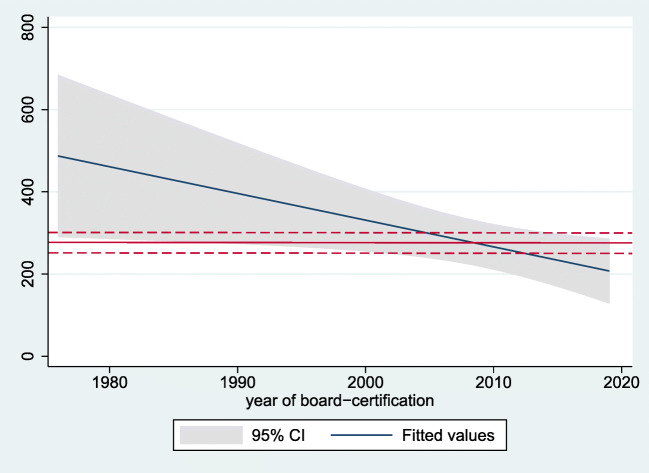
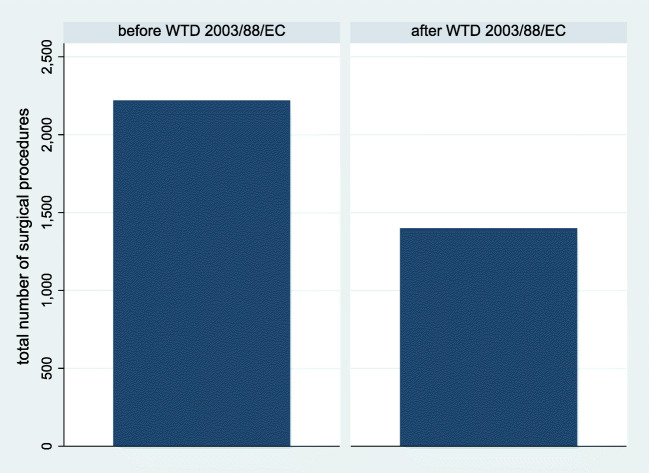
Of 430 responses, 168 were considered for analysis after checking in- and exclusion criteria. Survey responders had a mean age of 42.7 ± 8.8 years, and 88.8% were male. Responses mainly came from surgeons employed at university/teaching hospitals (85.1%) in Germany (22.0%), France (12.5%), the United Kingdom (UK; 8.3%), Switzerland (7.7%), and Greece (7.1%). Most responders graduated in the years between 2011 and 2019 (57.7%). Thirty-eight responders (22.6%) graduated before and 130 responders (77.4%) after the European WTD 2003/88/EC came into effect. The mean number of surgical procedures performed independently, supervised or assisted throughout residency was 540 (95% CI 424-657), 482 (95% CI 398-568), and 579 (95% CI 441-717), respectively. Detailed numbers for cranial, spinal, adult, and pediatric subgroups are presented in the article. There was an annual decrease of about 33 cases in total caseload between 1976 and 2019 (coeff. - 33, 95% CI - 62 to - 4, p = 0.025). Variables associated with lesser total caseload during residency were training abroad (1210 vs. 1747, p = 0.083) and female sex by trend (947 vs. 1671, p = 0.111), whereas case numbers were comparable across the EANS countries (p = 0.443).
The final results of this survey largely confirm the previously reported numbers. They provide an opportunity for current trainees to compare their own case logs with. Again, we confirm a significant decline in surgical exposure during training between 1976 and 2019. In addition, the current analysis reveals that female sex and training abroad may be variables associated with lesser case numbers during residency.
要求欧洲神经外科学会协会(EANS)成员国的认证神经外科医生审查他们的住院医师病例记录并参与 31 个问题的电子调查(SurveyMonkey Inc.,加利福尼亚州圣马特奥)。考虑到 2018 年 4 月 25 日至 2020 年 4 月 25 日之间收到的答复。我们排除了不完整的答复,来自非 EANS 成员国的答复或尚未完成住院医师培训的答复。
在检查了入组和排除标准后,从 430 份答复中,有 168 份被认为可用于分析。调查应答者的平均年龄为 42.7±8.8 岁,88.8%为男性。答复主要来自德国(22.0%),法国(12.5%),英国(8.3%),瑞士(7.7%)和希腊(7.1%)的大学/教学医院的外科医生。大多数应答者毕业于 2011 年至 2019 年之间(57.7%)。38 名应答者(22.6%)毕业于欧洲 WTD 2003/88/EC 生效之前,130 名应答者(77.4%)毕业于该法案之后。整个住院医师培训期间独立进行,监督或协助的手术程序数量分别为 540(95%CI 424-657),482(95%CI 398-568)和 579(95%CI 441-717)。文章中介绍了详细的颅,脊柱,成人和儿科亚组数字。1976 年至 2019 年之间,总病例量每年减少约 33 例(系数-33,95%CI-62 至-4,p=0.025)。与住院医师培训期间总病例量较低相关的变量是出国培训(1210 与 1747,p=0.083)和女性(趋势,947 与 1671,p=0.111),而 EANS 国家之间的病例数量相当(p=0.443)。
这项调查的最终结果在很大程度上证实了之前报告的数字。它们为当前的受训者提供了一个机会,可以将自己的病例记录与其他人进行比较。同样,我们再次确认在 1976 年至 2019 年期间,手术培训期间的手术暴露量明显下降。此外,目前的分析表明,女性和出国培训可能是与住院医师培训期间病例数量较少相关的变量。