Department of Internal Medicine, Division of Thrombosis and Hemostasis, Einthoven laboratory for Vascular and Regenerative Medicine, Leiden University Medical Center, Leiden, the Netherlands.
Department of Hematology, Erasmus University Medical Center, Rotterdam, The Netherlands.
Thromb Haemost. 2020 Nov;120(11):1569-1579. doi: 10.1055/s-0040-1715442. Epub 2020 Aug 15.
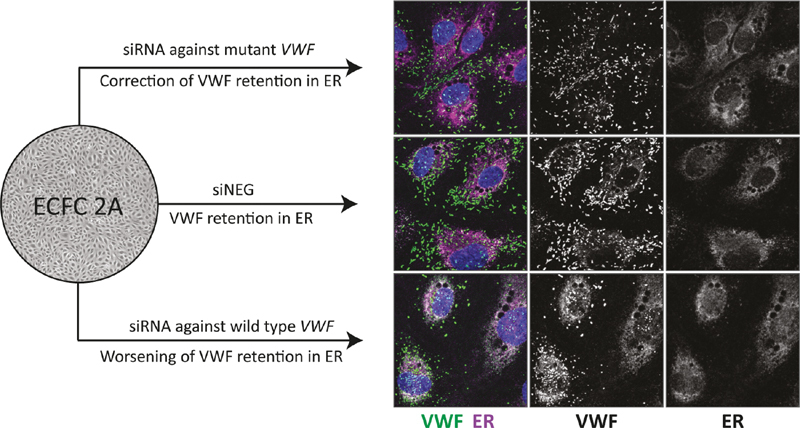
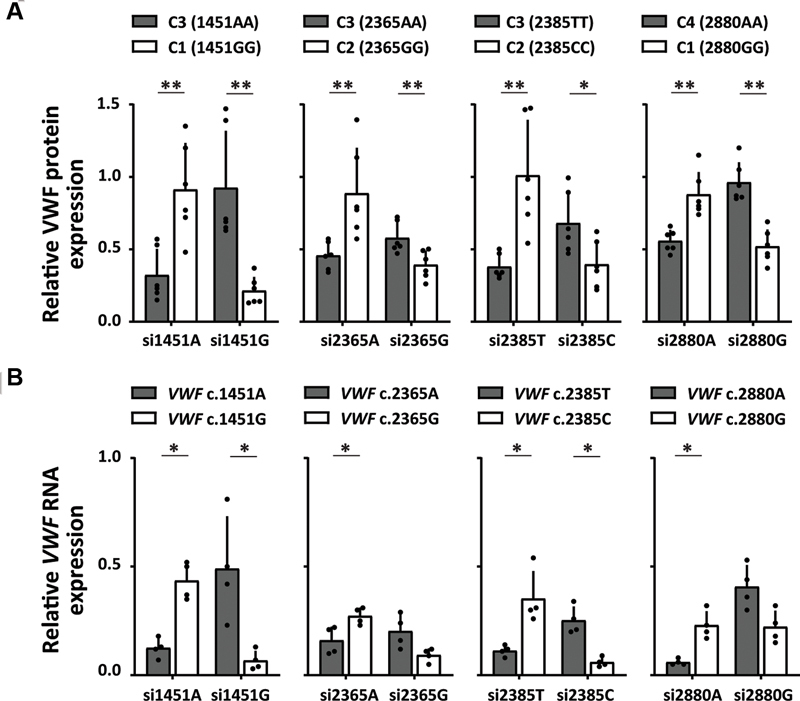
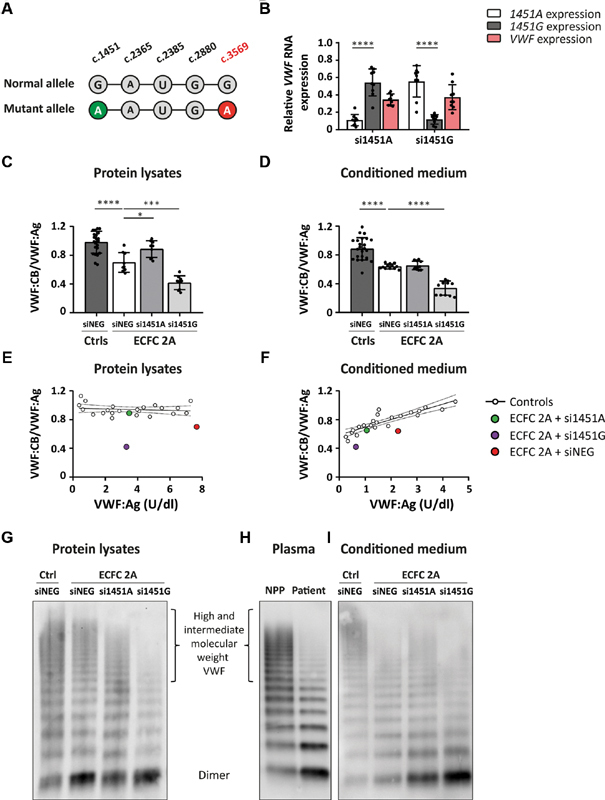
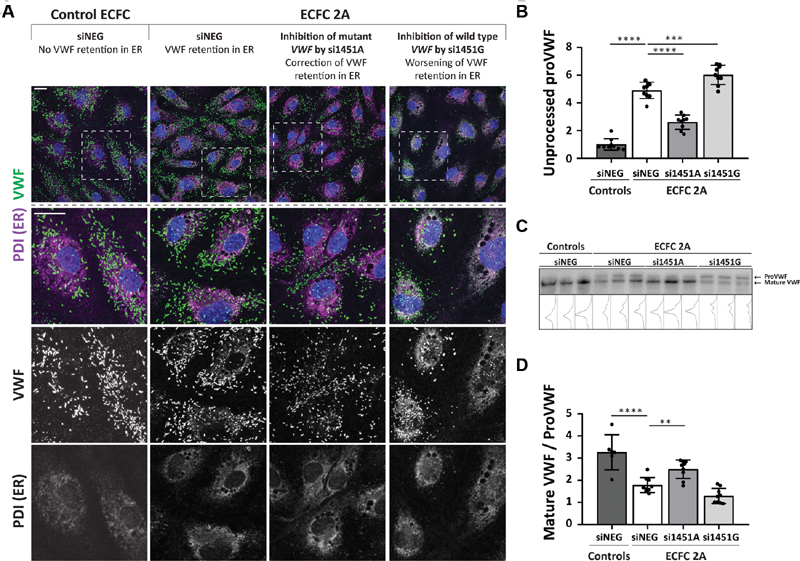
Von Willebrand disease (VWD) is the most common inherited bleeding disorder and is mainly caused by dominant-negative mutations in the multimeric protein von Willebrand factor (VWF). These mutations may either result in quantitative or qualitative defects in VWF. VWF is an endothelial protein that is secreted to the circulation upon endothelial activation. Once secreted, VWF multimers bind platelets and chaperone coagulation factor VIII in the circulation. Treatment of VWD focuses on increasing VWF plasma levels, but production and secretion of mutant VWF remain uninterrupted. Presence of circulating mutant VWF might, however, still affect normal hemostasis or functionalities of VWF beyond hemostasis. We hypothesized that inhibition of the production of mutant VWF improves the function of VWF overall and ameliorates VWD phenotypes. We previously proposed the use of allele-specific small-interfering RNAs (siRNAs) that target frequent single nucleotide polymorphisms to inhibit mutant . The aim of this study is to prove the functionality of these allele-specific siRNAs in endothelial colony-forming cells (ECFCs). We isolated ECFCs from a VWD type 2A patient with an intracellular multimerization defect, reduced VWF collagen binding, and a defective processing of proVWF to VWF. After transfection of an allele-specific siRNA that specifically inhibited expression of mutant VWF, we showed amelioration of the laboratory phenotype, with normalization of the VWF collagen binding, improvement in VWF multimers, and enhanced VWF processing. Altogether, we prove that allele-specific inhibition of the production of mutant VWF by siRNAs is a promising therapeutic strategy to improve VWD phenotypes.
血管性血友病(VWD)是最常见的遗传性出血性疾病,主要由血管性血友病因子(VWF)多聚体蛋白的显性负突变引起。这些突变可能导致 VWF 的数量或质量缺陷。VWF 是一种内皮蛋白,在内皮细胞激活时分泌到循环中。一旦分泌,VWF 多聚体与血小板结合,并在循环中充当凝血因子 VIII 的伴侣。VWD 的治疗重点是增加 VWF 血浆水平,但突变型 VWF 的产生和分泌仍未中断。然而,循环中存在突变型 VWF 可能仍然会影响 VWF 的正常止血功能或止血功能以外的其他功能。我们假设抑制突变型 VWF 的产生可以改善 VWF 的整体功能,并改善 VWD 的表型。我们之前提出使用针对常见单核苷酸多态性的等位基因特异性小干扰 RNA(siRNA)来抑制突变型。本研究的目的是证明这些等位基因特异性 siRNA 在血管内皮祖细胞(ECFCs)中的功能。我们从一位 2A 型 VWD 患者中分离出 ECFCs,该患者存在细胞内多聚化缺陷、VWF 胶原结合减少以及前 VWF 向 VWF 的加工缺陷。在转染专门抑制突变型 VWF 表达的等位基因特异性 siRNA 后,我们显示出实验室表型的改善,VWF 胶原结合正常化,VWF 多聚体改善,以及 VWF 加工增强。总之,我们证明了 siRNA 对突变型 VWF 产生的等位基因特异性抑制是改善 VWD 表型的一种有前途的治疗策略。