Hearing Systems Section, Department of Health Technology, Technical University of Denmark, DK-2800, Kgs. Lyngby, Denmark.
Medical Research Council Cognition and Brain Sciences Unit, University of Cambridge, 15 Chaucer Road, Cambridge, CB2 7EF, UK.
J Assoc Res Otolaryngol. 2020 Dec;21(6):511-526. doi: 10.1007/s10162-020-00768-x. Epub 2020 Aug 17.
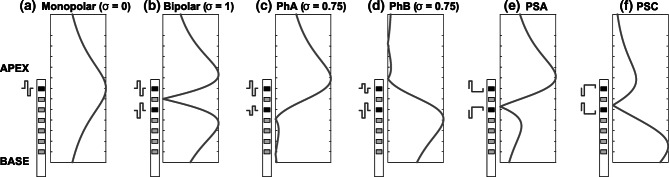
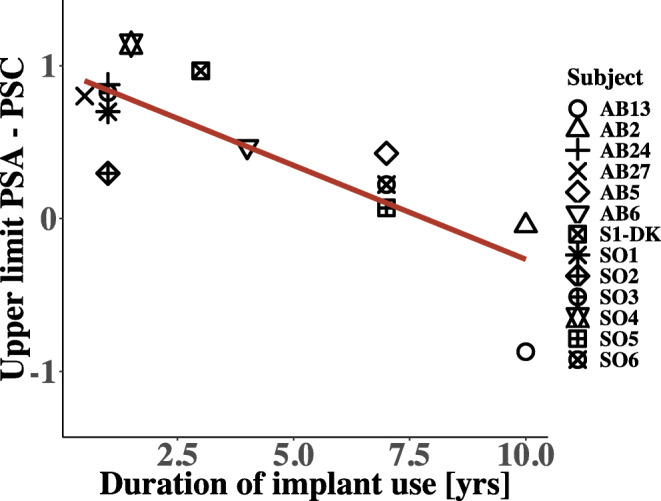
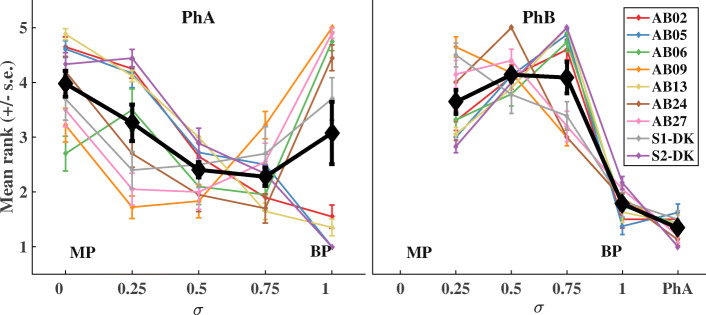
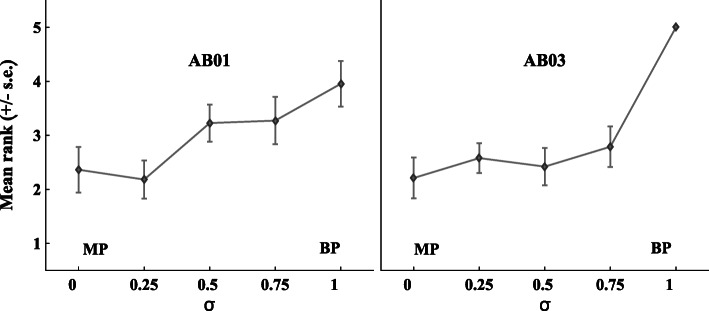
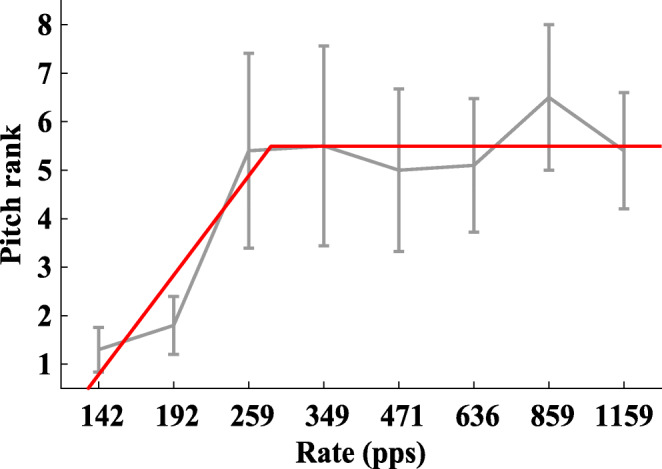
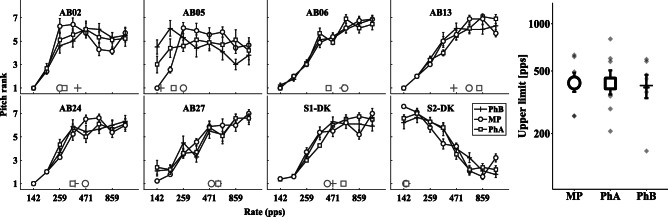
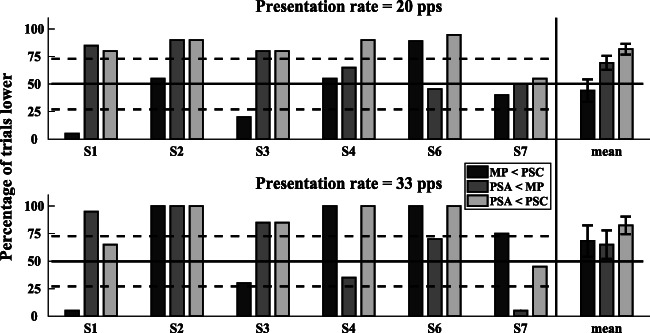
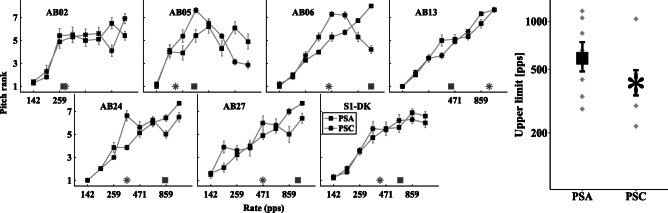
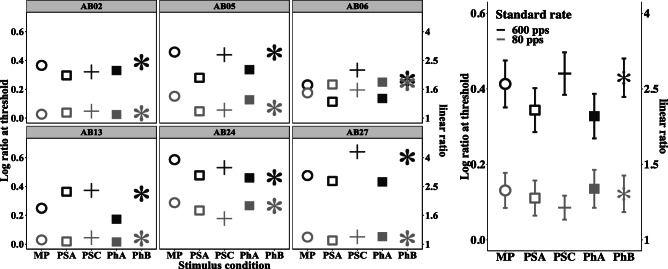
It has been suggested that a specialized high-temporal-acuity brainstem pathway can be activated by stimulating more apically in the cochlea than is achieved by cochlear implants (CIs) when programmed with contemporary clinical settings. We performed multiple experiments to test the effect on pitch perception of phantom stimulation and asymmetric current pulses, both supposedly stimulating beyond the most apical electrode of a CI. The two stimulus types were generated using a bipolar electrode pair, composed of the most apical electrode of the array and a neighboring, more basal electrode. Experiment 1 used a pitch-ranking procedure where neural excitation was shifted apically or basally using so-called phantom stimulation. No benefit of apical phantom stimulation was found on the highest rate up to which pitch ranks increased (upper limit), nor on the slopes of the pitch-ranking function above 300 pulses per second (pps). Experiment 2 used the same procedure to study the effects of apical pseudomonophasic pulses, where the locus of excitation was manipulated by changing stimulus polarity. A benefit of apical stimulation was obtained for the slopes above 300 pps. Experiment 3 used an adaptive rate discrimination procedure and found a small but significant benefit of both types of apical stimulation. Overall, the results show some benefit for apical stimulation on temporal pitch processing at high pulse rates but reveal that the effect is smaller and more variable across listeners than suggested by previous research. The results also provide some indication that the benefit of apical stimulation may decline over time since implantation.
有人提出,通过在耳蜗中比当前临床设置下的耳蜗植入物(CI)编程时更向顶部刺激,可以激活专门的高时间分辨率脑干通路。我们进行了多项实验,以测试假设的超越 CI 最顶端电极刺激的幻听刺激和不对称电流脉冲对音调感知的影响。这两种刺激类型使用双极电极对产生,该电极对由数组的最顶端电极和相邻的更基底部电极组成。实验 1 使用了一种音调排序程序,通过所谓的幻听刺激来改变神经兴奋的顶部或底部位置。在音调排名增加的最高速率(上限)上,以及在每秒 300 个脉冲以上的音调排序函数的斜率上,都没有发现顶部幻听刺激的好处。实验 2 使用相同的程序来研究顶部伪单相脉冲的影响,其中通过改变刺激极性来操纵兴奋的位置。在每秒 300 个脉冲以上的斜率上,获得了顶部刺激的好处。实验 3 使用了自适应速率辨别程序,发现这两种类型的顶部刺激都有很小但显著的好处。总体而言,结果表明在高脉冲速率下,顶部刺激对时间音调处理有一定的好处,但与先前的研究相比,结果表明这种效果在听众之间更小且更具变异性。结果还表明,由于植入物的原因,顶部刺激的好处可能会随着时间的推移而下降。