Cosentino Stefano, Carlyon Robert P, Deeks John M, Parkinson Wendy, Bierer Julie A
MRC Cognition and Brain Sciences Unit, 15 Chaucer Rd, Cambridge, CB2 7EF, UK.
Department of Speech and Hearing Sciences, University of Washington, 1417 NE 42nd St, Seattle, WA, 98105, USA.
J Assoc Res Otolaryngol. 2016 Aug;17(4):371-82. doi: 10.1007/s10162-016-0569-5. Epub 2016 Apr 21.
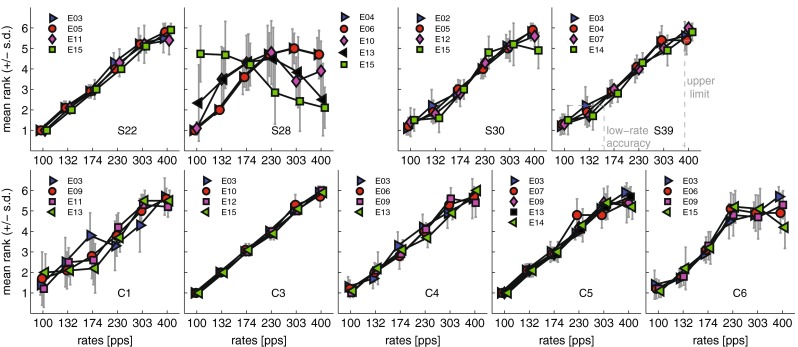
Cochlear implant (CI) users have poor temporal pitch perception, as revealed by two key outcomes of rate discrimination tests: (i) rate discrimination thresholds (RDTs) are typically larger than the corresponding frequency difference limen for pure tones in normal hearing listeners, and (ii) above a few hundred pulses per second (i.e. the "upper limit" of pitch), CI users cannot discriminate further increases in pulse rate. Both RDTs at low rates and the upper limit of pitch vary across listeners and across electrodes in a given listener. Here, we compare across-electrode and across-subject variation in these two measures with the variation in performance on another temporal processing task, gap detection, in order to explore the limitations of temporal processing in CI users. RDTs were obtained for 4-5 electrodes in each of 10 Advanced Bionics CI users using two interleaved adaptive tracks, corresponding to standard rates of 100 and 400 pps. Gap detection was measured using the adaptive procedure and stimuli described by Bierer et al. (JARO 16:273-284, 2015), and for the same electrodes and listeners as for the rate discrimination measures. Pitch ranking was also performed using a mid-point comparison technique. There was a marginal across-electrode correlation between gap detection and rate discrimination at 400 pps, but neither measure correlated with rate discrimination at 100 pps. Similarly, there was a highly significant across-subject correlation between gap detection and rate discrimination at 400, but not 100 pps, and these two correlations differed significantly from each other. Estimates of low-rate sensitivity and of the upper limit of pitch, obtained from the pitch ranking experiment, correlated well with rate discrimination for the 100- and 400-pps standards, respectively. The results are consistent with the upper limit of rate discrimination sharing a common basis with gap detection. There was no evidence that this limitation also applied to rate discrimination at lower rates.
人工耳蜗(CI)使用者的时间音调感知能力较差,这在速率辨别测试的两个关键结果中得以体现:(i)速率辨别阈值(RDT)通常大于正常听力者纯音对应的频率差异阈限,且(ii)每秒几百个脉冲以上(即音调的“上限”)时,CI使用者无法辨别脉冲速率的进一步增加。低速率下的RDT以及音调上限在不同听者之间以及给定听者的不同电极之间都会有所变化。在此,我们将这两种测量方法中跨电极和跨受试者的变化与另一时间处理任务——间隙检测的表现变化进行比较,以探究CI使用者时间处理的局限性。使用两条交错的自适应轨迹,为10名Advanced Bionics CI使用者中的每一位的4 - 5个电极获取RDT,对应标准速率为100和400脉冲每秒。间隙检测采用Bierer等人(《美国听力学杂志》16:273 - 284,2015年)描述的自适应程序和刺激进行测量,且针对与速率辨别测量相同的电极和听者。音调排序也使用中点比较技术进行。在400脉冲每秒时,间隙检测与速率辨别之间存在微弱的跨电极相关性,但两种测量方法与100脉冲每秒时的速率辨别均无相关性。同样,在400脉冲每秒而非100脉冲每秒时,间隙检测与速率辨别之间存在高度显著的跨受试者相关性,且这两种相关性彼此差异显著。从音调排序实验中获得的低速率敏感度估计值和音调上限估计值,分别与100和400脉冲每秒标准下的速率辨别相关性良好。结果表明,速率辨别上限与间隙检测有共同基础。没有证据表明这种局限性也适用于较低速率下的速率辨别。