Department of Neurology, Beijing Tiantan Hospital, Capital Medical University, Beijing, China.
Curr Neurovasc Res. 2020;17(4):487-494. doi: 10.2174/1567202617666200817141837.
There is some controversy whether stroke history is an independent risk factor for poor prognosis of stroke or not. This study aimed to investigate the difference of mortality, disability and recurrent rate of ischemic stroke patients without and with stroke history, as well as to explore the effect of stroke history on stroke prognosis.
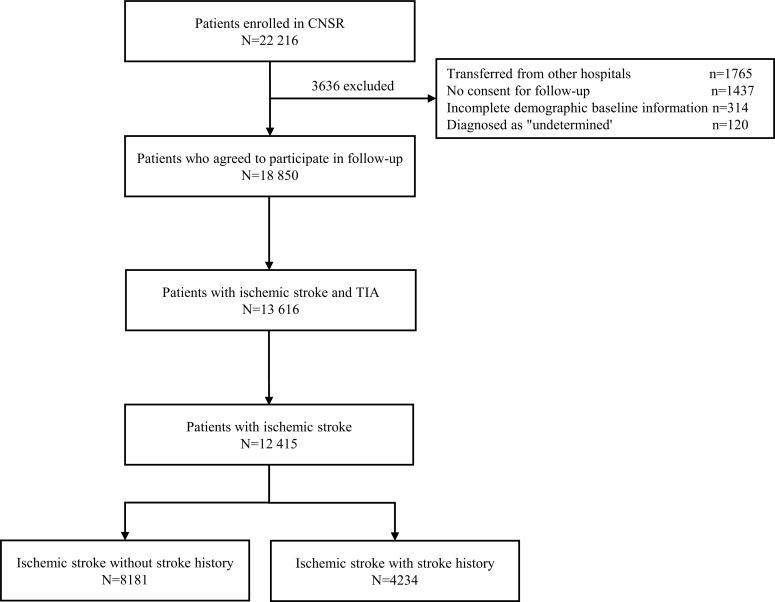
We analyzed patients with ischemic stroke enrolled in the China National Stroke Registry which was a nationwide, multicenter, and prospective registry of consecutive patients with acute cerebrovascular events from 2007 to 2008. Multivariable logistic regression was performed to assess the risk of worse prognosis of stroke history in patients with ischemic stroke.
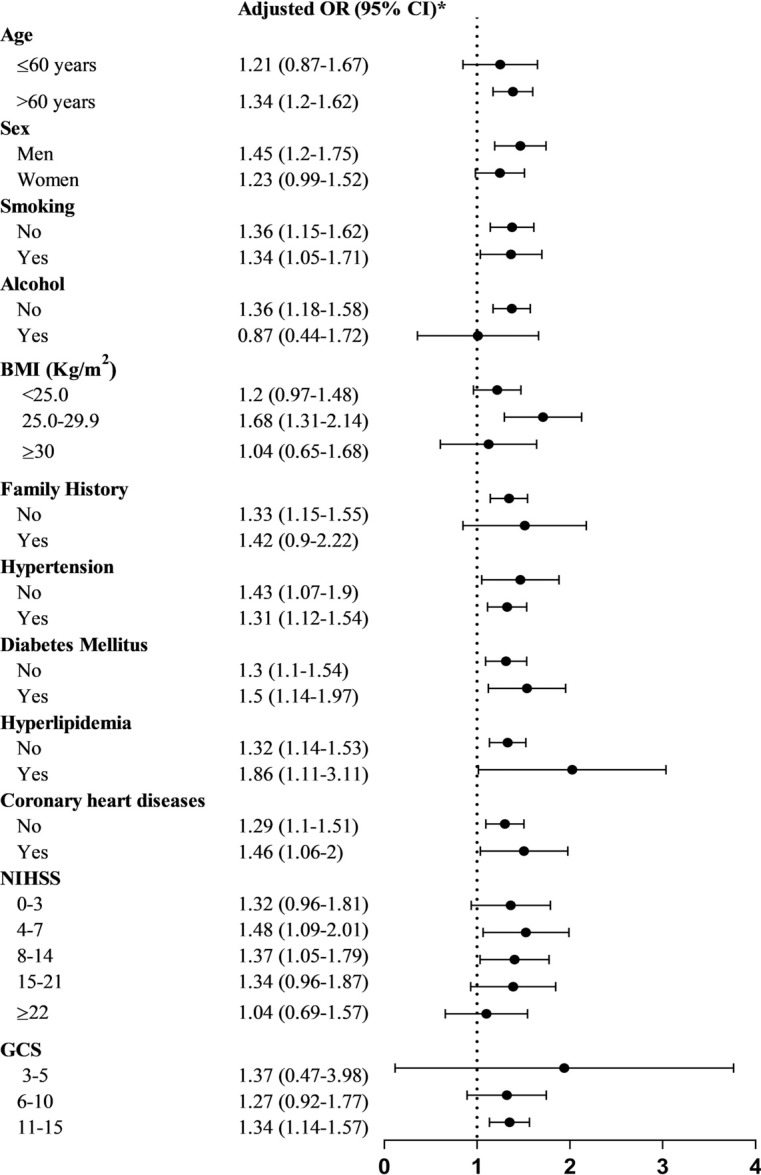
A total of 8181(65.9%) patients without stroke history and 4234(34.1%) patients with stroke history were enrolled in the study. The mortality, recurrence, modified Rankin Scale (mRS) 3-6 rate was 11.4%, 14.7% and 28.5% respectively at 1 year for patients without stroke history, which was significantly lower than that of 17.3%, 23.6%, 42.1% in patients with stroke history, respectively. Multivariable analysis showed that patients with stroke history had higher risk of death [odds ratio (OR) 1.34,95% confidence interval (CI) 1.17-1.54], recurrence (OR 1.47, 95 % CI 1.31-1.65) and mRS 3-6 (OR 1.49,95% CI 1.34-1.66) at 1 year.
After adjusting for the potential confounders, stroke history was still an independent risk factor for poor prognosis of ischemic stroke, which further emphasizes the importance of secondary prevention of ischemic stroke. The specific causes of poor prognosis in patients with history of stroke need to be furtherly investigated.
卒中史是否是卒中预后不良的独立危险因素尚存争议。本研究旨在探讨有无卒中史的缺血性卒中患者的病死率、残疾率和再发率的差异,并探讨卒中史对卒中预后的影响。
我们分析了 2007 年至 2008 年期间中国国家卒中登记(China National Stroke Registry)连续入组的急性脑血管病患者,该登记是一项全国性、多中心、前瞻性登记。采用多变量 logistic 回归评估缺血性卒中患者存在卒中史对其预后不良的风险。
共纳入 8181 例(65.9%)无卒中史患者和 4234 例(34.1%)有卒中史患者。无卒中史患者 1 年病死率、再发率、改良 Rankin 量表(mRS)3-6 分率分别为 11.4%、14.7%和 28.5%,显著低于有卒中史患者的 17.3%、23.6%和 42.1%。多变量分析显示,有卒中史患者的死亡风险[比值比(OR)1.34,95%置信区间(CI)1.17-1.54]、再发风险(OR 1.47,95%CI 1.31-1.65)和 mRS 3-6 分风险(OR 1.49,95%CI 1.34-1.66)更高。
校正潜在混杂因素后,卒中史仍是缺血性卒中预后不良的独立危险因素,进一步强调了缺血性卒中二级预防的重要性。需要进一步研究有卒中史患者预后不良的具体原因。