Department of Trauma and Emergency Surgery, Linkou branch of Chang Gung Memorial Hospital, 5, Fuxing St., Guishan Dist, Taoyuan City, 33305, Taiwan.
World J Emerg Surg. 2020 Aug 17;15(1):48. doi: 10.1186/s13017-020-00328-x.
The most common cause of death in cases of pelvic trauma is exsanguination caused by associated injuries, not the pelvic injury itself. For patients with relatively isolated pelvic trauma, the impact of vascular injury severity on outcome remains unclear. We hypothesized that the severity of the pelvic vascular injury plays a more decisive role in outcome than fracture pattern complexity.
Medical records of patients with pelvic fracture at a single center between January 2016 and December 2017 were retrospectively reviewed. Those with an abbreviated injury scale (AIS) score ≥ 3 in areas other than the pelvis were excluded. Lateral compression (LC) type 1 fractures and anteroposterior compression (APC) type 1 fractures according to the Young-Burgess classification and ischial fractures were defined as simple pelvic fractures, while other fracture types were considered complicated pelvic fractures. Based on CT, vascular injury severity was defined as minor (fracture with or without hematoma) or severe (hematoma with contrast pooling/extravasation). Patient demographics, clinical parameters, and outcome measures were compared between the groups.
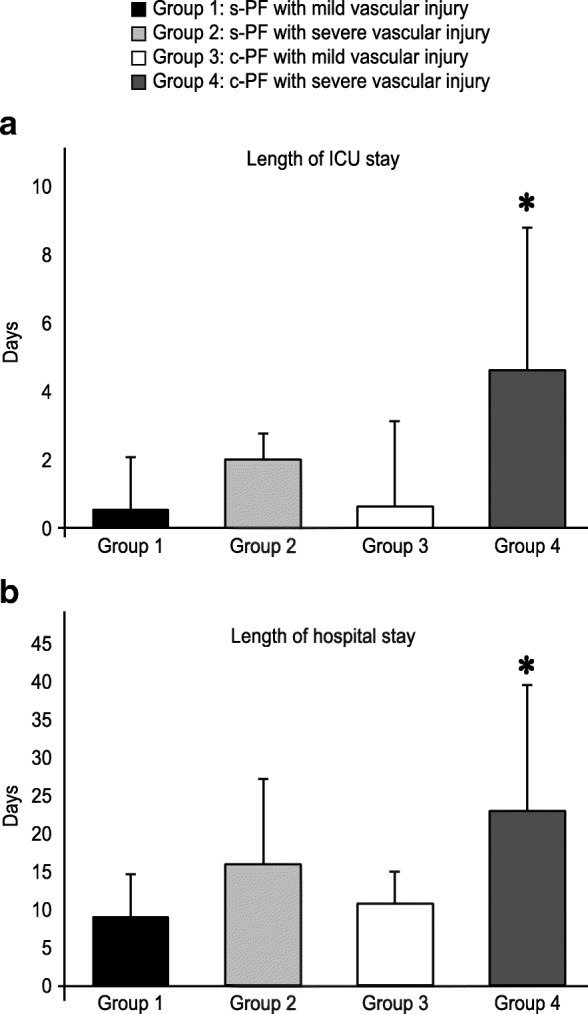
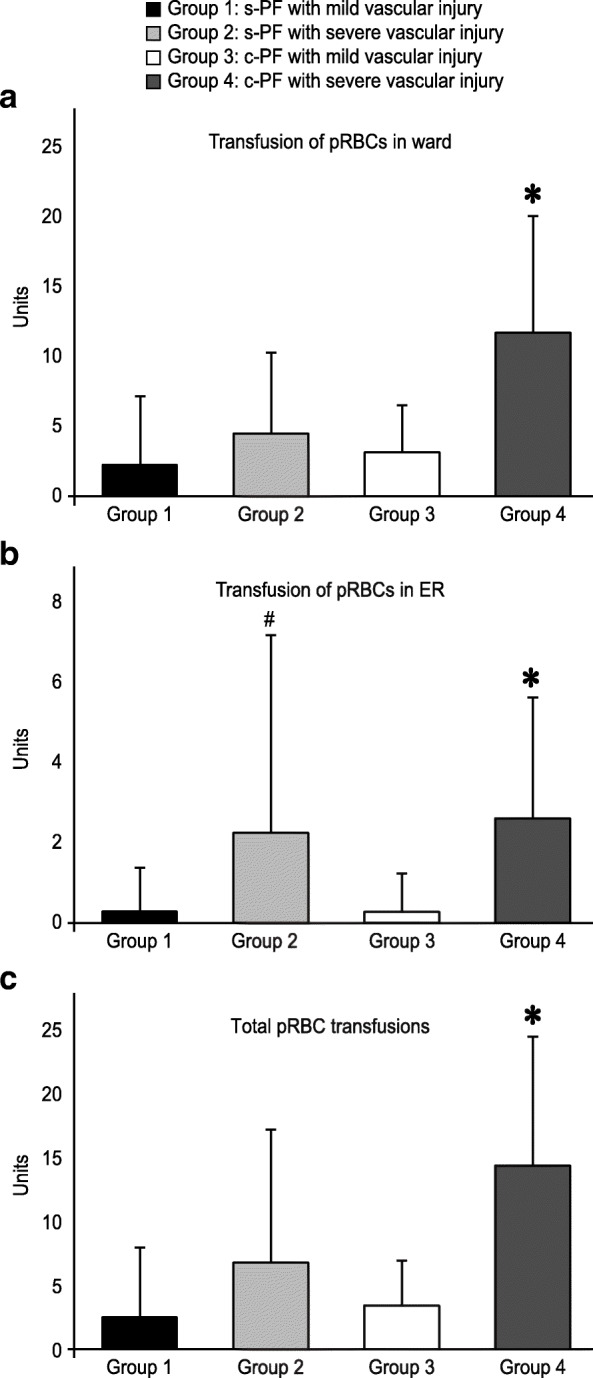
Severe vascular injuries occurred in 26 of the 155 patients and were associated with poorer hemodynamics, a higher injury severity score (ISS), more blood transfusions, and a longer ICU stay (3.81 vs. 0.86 days, p = 0.000) and total hospital stay (20.7 vs. 10.1 days, p = 0.002) compared with minor vascular injuries. By contrast, those with complicated pelvic fractures (LC II/III, APC II/III, vertical shear, and combined type fracture) required a similar number of transfusions and had a similar length of ICU stay as those with simple pelvic fractures (LC I, APC I, and ischium fracture) but had a longer total hospital stay (13.6 vs. 10.3 days, p = 0.034). These findings were similar even if only patients with ISS ≥ 16 were considered.
Our results indicate that even in patients with relatively isolated pelvic injuries, vascular injury severity is more closely correlated to the outcome than the type of anatomical fracture. Therefore, a more balanced classification of pelvic injury that takes both the fracture pattern and hemodynamic status into consideration, such as the WSES classification, seems to have better utility for clinical practice.
骨盆创伤患者死亡的最常见原因是由相关损伤引起的出血,而不是骨盆损伤本身。对于骨盆损伤相对孤立的患者,血管损伤严重程度对结果的影响尚不清楚。我们假设骨盆血管损伤的严重程度比骨折模式的复杂性对结果的影响更大。
回顾性分析 2016 年 1 月至 2017 年 12 月在一家中心治疗的骨盆骨折患者的病历。排除 AIS 评分(abbreviated injury scale)骨盆以外部位≥3 分的患者。根据 Young-Burgess 分类,LC 1 型和 APC 1 型骨折和坐骨骨折被定义为简单骨盆骨折,而其他骨折类型被认为是复杂骨盆骨折。根据 CT,血管损伤严重程度定义为轻微(骨折伴或不伴血肿)或严重(血肿伴造影剂积聚/外渗)。比较两组患者的人口统计学、临床参数和结局指标。
155 例患者中,26 例发生严重血管损伤,其血流动力学较差,损伤严重程度评分(ISS)较高,输血较多,ICU 住院时间(3.81 天比 0.86 天,p=0.000)和总住院时间(20.7 天比 10.1 天,p=0.002)均较长。与轻微血管损伤相比,复杂骨盆骨折(LC II/III、APC II/III、垂直剪力和联合骨折)的患者需要输注的血液量相似,ICU 住院时间相似,但总住院时间较长(13.6 天比 10.3 天,p=0.034)。即使只考虑 ISS≥16 的患者,也得出了类似的结果。
我们的结果表明,即使在骨盆损伤相对孤立的患者中,血管损伤的严重程度与结局的相关性也比解剖骨折的类型更密切。因此,一种更平衡的骨盆损伤分类方法,同时考虑骨折模式和血流动力学状态,如 WSES 分类,似乎对临床实践更有用。