Department of Trauma and Emergency Surgery, Chang Gung Memorial Hospital, Chang Gung University, Taipei, Taiwan.
Department of Trauma and Burn Surgery, Stroger Hospital of Cook County, Rush University, 8th Floor, 1950 West Polk Street, Chicago, IL, 60612, USA.
World J Emerg Surg. 2021 Oct 16;16(1):54. doi: 10.1186/s13017-021-00399-4.
In 2017, a novel classification for pelvic injuries was established by the World Society of Emergency Surgery (WSES). We validated its effectiveness using nationwide real-world data. The roles of associated vascular injury and open fracture in this system were also evaluated.
Patients with pelvic fractures in the National Trauma Data Bank 2015 dataset were retrospectively studied. First, the mortality rates were compared by WSES classification. Second, independent predictors of mortality were evaluated using a multivariate logistic regression model. Patients with and without associated vascular injuries and the same hemodynamic and pelvic ring stability statuses were compared. Patients with associated vascular injuries were compared to the proportion of nonsurvivors and survivors with unstable pelvic ring injuries. Third, the outcomes were compared between patients with open pelvic fracture and closed pelvic fracture in the mild, moderate and severe WSES classes.
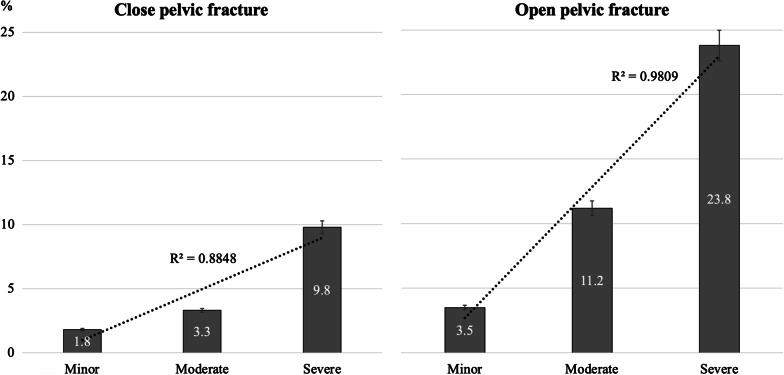
During the 12-month study period, 44,163 blunt pelvic fracture patients were included. The mortality rates were 1.8%, 3.8% and 10.6% for the mild, moderate and severe WSES classes, respectively (p < 0.001). MLR analysis showed that unstable pelvic ring injury did not significantly affect mortality (p = 0.549), whereas open pelvic fracture and associated vascular injury were independent predictors of mortality (odds of mortality: open pelvic fracture 1.630, p < 0.001; associated vascular injury 1.602, p < 0.001). Patients with associated vascular injuries showed that there was no significant difference in the proportion of patients with unstable pelvic ring injuries between survivors and nonsurvivors (37.2% vs. 32.7%, p = 0.323). In all three classes, patients with open pelvic fractures had significantly higher mortality rates and infection rates than patients with closed fractures (mortality rates: minor 3.5% vs. 1.8%, p = 0.009, moderate 11.2% vs. 3.3%, p < 0.001, severe 23.8% vs. 9.8%, p < 0.001; infection rates: minor 3.3% vs. 0.7%, p < 0.001, moderate 6.7% vs. 2.1%, p < 0.001, severe 7.9% vs. 2.8%, p < 0.001).
Based on this nationwide study, the WSES guideline provides an accurate and reproducible classification of pelvic fractures. It is recommended that open/closed fractures and associated vascular injuries be evaluated as supplements of the WSES classification.
2017 年,世界急诊外科学会(WSES)建立了一种新的骨盆损伤分类方法。我们使用全国范围内的真实数据验证了其有效性。本研究还评估了相关血管损伤和开放性骨折在该系统中的作用。
回顾性分析 2015 年国家创伤数据库中骨盆骨折患者的数据。首先,根据 WSES 分类比较死亡率。其次,使用多变量逻辑回归模型评估死亡率的独立预测因素。比较伴有和不伴有相关血管损伤且具有相同血流动力学和骨盆环稳定性的患者。比较伴有相关血管损伤的患者与不稳定骨盆环损伤的非幸存者和幸存者的比例。第三,比较 WSES 分级轻度、中度和重度的开放性骨盆骨折与闭合性骨盆骨折患者的结局。
在 12 个月的研究期间,共纳入 44163 例钝性骨盆骨折患者。轻度、中度和重度 WSES 分级的死亡率分别为 1.8%、3.8%和 10.6%(p<0.001)。MLR 分析显示不稳定骨盆环损伤对死亡率无显著影响(p=0.549),而开放性骨盆骨折和相关血管损伤是死亡率的独立预测因素(死亡率的比值比:开放性骨盆骨折 1.630,p<0.001;相关血管损伤 1.602,p<0.001)。伴有相关血管损伤的患者中,存活者与非存活者不稳定骨盆环损伤的比例无显著差异(37.2%比 32.7%,p=0.323)。在所有 3 个级别中,开放性骨盆骨折患者的死亡率和感染率均显著高于闭合性骨折患者(死亡率:轻度 3.5%比 1.8%,p=0.009,中度 11.2%比 3.3%,p<0.001,重度 23.8%比 9.8%,p<0.001;感染率:轻度 3.3%比 0.7%,p<0.001,中度 6.7%比 2.1%,p<0.001,重度 7.9%比 2.8%,p<0.001)。
基于这项全国性研究,WSES 指南为骨盆骨折提供了一种准确且可重复的分类方法。建议将开放性/闭合性骨折和相关血管损伤作为 WSES 分类的补充。