NUTRIM School of Nutrition and Translational Research in Metabolism, Maastricht University, Maastricht, Netherlands.
Department of Nutrition and Movement Sciences, Maastricht University Medical Center, Maastricht, Netherlands.
Cardiovasc Diabetol. 2020 Aug 17;19(1):129. doi: 10.1186/s12933-020-01097-2.
Pericardial fat (PF) has been suggested to directly act on cardiomyocytes, leading to diastolic dysfunction. The aim of this study was to investigate whether a higher PF volume is associated with a lower diastolic function in healthy subjects.
254 adults (40-70 years, BMI 18-35 kg/m, normal left ventricular ejection fraction), with (a)typical chest pain (otherwise healthy) from the cardiology outpatient clinic were retrospectively included in this study. All patients underwent a coronary computed tomographic angiography for the measurement of pericardial fat volume, as well as a transthoracic echocardiography for the assessment of diastolic function parameters. To assess the independent association of PF and diastolic function parameters, multivariable linear regression analysis was performed. To maximize differences in PF volume, the group was divided in low (lowest quartile of both sexes) and high (highest quartile of both sexes) PF volume. Multivariable binary logistic analysis was used to study the associations within the groups between PF and diastolic function, adjusted for age, BMI, and sex.
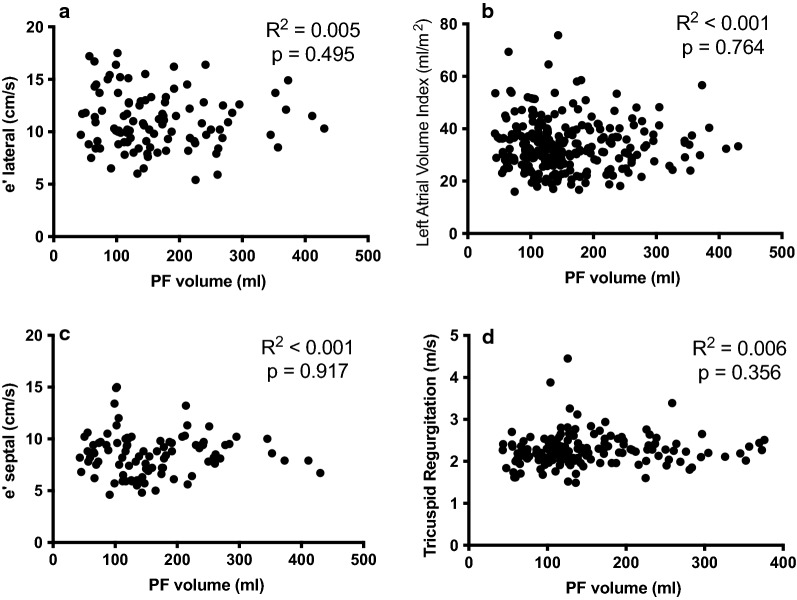
Significant associations for all four diastolic parameters with the PF volume were found after adjusting for BMI, age, and sex. In addition, subjects with high pericardial fat had a reduced left atrial volume index (p = 0.02), lower E/e (p < 0.01) and E/A (p = 0.01), reduced e' lateral (p < 0.01), reduced e' septal p = 0.03), compared to subjects with low pericardial fat.
These findings confirm that pericardial fat volume, even in healthy subjects with normal cardiac function, is associated with diastolic function. Our results suggest that the mechanical effects of PF may limit the distensibility of the heart and thereby directly contribute to diastolic dysfunction. Trial registration NCT01671930.
心包脂肪(PF)被认为直接作用于心肌细胞,导致舒张功能障碍。本研究旨在探讨健康受试者中 PF 体积较高是否与舒张功能较低相关。
本研究回顾性纳入了来自心内科门诊的 254 名成年人(40-70 岁,BMI 18-35kg/m,正常左心室射血分数),他们有(非典型)胸痛(其他方面健康)。所有患者均接受了冠状动脉计算机断层血管造影术以测量心包脂肪体积,并进行了经胸超声心动图以评估舒张功能参数。为了评估 PF 与舒张功能参数的独立相关性,进行了多变量线性回归分析。为了最大限度地增加 PF 体积的差异,将该组分为低(男女最低四分位数)和高(男女最高四分位数)PF 体积组。使用多变量二项逻辑分析来研究组内 PF 与舒张功能之间的关联,调整年龄、BMI 和性别。
在调整 BMI、年龄和性别后,所有四个舒张参数与 PF 体积均存在显著相关性。此外,与低 PF 组相比,高 PF 组的左心房容积指数降低(p=0.02)、E/e 降低(p<0.01)和 E/A 降低(p=0.01)、e' 侧壁降低(p<0.01)、e' 间隔降低(p=0.03)。
这些发现证实,即使在心脏功能正常的健康受试者中,PF 体积也与舒张功能相关。我们的结果表明,PF 的机械效应可能限制心脏的扩张性,从而直接导致舒张功能障碍。
NCT01671930。