Center for Inflammation and Metabolism/Center for Physical Activity Research, Rigshospitalet, Copenhagen, Denmark.
Steno Diabetes Center Copenhagen, Gentofte, Denmark.
Cardiovasc Diabetol. 2019 Aug 30;18(1):114. doi: 10.1186/s12933-019-0917-y.
Cardiac fat is a cardiovascular biomarker but its importance in patients with type 2 diabetes is not clear. The aim was to evaluate the predictive potential of epicardial (EAT), pericardial (PAT) and total cardiac (CAT) fat in type 2 diabetes and elucidate sex differences.
EAT and PAT were measured by echocardiography in 1030 patients with type 2 diabetes. Follow-up was performed through national registries. The end-point was the composite of incident cardiovascular disease (CVD) and all-cause mortality. Analyses were unadjusted (model 1), adjusted for age and sex (model 2), plus systolic blood pressure, body mass index (BMI), low-density lipoprotein (LDL), smoking, diabetes duration and glycated hemoglobin (HbA) (model 3).
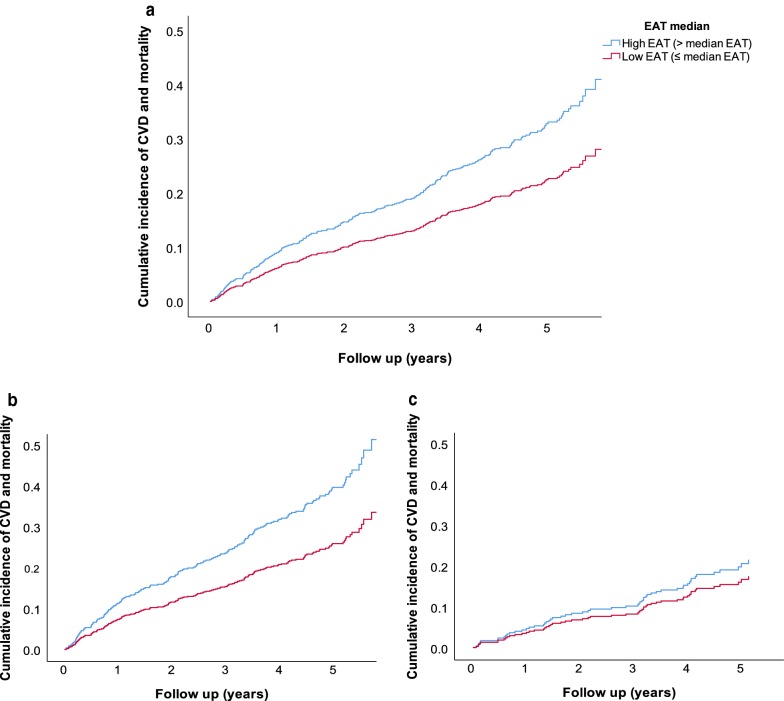
Median follow-up was 4.7 years and 248 patients (191 men vs. 57 women) experienced the composite end-point. Patients with high EAT (> median level) had increased risk of the composite end-point in model 1 [Hazard ratio (HR): 1.46 (1.13; 1.88), p = 0.004], model 2 [HR: 1.31 (1.01; 1.69), p = 0.038], and borderline in model 3 [HR: 1.32 (0.99; 1.77), p = 0.058]. For men, but not women, high EAT was associated with a 41% increased risk of CVD and mortality in model 3 (p = 0.041). Net reclassification index improved when high EAT was added to model 3 (19.6%, p = 0.035). PAT or CAT were not associated with the end-point.
High levels of EAT were associated with the composite of incident CVD and mortality in patients with type 2 diabetes, particularly in men, after adjusting for CVD risk factors. EAT modestly improved risk prediction over CVD risk factors.
心脏脂肪是心血管生物标志物,但在 2 型糖尿病患者中的重要性尚不清楚。目的是评估 2 型糖尿病患者的心外膜(EAT)、心包(PAT)和总心脏(CAT)脂肪的预测潜力,并阐明性别差异。
对 1030 例 2 型糖尿病患者进行超声心动图测量 EAT 和 PAT。通过国家登记处进行随访。终点是心血管疾病(CVD)和全因死亡率的复合事件。分析未经调整(模型 1)、按年龄和性别调整(模型 2)、加收缩压、体重指数(BMI)、低密度脂蛋白(LDL)、吸烟、糖尿病病程和糖化血红蛋白(HbA)(模型 3)。
中位随访时间为 4.7 年,248 例患者(191 例男性与 57 例女性)发生复合终点事件。EAT 高(>中位数水平)的患者在模型 1 中复合终点事件的风险增加[风险比(HR):1.46(1.13;1.88),p=0.004],在模型 2 中[HR:1.31(1.01;1.69),p=0.038],在模型 3 中接近显著[HR:1.32(0.99;1.77),p=0.058]。对于男性,但不是女性,EAT 高与模型 3 中 CVD 和死亡率增加 41%相关(p=0.041)。当将 EAT 高添加到模型 3 时,净重新分类指数提高(19.6%,p=0.035)。PAT 或 CAT 与终点无关。
在调整 CVD 危险因素后,2 型糖尿病患者 EAT 水平升高与 CVD 事件和死亡率的复合事件相关,尤其是男性。EAT 可适度改善 CVD 危险因素的风险预测。