Department of Psychiatry, The First Affiliated Hospital of Xi'an Jiaotong University, Xi'an, China.
Clinical Research Center, The First Affiliated Hospital of Xi'an Jiaotong University, Xi'an, China.
Int J Neuropsychopharmacol. 2021 Jan 20;24(1):32-39. doi: 10.1093/ijnp/pyaa062.
Neuroticism is a strong predictor for a variety of social and behavioral outcomes, but the etiology is still unknown. Our study aims to provide a comprehensive investigation of causal effects of serum metabolome phenotypes on risk of neuroticism using Mendelian randomization (MR) approaches.
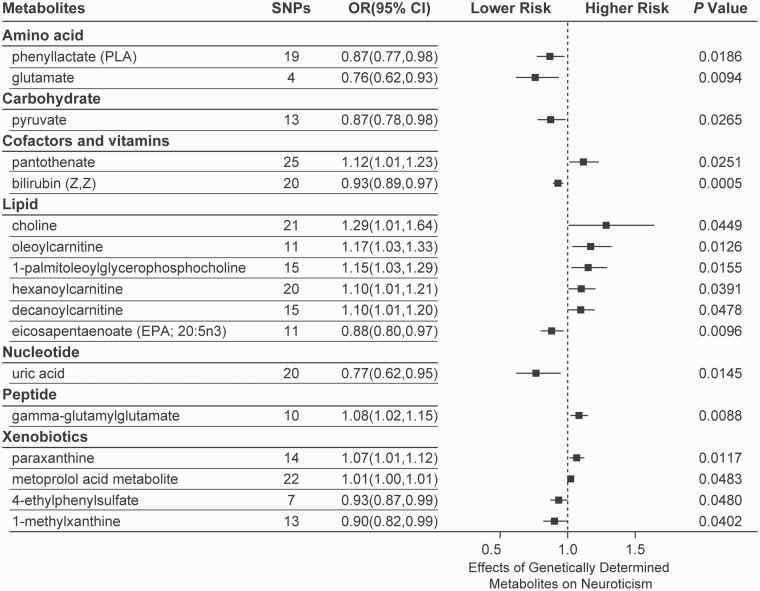
Genetic associations with 486 metabolic traits were utilized as exposures, and data from a large genome-wide association study of neuroticism were selected as outcome. For MR analysis, we used the standard inverse-variance weighted (IVW) method for primary MR analysis and 3 additional MR methods (MR-Egger, weighted median, and MR pleiotropy residual sum and outlier) for sensitivity analyses.
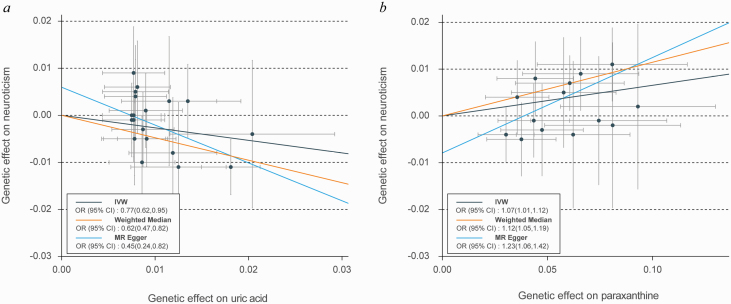
Our study identified 31 metabolites that might have causal effects on neuroticism. Of the 31 metabolites, uric acid and paraxanthine showed robustly significant association with neuroticism in all MR methods. Using single nucleotide polymorphisms as instrumental variables, a 1-SD increase in uric acid was associated with approximately 30% lower risk of neuroticism (OR: 0.77; 95% CI: 0.62-0.95; PIVW = 0.0145), whereas a 1-SD increase in paraxanthine was associated with a 7% higher risk of neuroticism (OR: 1.07; 95% CI: 1.01-1.12; PIVW = .0145).
Our study suggested an increased level of uric acid was associated with lower risk of neuroticism, whereas paraxanthine showed the contrary effect. Our study provided novel insight by combining metabolomics with genomics to help understand the pathogenesis of neuroticism.
神经质是多种社会和行为结果的强有力预测因子,但病因仍不清楚。我们的研究旨在使用孟德尔随机化(MR)方法,全面研究血清代谢组表型对神经质风险的因果影响。
将与 486 种代谢特征相关的遗传关联作为暴露因素,并选择神经质的大型全基因组关联研究的数据作为结果。对于 MR 分析,我们使用标准的逆方差加权(IVW)方法进行主要 MR 分析,并使用另外 3 种 MR 方法(MR-Egger、加权中位数和 MR 偏倚残差和异常值)进行敏感性分析。
我们的研究确定了 31 种可能对神经质有因果影响的代谢物。在所有 MR 方法中,尿酸和对黄嘌呤均与神经质呈显著相关。使用单核苷酸多态性作为工具变量,尿酸每增加 1-SD,神经质的风险约降低 30%(OR:0.77;95%CI:0.62-0.95;PIVW=0.0145),而对黄嘌呤每增加 1-SD,神经质的风险增加 7%(OR:1.07;95%CI:1.01-1.12;PIVW=0.0145)。
我们的研究表明,尿酸水平升高与神经质风险降低有关,而对黄嘌呤则显示出相反的效果。我们的研究通过将代谢组学与基因组学相结合,提供了新的见解,有助于理解神经质的发病机制。