The Walter and Eliza Hall Institute of Medical Research, Victoria, Australia, 3052.
Department of Medical Biology, The University of Melbourne, Victoria, Australia, 3052.
Clin Sci (Lond). 2020 Aug 28;134(16):2091-2115. doi: 10.1042/CS20191211.
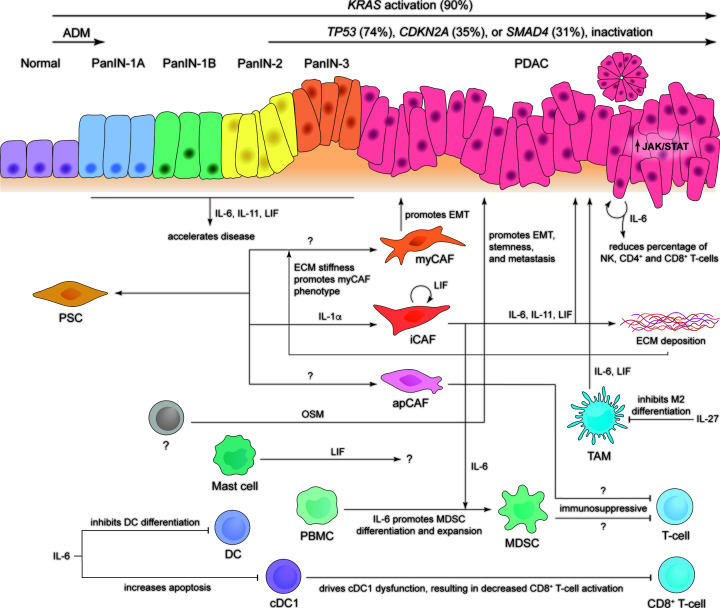
Pancreatic cancer has one of the poorest prognoses of all malignancies, with little improvement in clinical outcome over the past 40 years. Pancreatic ductal adenocarcinoma is responsible for the vast majority of pancreatic cancer cases, and is characterised by the presence of a dense stroma that impacts therapeutic efficacy and drives pro-tumorigenic programs. More specifically, the inflammatory nature of the tumour microenvironment is thought to underlie the loss of anti-tumour immunity and development of resistance to current treatments. Inflammatory pathways are largely mediated by the expression of, and signalling through, cytokines, chemokines, and other cellular messengers. In recent years, there has been much attention focused on dual targeting of cancer cells and the tumour microenvironment. Here we review our current understanding of the role of IL-6, and the broader IL-6 cytokine family, in pancreatic cancer, including their contribution to pancreatic inflammation and various roles in pancreatic cancer pathogenesis. We also summarise potential opportunities for therapeutic targeting of these pathways as an avenue towards combating poor patient outcomes.
胰腺癌是所有恶性肿瘤中预后最差的一种,在过去的 40 年中,其临床疗效几乎没有改善。胰腺导管腺癌是绝大多数胰腺癌病例的原因,其特征是存在密集的基质,这会影响治疗效果并驱动肿瘤发生程序。更具体地说,肿瘤微环境的炎症性质被认为是肿瘤免疫丧失和对当前治疗产生耐药性的基础。炎症途径主要由细胞因子、趋化因子和其他细胞信使的表达和信号转导介导。近年来,人们对双重靶向癌细胞和肿瘤微环境的方法给予了极大的关注。在这里,我们回顾了我们目前对白细胞介素 6(IL-6)及其更广泛的 IL-6 细胞因子家族在胰腺癌中的作用的理解,包括它们对胰腺炎症的贡献以及在胰腺癌发病机制中的各种作用。我们还总结了这些途径的治疗靶向的潜在机会,作为对抗患者不良预后的一种途径。