International Crops Research Institute for the Semi-Arid Tropics (ICRISAT), Hyderabad, India.
International Maize and Wheat Improvement Center (CIMMYT), Mexico City, Mexico.
Theor Appl Genet. 2020 Nov;133(11):3101-3117. doi: 10.1007/s00122-020-03658-1. Epub 2020 Aug 18.
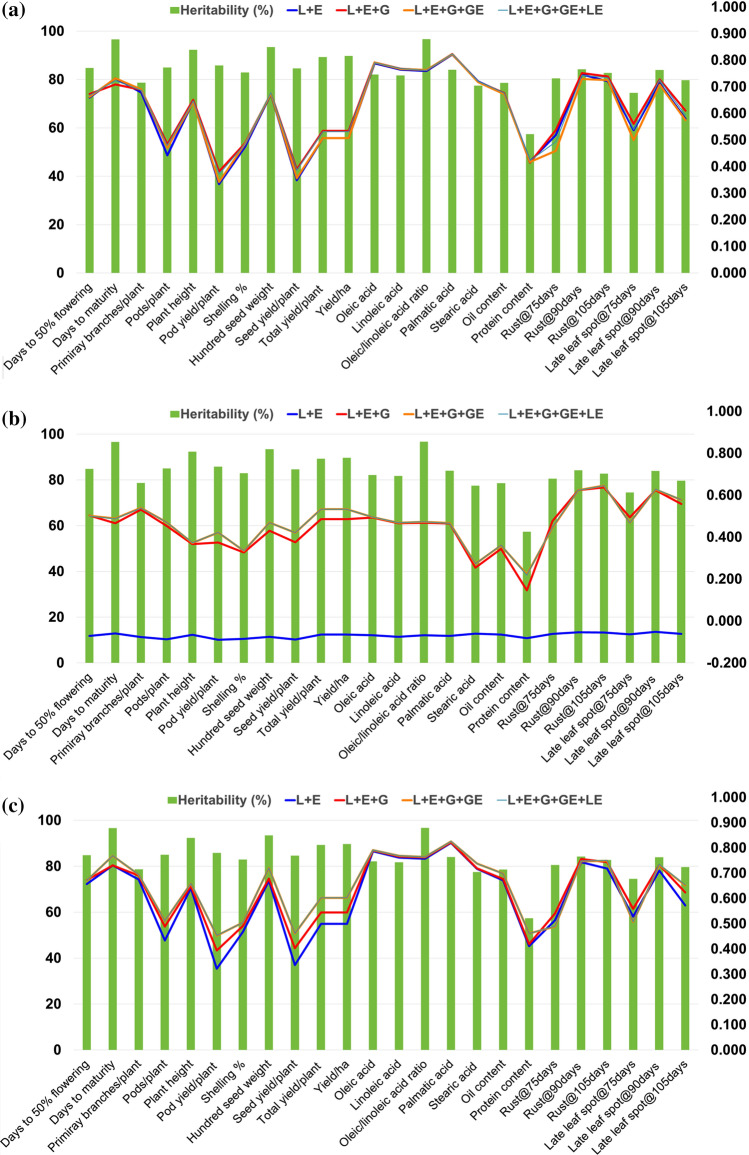
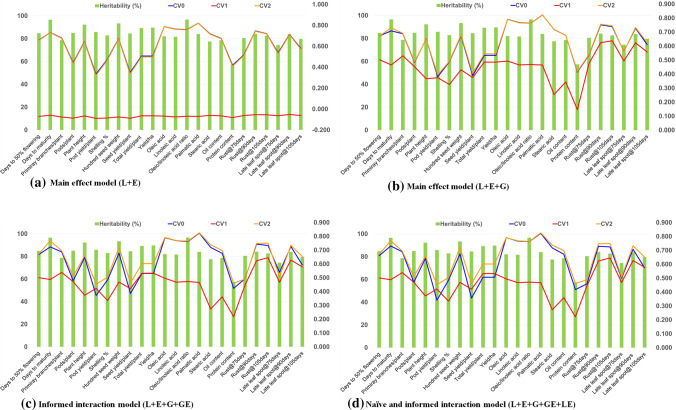
Comparative assessment identified naïve interaction model, and naïve and informed interaction GS models suitable for achieving higher prediction accuracy in groundnut keeping in mind the high genotype × environment interaction for complex traits. Genomic selection (GS) can be an efficient and cost-effective breeding approach which captures both small- and large-effect genetic factors and therefore promises to achieve higher genetic gains for complex traits such as yield and oil content in groundnut. A training population was constituted with 340 elite lines followed by genotyping with 58 K 'Axiom_Arachis' SNP array and phenotyping for key agronomic traits at three locations in India. Four GS models were tested using three different random cross-validation schemes (CV0, CV1 and CV2). These models are: (1) model 1 (M1 = E + L) which includes the main effects of environment (E) and line (L); (2) model 2 (M2 = E + L + G) which includes the main effects of markers (G) in addition to E and L; (3) model 3 (M3 = E + L + G + GE), a naïve interaction model; and (4) model 4 (E + L + G + LE + GE), a naïve and informed interaction model. Prediction accuracy estimated for four models indicated clear advantage of the inclusion of marker information which was reflected in better prediction accuracy achieved with models M2, M3 and M4 as compared to M1 model. High prediction accuracies (> 0.600) were observed for days to 50% flowering, days to maturity, hundred seed weight, oleic acid, rust@90 days, rust@105 days and late leaf spot@90 days, while medium prediction accuracies (0.400-0.600) were obtained for pods/plant, shelling %, and total yield/plant. Assessment of comparative prediction accuracy for different GS models to perform selection for untested genotypes, and unobserved and unevaluated environments provided greater insights on potential application of GS breeding in groundnut.
比较评估确定了适合实现更高预测准确性的朴素交互模型,以及朴素和知情交互 GS 模型,这是考虑到复杂性状的高基因型 × 环境互作而得出的。基因组选择(GS)可以是一种高效且具有成本效益的育种方法,它可以捕获小效应和大效应的遗传因素,因此有望为复杂性状(如花生的产量和油含量)实现更高的遗传增益。使用三种不同的随机交叉验证方案(CV0、CV1 和 CV2)测试了四个 GS 模型。这些模型是:(1)模型 1(M1=E+L),包括环境(E)和系(L)的主效应;(2)模型 2(M2=E+L+G),除了 E 和 L 之外,还包括标记(G)的主效应;(3)模型 3(M3=E+L+G+GE),一个朴素交互模型;和(4)模型 4(E+L+G+LE+GE),一个朴素和知情交互模型。对四个模型进行的预测准确性估计表明,包含标记信息具有明显优势,这反映在模型 M2、M3 和 M4 比模型 M1 获得更好的预测准确性。对于开花 50%的天数、成熟天数、百粒重、油酸、锈病@90 天、锈病@105 天和晚叶斑病@90 天,观察到高预测准确性(>0.600),而对于荚数/株、脱皮率和总产/株,获得中等预测准确性(0.400-0.600)。对不同 GS 模型进行比较预测准确性评估,以对未测试基因型、未观察和未评估环境进行选择,为 GS 育种在花生中的潜在应用提供了更深入的了解。