Adhikari Anil, Basnet Bhoja Raj, Crossa Jose, Dreisigacker Susanne, Camarillo Fatima, Bhati Pradeep Kumar, Jarquin Diego, Manes Yann, Ibrahim Amir M H
Texas A&M University, College Station, TX, United States.
Department of Horticulture, University of Wisconsin, Madison, WI, United States.
Front Genet. 2020 Dec 8;11:586687. doi: 10.3389/fgene.2020.586687. eCollection 2020.
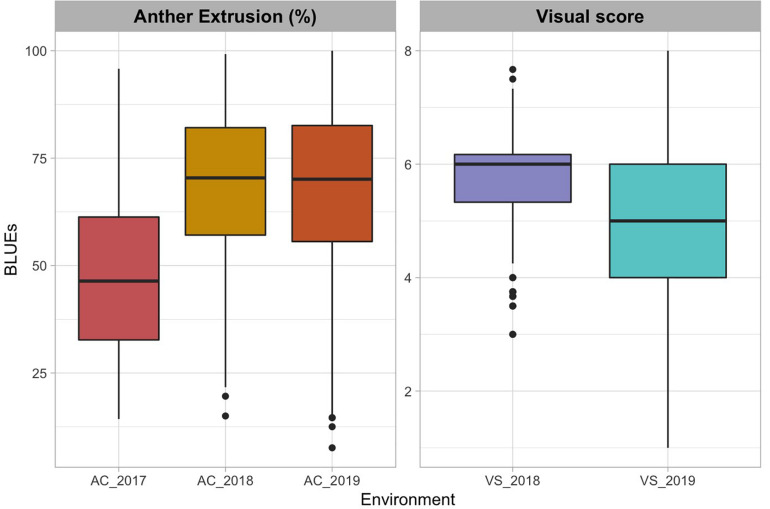
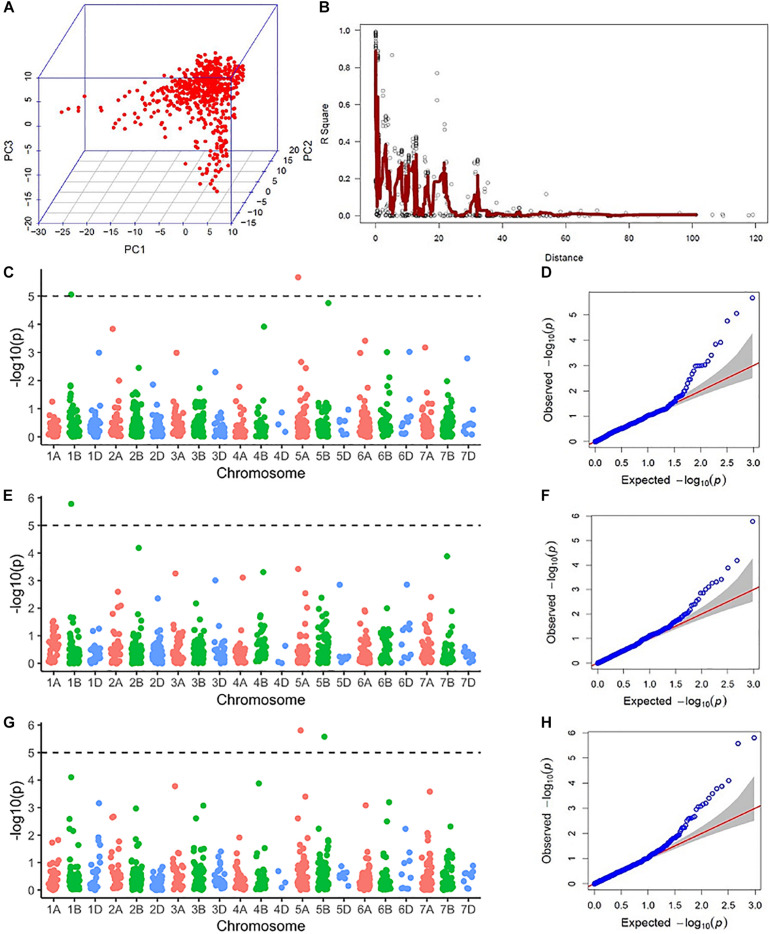
Anther extrusion (AE) is the most important male floral trait for hybrid wheat seed production. AE is a complex quantitative trait that is difficult to phenotype reliably in field experiments not only due to high genotype-by-environment effects but also due to the short expression window in the field condition. In this study, we conducted a genome-wide association scan (GWAS) and explored the possibility of applying genomic prediction (GP) for AE in the CIMMYT hybrid wheat breeding program. An elite set of male lines ( = 603) were phenotype for anther count (AC) and anther visual score (VS) across three field experiments in 2017-2019 and genotyped with the 20K Infinitum is elect SNP array. GWAS produced five marker trait associations with small effects. For GP, the main effects of lines (L), environment (E), genomic (G) and pedigree relationships (A), and their interaction effects with environments were used to develop seven statistical models of incremental complexity. The base model used only L and E, whereas the most complex model included L, E, G, A, and G × E and A × E. These models were evaluated in three cross-validation scenarios (CV0, CV1, and CV2). In cross-validation CV0, data from two environments were used to predict an untested environment; in random cross-validation CV1, the test set was never evaluated in any environment; and in CV2, the genotypes in the test set were evaluated in only a subset of environments. The prediction accuracies ranged from -0.03 to 0.74 for AC and -0.01 to 0.54 for VS across different models and CV schemes. For both traits, the highest prediction accuracies with low variance were observed in CV2, and inclusion of the interaction effects increased prediction accuracy for AC only. In CV0, the prediction accuracy was 0.73 and 0.45 for AC and VS, respectively, indicating the high reliability of across environment prediction. Genomic prediction appears to be a very reliable tool for AE in hybrid wheat breeding. Moreover, high prediction accuracy in CV0 demonstrates the possibility of implementing genomic selection across breeding cycles in related germplasm, aiding the rapid breeding cycle.
花药挤出(AE)是杂交小麦种子生产中最重要的雄性花部性状。AE是一个复杂的数量性状,在田间试验中难以可靠地表型,这不仅是由于基因型与环境的互作效应高,还因为在田间条件下其表达窗口较短。在本研究中,我们进行了全基因组关联扫描(GWAS),并探讨了在国际玉米小麦改良中心(CIMMYT)杂交小麦育种计划中对AE应用基因组预测(GP)的可能性。一组优良的雄性系(n = 603)在2017 - 2019年的三个田间试验中对花药数量(AC)和花药视觉评分(VS)进行了表型分析,并用20K Infinitum Illumina SNP芯片进行了基因分型。GWAS产生了5个效应较小的标记 - 性状关联。对于GP,利用系谱(L)、环境(E)、基因组(G)和系谱关系(A)的主效应及其与环境的互作效应,构建了7个复杂度递增的统计模型。基础模型仅使用L和E,而最复杂的模型包括L、E、G、A以及G×E和A×E。这些模型在三种交叉验证方案(CV0、CV1和CV2)中进行了评估。在交叉验证CV0中,来自两个环境的数据用于预测一个未测试的环境;在随机交叉验证CV1中,测试集从未在任何环境中进行评估;在CV2中,测试集中的基因型仅在部分环境中进行评估。在不同模型和CV方案中,AC的预测准确率范围为 - 0.03至0.74,VS的预测准确率范围为 - 0.01至0.54。对于这两个性状,在CV2中观察到预测准确率最高且方差较低,并且仅对于AC,包含互作效应提高了预测准确率。在CV0中,AC和VS的预测准确率分别为0.73和0.45,表明跨环境预测具有较高的可靠性。基因组预测似乎是杂交小麦育种中AE的一种非常可靠的工具。此外,CV0中的高预测准确率证明了在相关种质的育种周期中实施基因组选择的可能性,有助于缩短育种周期。