Lombardi Giuseppe, Barresi Valeria, Indraccolo Stefano, Simbolo Michele, Fassan Matteo, Mandruzzato Susanna, Simonelli Matteo, Caccese Mario, Pizzi Marco, Fassina Arianna, Padovan Marta, Masetto Elena, Gardiman Marina Paola, Bonavina Maria Giuseppina, Caffo Maria, Persico Pasquale, Chioffi Franco, Denaro Luca, Dei Tos Angelo Paolo, Scarpa Aldo, Zagonel Vittorina
Department of Oncology, Oncology 1, Veneto Institute of oncology-IRCCS, 35128 Padua, Italy.
Department of Diagnostics and Public Health, Section of Pathology, University of Verona, 37134 Verona, Italy.
Cancers (Basel). 2020 Aug 14;12(8):2283. doi: 10.3390/cancers12082283.
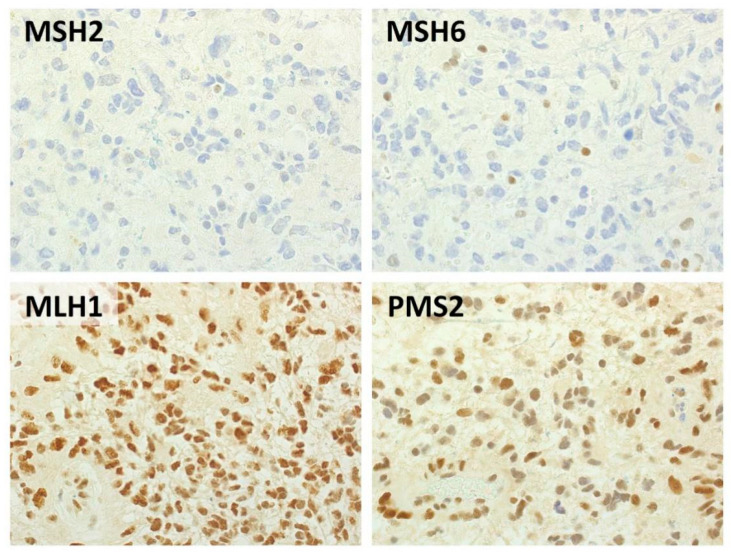
Pembrolizumab demonstrated promising results in hypermutated tumors of diverse origin. Immunohistochemical loss of mismatch repair (MMR) proteins has been suggested as a surrogate of hypermutation in high-grade gliomas (HGG). We evaluated the efficacy and safety of pembrolizumab in relapsing HGGs with immunohistochemical loss of at least 1 MMR protein. Molecular biomarkers of pembrolizumab activity were also analyzed.
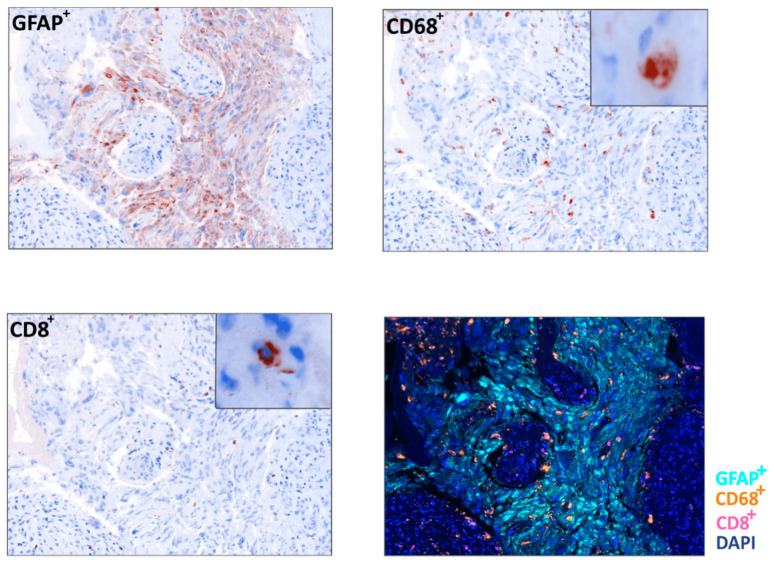
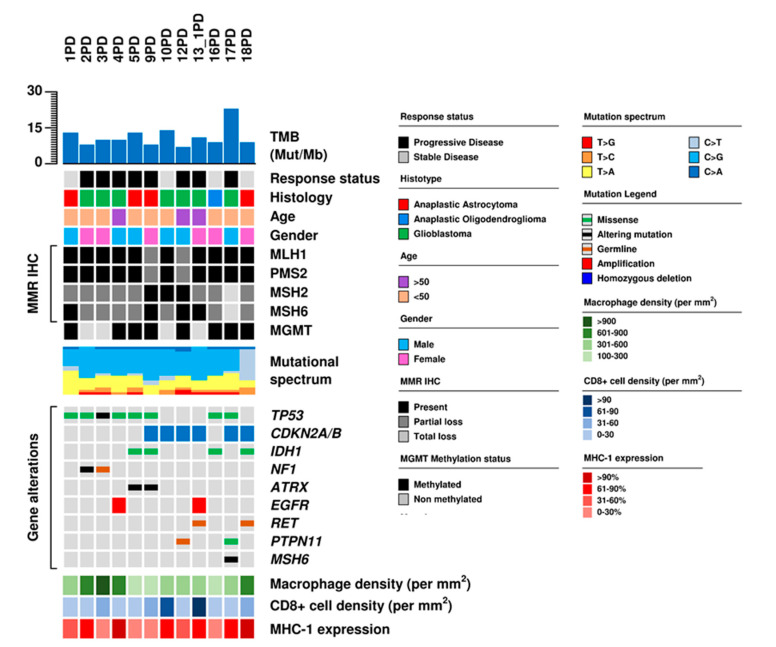
Consecutive patients with recurrent HGG and partial or complete loss of MMR protein expression were prospectively enrolled; they received pembrolizumab 200 mg once every 3 weeks until disease progression. The primary endpoint was disease control rate (DCR). Post hoc exploratory analyses included next-generation sequencing to assess tumor mutational burden (TMB), and immunostaining for CD8+ T-cells and CD68+ macrophages.
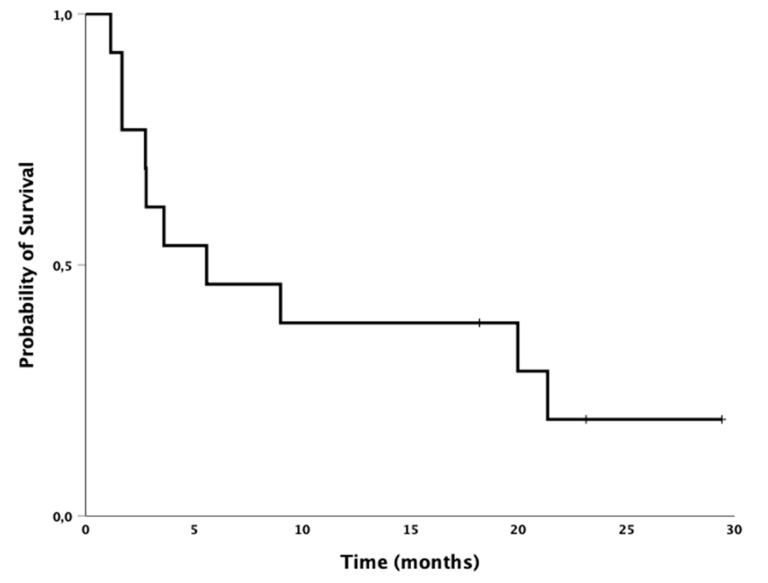
Among 310 HGG patients screened, 13 cases with MMR loss were enrolled: eight glioblastoma, four anaplastic astrocytoma, and one anaplastic oligodendroglioma. Median age was 43 years. DCR was 31%: four patients had stable disease and no patient had complete or partial response. TMB ranged between 6.8 and 23.4 mutations/megabase. Neither TMB nor gene mutations, nor CD8+ T-cell and CD68+ macrophage content, were associated with pembrolizumab activity.
pembrolizumab showed no apparent benefit in these patients. No molecular biomarker was found to be associated with pembrolizumab activity.
帕博利珠单抗在多种来源的高突变肿瘤中显示出有前景的结果。错配修复(MMR)蛋白的免疫组化缺失被认为是高级别胶质瘤(HGG)中高突变的替代指标。我们评估了帕博利珠单抗在至少一种MMR蛋白免疫组化缺失的复发性HGG中的疗效和安全性。还分析了帕博利珠单抗活性的分子生物标志物。
前瞻性纳入连续的复发性HGG且MMR蛋白表达部分或完全缺失的患者;他们接受每3周一次200mg帕博利珠单抗治疗,直至疾病进展。主要终点是疾病控制率(DCR)。事后探索性分析包括下一代测序以评估肿瘤突变负荷(TMB),以及CD8 + T细胞和CD68 +巨噬细胞的免疫染色。
在310例接受筛查的HGG患者中,13例MMR缺失患者入组:8例胶质母细胞瘤,4例间变性星形细胞瘤和1例间变性少突胶质细胞瘤。中位年龄为43岁。 DCR为31%:4例患者病情稳定,无患者有完全或部分缓解。 TMB范围在6.8至23.4个突变/兆碱基之间。 TMB、基因突变、CD8 + T细胞和CD68 +巨噬细胞含量均与帕博利珠单抗活性无关。
帕博利珠单抗在这些患者中未显示出明显益处。未发现与帕博利珠单抗活性相关的分子生物标志物。